
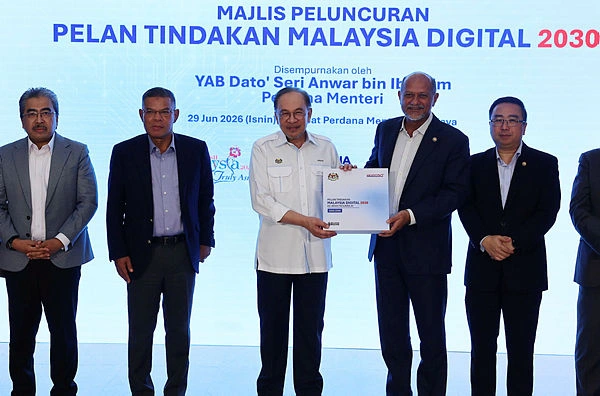
PUTRAJAYA ( WNAM MONITORING): Prime Minister Datuk Seri Anwar Ibrahim launched Malaysia Digital 2030 (MD2030), a national action plan for 2026-2030 that marks a major shift in the country’s digital strategy from being a technology consumer to a producer of home-grown innovation.
The launch was attended by Digital Minister Gobind Singh Deo, Communications Minister Datuk Fahmi Fadzil and Chief Secretary to the Government Tan Sri Shamsul Azri Abu Bakar.
In a statement, the Digital Ministry said the action plan sets ambitious national targets by 2030, including raising the digital economy’s contribution to gross domestic product (GDP) to 30%, creating 500,000 high-value digital jobs, generating RM4.5 billion in public sector savings through digitalisation, and delivering 95% of government services fully online from end to end.
The ministry has been designated as the lead agency to drive the country’s strategic direction in realising the ‘Towards an AI Nation 2030’ agenda.
MD2030 is built around seven strategic pillars, namely government, economy, infrastructure, talent, society, trust and security, and innovation, with each led by the relevant ministry under a whole-of-government approach.
Each pillar will be overseen by a cluster head. The Government pillar will be led by Shamsul Azri; Economy by Investment, Trade and Industry Minister Datuk Seri Johari Abdul Ghani; Infrastructure by Fahmi; Talent by Human Resources Minister Datuk Seri R. Ramanan; Society by Women, Family and Community Development Minister Datuk Seri Nancy Shukri; Trust and Security by Gobind; and Innovation by Science, Technology and Innovation Minister Datuk Chang Lih Kang.
The Government pillar will focus on enhancing public service delivery through the establishment of GovTech Malaysia.
The Economy pillar aims to position Malaysia as a regional digital innovation and trade hub by promoting “Made by Malaysia” products, accelerating technology adoption in High Growth High Value (HGHV) sectors, and unlocking the potential of data, digital assets and intellectual property (IP).
The Infrastructure pillar will prioritise nationwide high-quality internet connectivity while developing sustainable digital infrastructure, including data centres, cloud computing and smart cities.
The Talent pillar seeks to prepare the workforce for the digital economy through a comprehensive talent policy framework, agile workforce transition initiatives and efforts to strengthen Malaysia’s position as a regional and global digital talent hub.