
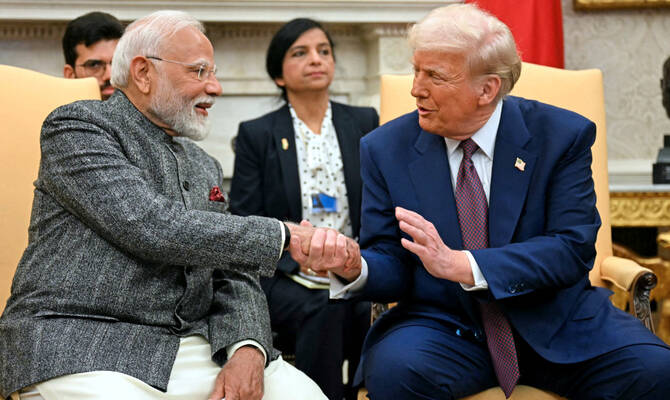
NEW DELHI ( WNAM MONITORING): India and the US released a framework for an interim trade agreement, as President Donald Trump on Saturday removed additional tariffs on Indian imports previously levied over Delhi’s purchase of Russian oil.
Under the proposed agreement, Washington’s reciprocal tariffs on Indian goods will be set at 18 percent, while India will eliminate or reduce tariffs on all US industrial goods as well as a wide range of US food and agricultural products, according to a joint statement.
The framework comes after Trump announced his plan to reduce import tariffs on India earlier this week, six months after accusing India of funding Moscow’s war in Ukraine and subjecting it to a combined tariff rate of around 50 percent on most of the exports.
“This will open a $30 trillion market for Indian exporters, especially MSMEs, farmers and fishermen. The increase in exports will create (hundreds of thousands) of new job opportunities for our women and youth,” Indian trade minister Piyush Goyal said on X.
He previously said that the two countries will likely sign the formal trade deal in March.
In an executive order, Trump said the US Secretary of Commerce “shall monitor whether India resumes directly or indirectly importing Russian Federation oil,” as his decision to rescind the punitive levies on Indian imports came after “India has committed to stop” doing so, while also promising to purchase US energy products and expand defense cooperation over the next decade.
New Delhi has long abstained from publicly criticizing Russia over the Ukraine war and did not join in with the international sanctions on Moscow, despite pressure from Western countries. With bilateral ties spanning more than seven decades, Russia is also India’s main source of military hardware.
“Other aspects of the Russia relationship will continue, but on oil there will be a reduction. But how much of a reduction we will have to see,” Nandan Unnikrishnan, a distinguished fellow at the Observer Research Foundation in New Delhi, told Arab News.
India, which imports more than 80 percent of its crude oil requirements, was previously the biggest buyer of discounted Russian crude, but it has been importing less recently, according to the latest reports.
“All countries compromise when it’s a question of national interest. If they find that compromise serves their national interest better, they compromise. The Russians have also done it. The Chinese have done it. Everybody has done it. Everyone understands the pressure India is under,” Unnikrishnan said.
Bharat Karnad, an emeritus professor for national security studies at the Center for Policy Research in New Delhi, believes that India will continue to purchase energy from Moscow.
“There will be a trade deal (with the US), because Americans do not want to lose the Indian market, which is the biggest in the world right now in terms of being a free and open market,” he said.
“So that makes the American threat a little hollow. It’s just the usual threats that they issue all the time,” he continued. “I only hope the government of India does not buckle and believe these threats.”