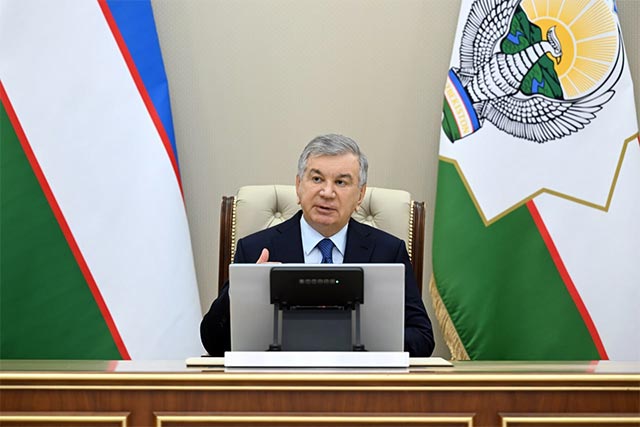
TASHKENT ( WNAM MONITORING): President of Uzbekistan Shavkat Mirziyoyev has reviewed and approved the draft priority reform programs and the State Program for implementing the “Uzbekistan–2030” Strategy for 2026, developed using a new approach that draws on advanced international experience.
The documents outline the main directions of state policy for the current year, set target indicators, and define specific mechanisms for their implementation.
Particular attention is paid to distinguishing between reform programs and the State Program. Reform programs include initiatives presented by the President in his Address to the People and the Oliy Majlis, as well as the most priority areas for 2026. These include: modernizing the infrastructure of mahallas and shaping them in the image of a “New Uzbekistan,” transitioning the economy to a technological and innovative growth model, stimulating domestic demand, developing professional skills and improving labor market architecture, ensuring ecological balance and rational water use, reforming public administration and the judicial system, and strengthening social cohesion.
Each initiative specifies implementation mechanisms and key performance indicators (KPIs), responsible officials, and coordinating state bodies. The programs are results-oriented rather than formal documents: for several initiatives, no separate normative act is required.
The State Program for implementing the “Uzbekistan–2030” Strategy sets target indicators for 2026 and includes a plan of 337 practical measures. Within the program, 59 draft key regulatory acts by sector and 12 drafts for strategic reforms have been prepared.
Public opinion was actively considered during the drafting process. Between 23 January and 1 February, a broad public discussion engaged over 5 million internet users. More than 22,000 proposals were submitted, of which around 1,000 were deemed constructive and included in the program draft. Over 10,000 students, educators, and civil servants participated in the discussions.
Among the supported initiatives are tougher penalties for violence against women and children, life imprisonment for pedophilia, improvement of mortgage and electric vehicle financing mechanisms, increasing the share of renewable energy to 30%, development of the anti-corruption system, and introduction of juries in criminal proceedings.
Other proposals highlighted include improving transparency in mahalla spending, road construction, pedestrian and bicycle paths, establishing business incubators, opening professional retraining centers, tightening liability for tree cutting, implementing KPIs for energy efficiency, and developing recycling and processing chains.
Discussions also took place abroad in the United States, Germany, Turkey, France, Canada, South Korea, Japan, Sweden, Portugal, and Kazakhstan. About 60 foreign proposals were submitted, including measures for transparent licensing for non-state schools, incentive systems for mentor interns, unified digital screening for early detection of cervical and breast cancer, performance-based subsidy models, and comprehensive services for exporters with electronic guidelines for working with lawyers.
Funding for the programs is set at 250.5 trillion soums, with an additional 50.4 billion USD to be attracted. The Ministry of Justice and the Accounts Chamber will ensure continuous monitoring, the Cabinet of Ministers will review implementation quarterly, information will be presented semiannually to the Legislative Chamber and monthly to the President. Responsible officials for each reform program will report quarterly to the President. Coordination and control of implementation are assigned to the Prime Minister.
Following his review, the President approved the reform programs and the State Program during the “Year of Mahalla Development and Community,” emphasizing that all measures must deliver tangible results for people: creating jobs, increasing incomes, and improving public satisfaction.