
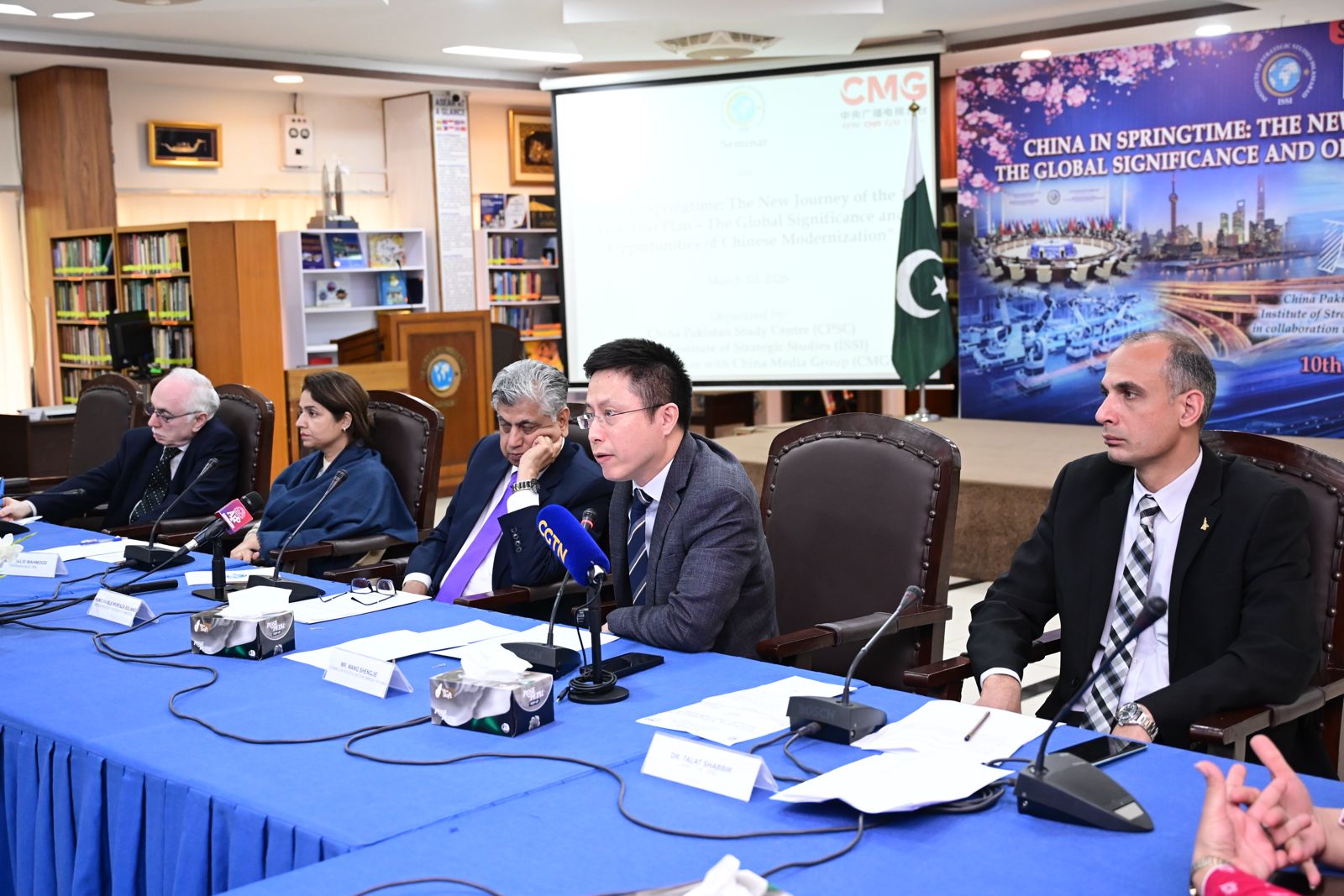
ISLAMABAD ( WNAM REPORT ): The Global Significance and Opportunities of Chinese Modernization” was held in Islamabad. The event was jointly organized by China Media Group and the Institute of Strategic Studies Islamabad (ISSI).
The seminar featured in-depth discussions on China’s development strategy and its global and regional implications, particularly its significance for Pakistan.
The chief guest at the event was Murtaza Solangi, Spokesperson for the President of Pakistan, Asif Ali Zardari, while the guest of honour was Wang Shungjie, Head of Political and Communications Affairs at the Chinese Embassy in Pakistan. The seminar was attended by a large number of former diplomats, representatives of think tanks, researchers, academics, and students.
Speaking on the occasion, Murtaza Solangi said that China’s upcoming 15th Five-Year Plan reflects a forward-looking and visionary approach, with a strong emphasis on innovation, environmentally sustainable development, and the promotion of artificial intelligence. He noted that China’s development model highlights the importance of aligning technological advancement with sustainable economic growth.
Wang Shengjie, Head of Political and Communications Affairs at the Chinese Embassy, said that experts from various sectors play a key role in the formulation of China’s Five-Year Plans, ensuring that these plans effectively reflect the country’s long-term development priorities. He said that China’s development planning not only promotes national progress but also contributes positively to the global economy.
Referring to the expected participation of a Pakistani astronaut in China’s space program this year, he said that China values Pakistan’s engagement in various important sectors. He also highlighted China’s technological progress, particularly the expansion of 5G networks, and noted that China is actively cooperating with Pakistan to strengthen digital connectivity.
Former Pakistani Ambassador to China Masood Khalid said that China’s remarkable development is the result of consistent and long-term planning carried forward through successive Five-Year Plans. He noted that China has successfully lifted nearly 800 million people out of poverty, which is regarded as one of the greatest achievements in the history of global development. He emphasized that Pakistan can learn valuable lessons from China’s strategic planning and effective implementation.
Professor Hassan Daud Butt, senior analyst and faculty member at Bahria University, said that China’s development model integrates poverty alleviation with environmental sustainability. He added that China has consistently achieved the targets set in its national development plans and that its economy continues to grow steadily despite global challenges.
Dr. Tahir Mumtaz Awan, Director of the Pakistan Institute of China Studies at the University of Sargodha, said that China’s new development strategy focuses on building an innovation-driven system. He noted that China is promoting technological self-reliance, particularly in areas such as artificial intelligence, digital technologies, and electric vehicles.
Dr. Talat Shabbir, Director of the China-Pakistan Study Centre at the Institute of Strategic Studies Islamabad, said that China has entered a new phase of development driven by innovation and high-quality growth. According to him, the 15th Five-Year Plan places special emphasis on emerging sectors such as artificial intelligence, advanced manufacturing, and the digital economy.
At the conclusion of the seminar, participants agreed that under the leadership of Chinese President Xi Jinping, China’s development strategy-focused on innovation, green transformation, and long-term planning offers valuable lessons for developing countries. They noted that this vision is also creating new opportunities for cooperation between China and Pakistan, contributing to shared development and regional stability.