
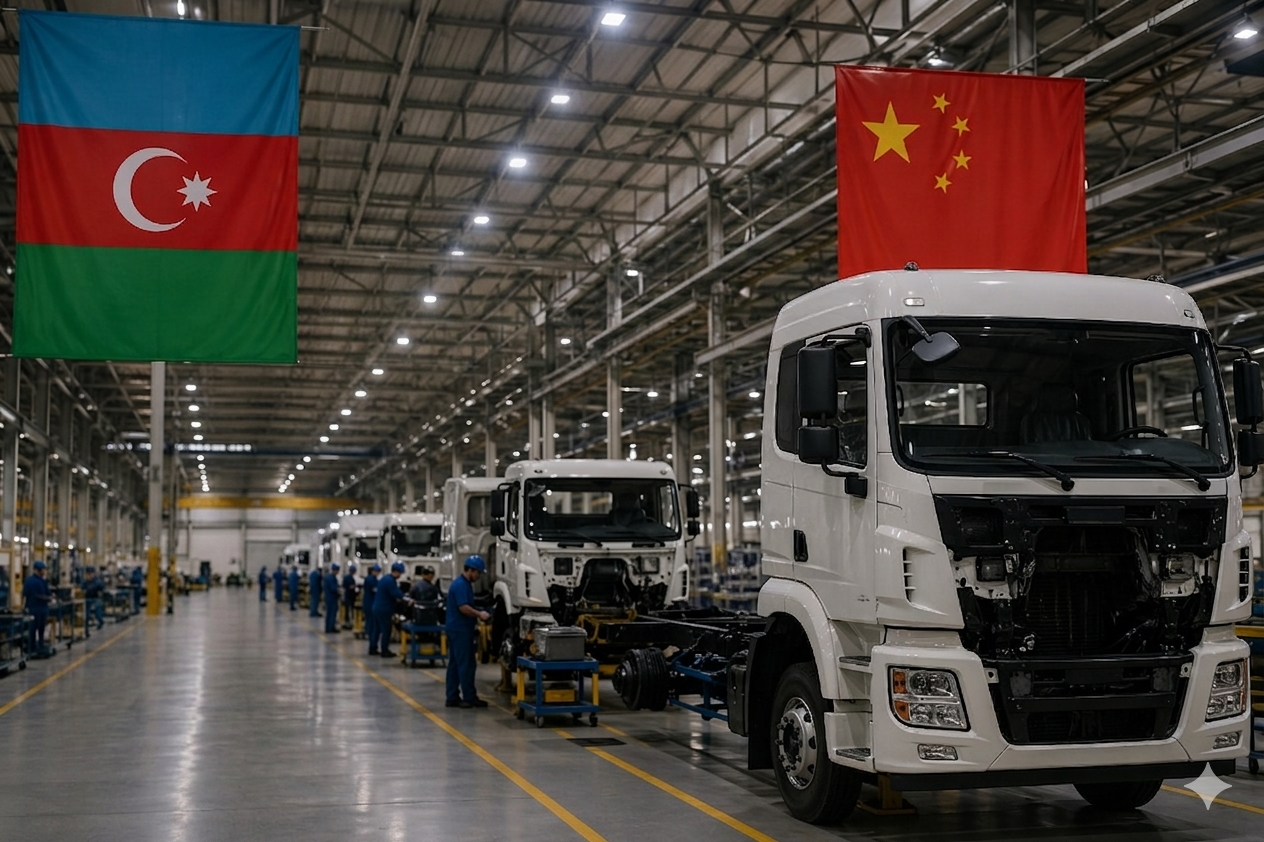
WNAM REPORT: Azerbaijan’s industrial story has long been told through the language of energy, such as barrels, pipelines, and export routes. However, beneath this dominant narrative, a quieter ambition has persisted for decades: to build a domestic manufacturing base capable of reducing dependence on imports and projecting economic resilience. The recent agreement between the Ganja Automobile Plant and two Chinese commercial vehicle manufacturers signals that this ambition is not only alive but evolving into something more concrete.
To understand the significance of this development, one must look back at Azerbaijan’s uneven but persistent efforts to establish an automotive industry. The foundations were laid during the Soviet era, when industrial production was centrally planned, and Azerbaijan’s role was largely auxiliary. After independence in 1991, the country faced economic disruption, institutional gaps, and a lack of capital, all of which constrained large-scale industrial projects. Still, the idea of domestic vehicle production did not disappear. The establishment of the Ganja Automobile Plant in the 2000s marked a renewed attempt to revive this sector, even if initially on a modest scale.
In its early years, the plant focused on assembling tractors and trucks in partnership with foreign manufacturers, particularly from Belarus. These projects were less about innovation and more about capacity building—learning how to operate assembly lines, manage supply chains, and maintain quality standards.
The new agreement with Chinese partners should be seen as the next step in that evolution. China’s automotive industry has undergone a remarkable transformation over the past two decades, moving from low-cost production to technological sophistication, particularly in electric vehicles and commercial transport solutions. By aligning itself with Chinese firms, Azerbaijan is not merely importing components; it is positioning itself within a global supply chain that is increasingly shaped by Asian manufacturing power.
There is, of course, a pragmatic logic behind this move. Azerbaijan’s domestic market alone cannot sustain large-scale vehicle production. The country’s population and purchasing power impose natural limits. However, the strategic value lies in regional integration. If managed effectively, Ganja could become a hub for assembling and distributing commercial vehicles across the South Caucasus, Central Asia, and potentially parts of Eastern Europe. This would transform Azerbaijan from a consumer of industrial goods into a participant in their circulation.
Skepticism remains warranted. Assembly-based production carries inherent limitations. Without deeper localization—such as the production of key components, investment in research and development, and the cultivation of a skilled workforce—the country risks remaining dependent on foreign technology and supply chains. The experience of other nations suggests that without deliberate policy support, assembly plants can stagnate, offering limited economic spillovers.
Yet dismissing the initiative outright would be equally shortsighted. Industrial policy is often a balancing act between ambition and feasibility. Azerbaijan does not currently possess the technological base to design and manufacture vehicles from scratch. What it can do is leverage partnerships to gradually build that capacity. Each agreement, each production line, and each trained technician contributes incrementally to a broader industrial competence.
There is also a geopolitical dimension that cannot be ignored. Azerbaijan has carefully navigated its relationships with major powers, maintaining a degree of strategic autonomy. Deepening economic ties with China, particularly in manufacturing, reflects a broader shift in global economic gravity. It allows Azerbaijan to diversify its partnerships beyond traditional Western and regional actors, reducing vulnerability to political and economic fluctuations.
At the same time, the government’s emphasis on rebuilding territories regained after the Karabakh conflict creates an additional layer of demand for commercial vehicles. Infrastructure projects, logistics networks, and construction activities all require reliable transport solutions. Local assembly could therefore serve immediate domestic needs while laying the groundwork for future export capacity.
Ultimately, the success of this initiative will depend not on the signing of agreements but on their implementation. Industrial development is measured in years, not headlines. It requires consistent investment, regulatory clarity, and a willingness to move beyond symbolic projects toward substantive economic transformation.
Azerbaijan stands at a familiar crossroads. It can treat this agreement as another isolated venture, or it can integrate it into a coherent industrial strategy that prioritizes long-term capability over short-term gains. The history of its automotive sector suggests that progress has often been incremental, even fragile. But it also shows a persistent desire to move beyond the constraints of a resource-dependent economy.
If that desire is matched with strategic discipline, the assembly lines in Ganja may one day represent more than just imported parts coming together. They could become the early chapters of a broader industrial narrative—one in which Azerbaijan is not merely adapting to global economic shifts, but actively shaping its place within them.