
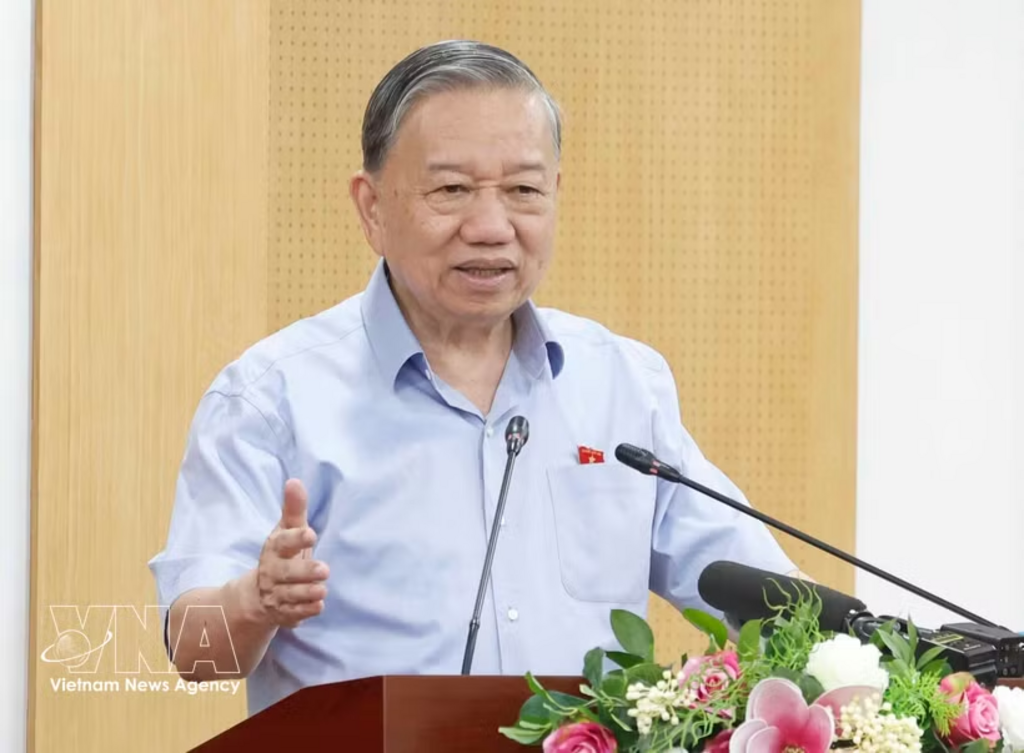
WNAM MONITORING: Hanoi is facing major challenges but also unprecedented opportunities to make a stronger breakthrough and develop in a manner befitting its role as a capital city, Party General Secretary and State President To Lam said at a meeting with voters from ten wards in central Hanoi on May 4.
General Secretary and State President Lam and members of the Hanoi delegation to the 16th National Assembly (NA) listened to public opinions and reported on the outcomes of the first session of the newly elected legislature.
Voters welcomed the successful organisation of the election and the first session of the 16th NA, saying the election of key State leaders had strengthened public confidence.
They expressed particular support for the revised Capital Law, describing it as a strategic step that could help transform Hanoi into a more modern, orderly and dynamic city.
Many voters called on the National Assembly to further improve the quality of debate, supervision and policy review so that it can better reflect the aspirations of the people.
Food safety emerged as one of the strongest concerns. Voters warned about the spread of banned substances in livestock production, excessive preservatives, counterfeit food and poor-quality products being sold in increasingly sophisticated ways. They proposed tougher criminal penalties instead of administrative sanctions, stricter regulation of business registration on digital platforms, and clearer assignment of responsibility among ministries, sectors and local authorities.
On urban governance, voters said the two-tier local administration model had produced initial positive results. More attention should be paid to labour market management, vocational training and employment support for workers in transition.
They also urged stronger implementation of the revised Capital Law through close coordination between Hanoi and central agencies in preparing an integrated master plan aligned with national and regional planning.
Healthcare was another major issue. Voters called for clearer implementation of the Politburo’s Resolution 72 on public health protection and care, including proposals for free medical check-ups, family doctor programmes, home nursing services, and electronic health records managed at grassroots medical facilities.
Responding to the opinions, the top leader said the frank, responsible and practical feedback from voters offered valuable insights into real-life demands.
He said the issues raised covered different sectors but converged on one central requirement: the State apparatus must serve the people more effectively, policies must be more closely aligned with reality, responsibilities must be clearer, and outcomes must be more tangible.
He stressed the need to strengthen grassroots healthcare, improve preventive medicine, and raise the quality of primary medical services.
On food safety, he called for a more coherent management mechanism, clearer accountability among ministries and local authorities, and strict handling of violations. In serious cases, criminal responsibility should be considered. He also said unhygienic street food stalls, especially around schools, should not be allowed to persist.
He also highlighted the urgency of upgrading infrastructure, renovating old apartment blocks and improving urban living conditions as part of broader urban restructuring.
He said the adoption of the revised Capital Law, together with Hanoi’s 100-year master plan, has created a new institutional foundation for the capital to design policies, mobilise resources, remove bottlenecks and reorganise development space.