
The crisis surrounding the Strait of Hormuz is usually viewed through the lens of energy security or military escalation. But it also has another, less visible, humanitarian dimension.
A recent article in The Guardian, “Calls for humanitarian corridor through Strait of Hormuz as Iran war hits vital aid,” points to a critical shift: because of the conflict involving the United States, Israel, and Iran, along with instability around Hormuz, traditional humanitarian supply routes are beginning to break down. For Afghanistan, this is no longer a theoretical concern but an operational reality.
According to the World Food Programme (WFP), cited by The Guardian, the cost of delivering food to Afghanistan has tripled. Cargo that previously moved by sea through Hormuz and onward to Pakistani ports must now travel overland across multiple countries, adding weeks to delivery times. The consequences are felt most acutely by vulnerable populations, particularly children.
Predictability is one of the core requirements of any humanitarian system, and that predictability is now disappearing. Some shipments are stranded in regional hubs. Routes are constantly changing. Fuel costs continue to rise. Even modest increases in oil prices significantly raise operational expenses for humanitarian agencies.
For Afghanistan, the implications are severe. The country has been in a prolonged food crisis for several years, with millions dependent on external aid. Delays of even one or two weeks can directly affect malnutrition and mortality rates.
According to United Nations estimates around 3.7 million Afghan children are currently suffering from wasting, nearly one million of them from severe wasting, a condition associated with sharply elevated mortality risks. UNICEF estimates that in 2026 alone, 1.304 million children aged 6-59 months will require treatment for acute malnutrition, including severe cases and other high-risk groups. Another 1.2 million pregnant and breastfeeding women are also suffering from acute malnutrition.
Under these conditions, even temporary disruptions in aid deliveries become a direct threat to human life.
The situation is being compounded by several overlapping factors. First, instability around the Strait of Hormuz has made maritime routes both more expensive and riskier. Second, the Pakistani corridor, previously the main overland route, has become unreliable, as repeated border closures and restrictions have tied humanitarian deliveries to the fluctuating political and security relationship between Kabul and Islamabad. Third, Iran has imposed restrictions on food exports and has itself become part of the conflict zone, undermining its role as both a supplier and transit route for Afghanistan.
Together, these developments are creating what can be described as a “triple crisis” for humanitarian logistics into Afghanistan. The previous aid delivery system is effectively ceasing to function.
In response, the WFP is restructuring its logistics network. One solution has been increased use of the Lapis Lazuli Corridor: Turkey-Georgia-Azerbaijan via the Caspian Sea-Turkmenistan and Afghanistan. Although this route is longer and more expensive, it offers predictability and an alternative to disrupted maritime pathways. The key issue is no longer which route is cheapest, but which is reliable.
This shift places Central Asia increasingly at the center of regional humanitarian logistics. Until recently, overland routes through Central Asia were seen as secondary options, unable to compete with maritime shipping in terms of speed or cost. That equation is now changing. Reliability is becoming more important than speed, and land corridors through Central Asia are beginning to look less like alternatives and more like necessities.
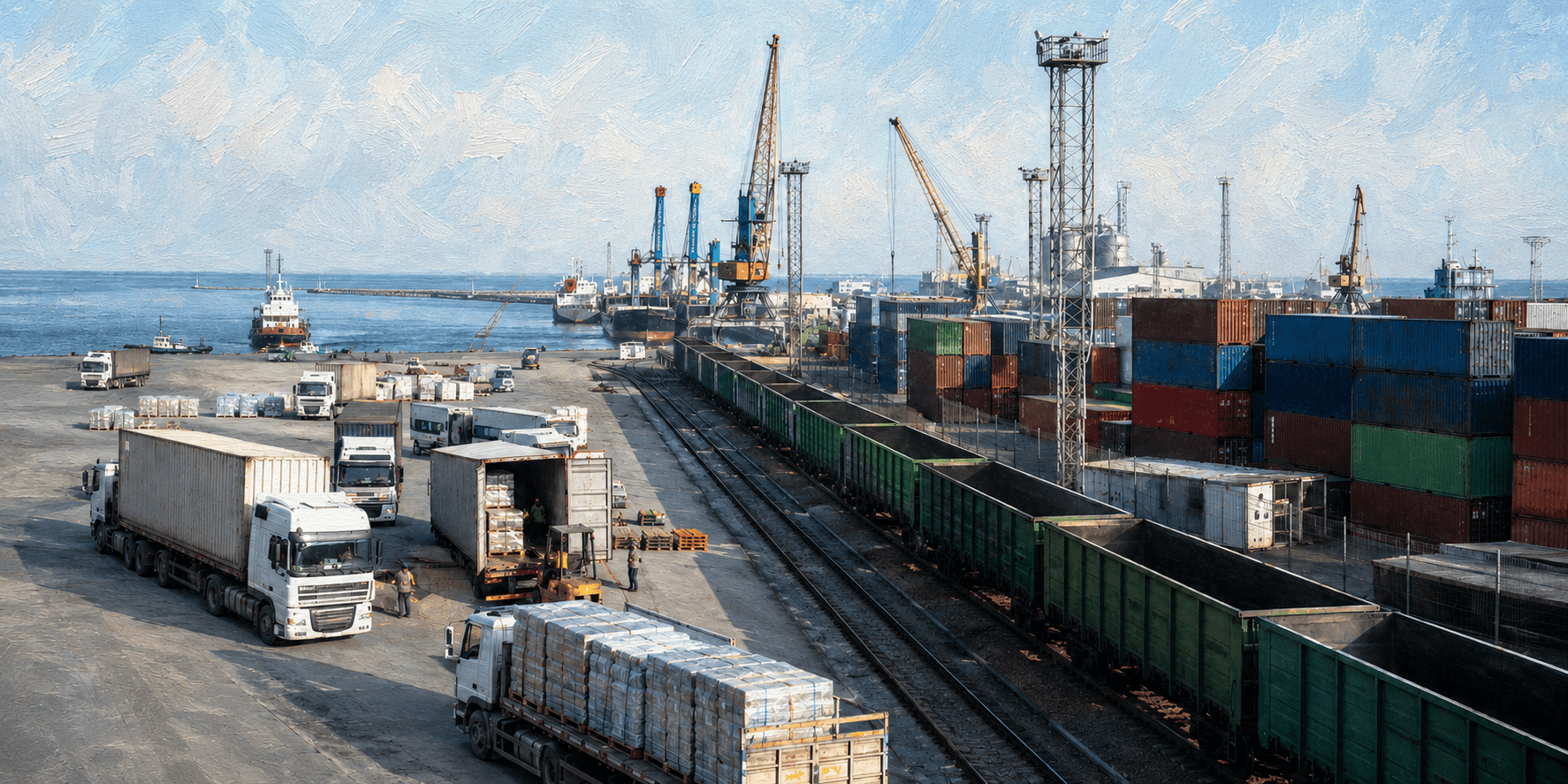
The region already possesses much of the infrastructure needed to support humanitarian transit. Ports on the Caspian Sea in Kazakhstan and Turkmenistan provide multimodal transport connections. Rail networks link Central Asia with Afghanistan through Uzbekistan and Turkmenistan. The city of Termez in Uzbekistan has long served as a key logistical hub for northern Afghanistan.
Importantly, Central Asian states are not directly involved in the conflict around Hormuz, making them more practical partners for international organizations. The infrastructure already exists; what is needed is adaptation and expansion rather than construction from scratch.
Regional roles are already beginning to emerge. Kazakhstan could serve as a northern entry point via the Caspian and rail corridors connected to China. Uzbekistan may become the principal overland hub through which humanitarian aid enters Afghanistan. Turkmenistan offers the shortest route into western Afghanistan.
Despite this potential, significant obstacles remain. High rail tariffs and port fees could make the corridors prohibitively expensive. Customs procedures continue to increase delays and uncertainty. Moreover, Central Asian countries still tend to develop logistics strategies independently, while regional coordination remains limited.
The most serious issue is the absence of a stable regional mechanism specifically designed for humanitarian logistics.
In this context, the newly established UN Regional Centre for the Sustainable Development Goals for Central Asia and Afghanistan in Almaty could take on increased significance. Formally, its role is to coordinate UN activities in Central Asia and engage with Afghanistan. But under current conditions, its potential could expand far beyond development coordination.
If the crisis around Hormuz leads to a long-term restructuring of logistics networks, the region will require not only alternative routes but also a center capable of coordinating them. Almaty already possesses several advantages: geographic proximity to key transport corridors, developed infrastructure, and a strong presence of international organizations.
This creates the possibility of transforming the UN regional office into a broader coordination hub responsible for harmonizing humanitarian routes, facilitating cooperation with regional governments, coordinating with the WFP and donor agencies, and helping establish unified transit rules for humanitarian cargo. Rather than creating an entirely new institution, such a system could evolve organically around existing UN structures.
That is what makes Almaty not simply a convenient location, but a potential center of a new humanitarian logistics architecture.