
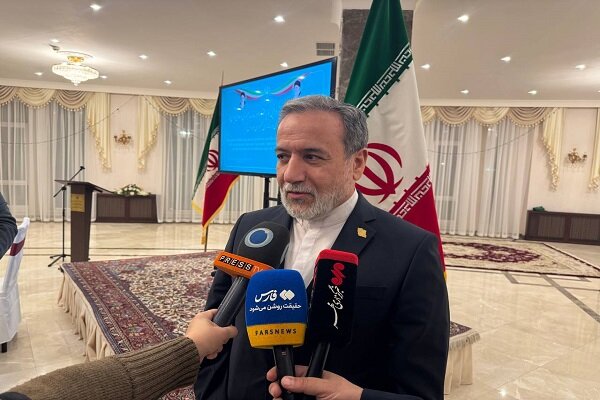
WNAM REPORT: Iran’s Foreign Minister Seyed Abbas Araghchi said relations between Iran and Belarus are steadily expanding in political, economic, and cultural domains, citing shared international positions and untapped cooperation potential.
Speaking at the conclusion of his visit to Minsk, the Belarusian capital, Araghchi said Iran and Belarus are politically and internationally aligned and have maintained close consultations over recent years on global developments and bilateral relations. He stated that there are no obstacles in bilateral ties and that the two sides conducted a comprehensive review of political and economic cooperation covering a wide range of areas.
He noted that cultural, international, security, and economic cooperation between the two countries holds significant untapped capacity. Despite the absence of formal barriers, Araghchi said the current trade volume does not reflect the true potential of bilateral relations. Existing obstacles and ways to facilitate trade were reviewed during the visit, and it was agreed that follow-up exchanges would take place.
The Iranian foreign minister said several joint commissions and committees between the two countries are scheduled to convene in the coming months. He added that political consultations between the two foreign ministries at the deputy minister level are planned to be held soon, followed by a visit by the Belarusian foreign minister to Iran and, subsequently, a visit by the Belarusian president.
Araghchi stated that visits by economic officials and ministers are also planned, and a one-year roadmap for bilateral relations has been designed to ensure structured and goal-oriented progress. He said Iran and Belarus hold closely aligned positions in international organizations and forums, particularly in opposing unilateralism and coercive policies.
He added that Iran and Belarus, along with other countries opposing US unilateralism and coercive measures, have formed a group at the United Nations known as the “Friends of the Charter,” which rejects sanctions and unilateral actions. Araghchi said foreign ministers of the group met during the previous UN General Assembly, and coordination in New York continues on a regular basis. He added that cooperation will also expand within BRICS, the Shanghai Cooperation Organization, and the Eurasian Economic Union.
On cultural cooperation, Araghchi said positive steps have already been taken and will be further developed. He referred to a meeting held with media figures, think tank directors, and members of the parliamentary friendship group, describing the discussions as constructive. He also pointed to a Belarusian musician and television host who performed music inspired by Iran, calling it a reflection of the broad cultural capacity between the two nations.
Araghchi said it was agreed to establish a joint consular committee to facilitate visa issuance, expand tourism, and address consular issues. He noted that while the number of Iranian students in Belarus is limited, there is strong interest in expanding academic cooperation, including faculty and student exchanges and joint research projects.
He added that Belarusian university degrees are well evaluated and of a high standard, noting that more than 10,000 Chinese students are currently studying in Belarus. Araghchi said economic cooperation opportunities are wide-ranging and further details will be announced once projects become operational.
The Iranian foreign minister described the visit as constructive, saying his meeting with the president of Belarus was useful and included direct discussions on cooperation projects. He said talks between the two foreign ministers were productive, and that he also met with the secretary of Belarus’s Security Council to discuss security and regional issues, during which Ali Larijani’s invitation for a visit to Iran was conveyed.