
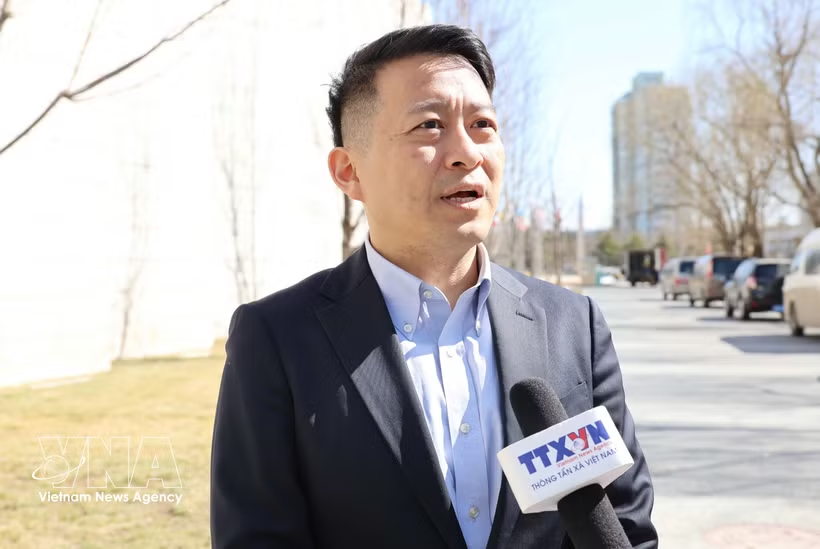
WNAM REPORT: The forthcoming visit to China by Party General Secretary and State President To Lam is expected to inject fresh momentum into the Vietnam – China Comprehensive Strategic Cooperative Partnership and advance efforts to build a a community with a shared future that carries strategic significance, a Chinese scholar has said.
In an interview , correspondents in Beijing ahead of the trip, Professor Qu Qiang of the Minzu University of China noted that ties between the two Parties and countries have entered a new stage, characterised by more frequent high-level exchanges, deeper cooperation, and improved engagement quality. This, he said, both reinforces the long-standing “comrades and brothers” bond and provides a renewed framing for bilateral relations.
On the visit’s key agenda, Qu highlighted the need to effectively implement common perceptions and overarching directions reached by senior leaders, particularly the “six major orientations” guiding bilateral ties, including more substantive cooperation, stronger security, closer coordination, and higher political trust. He stressed that these priorities should be carried through at all levels, from central agencies to localities, academia, businesses, and people-to-people exchanges.
Economic cooperation continues to take centre stage. Qu pointed out that Vietnam’s ambitious growth targets in the years ahead, including a GDP growth goal exceeding 10% and long-term development plans towards 2030, call for expanded economic engagement with China. Priority areas include boosting bilateral trade, enhancing technology exchange, and accelerating connectivity projects such as the Lao Cai – Hanoi – Hai Phong railway linked to China’s network, alongside cooperation in power and energy.
He also identified cooperation under the Belt and Road Initiative and the China – ASEAN framework as key drivers of regional economic integration and supply chain resilience. Amid ongoing global uncertainties, the two countries are expected to step up coordination to mitigate external shocks while fostering more stable and sustainable trade and supply chains.
On foreign policy, Qu underscored Vietnam’s consistent pursuit of an independent, self-reliant approach centred on national interests. In a complex global landscape, stronger coordination between Vietnam and China on regional and international issues would help safeguard their interests while contributing to broader peace, stability, and development.
Emphasising the role of regular high-level exchanges, Qu said such engagements not only help shape strategic direction but also strengthen political trust, facilitate the management of differences, and drive practical cooperation. He added that both countries share similarities in political systems and serve as key nodes in the China – ASEAN supply chain, supporting global supply chain stability.
Citing recent trade figures, Qu noted that China’s import-export turnover has surpassed global expectations, with imports rising by around 19% and exports by about 20%. These gains, he said, reflect not only China’s own efforts but also close cooperation with ASEAN partners, particularly Vietnam. At the same time, Vietnam has sustained solid economic growth despite global headwinds, pointing to considerable scope for further bilateral collaboration.
From a regional standpoint, Qu noted that Vietnam and China have effectively worked together to bolster political trust, manage differences, and maintain stability, helping make the China – ASEAN region one of the few globally to sustain both robust growth and political-security stability.
With political trust strengthening, practical cooperation expanding, and shared interests deepening, bilateral relations are well positioned to continue on a stable and sustainable trajectory, contributing to peace, stability, and development in the region and beyond, he added.