
LONDON: NATO allies said on Monday they would not get involved in US President Donald Trump’s plan to blockade the Strait of Hormuz, proposing instead to intervene only once fighting ends, in a move likely to anger Trump and increase strains in the alliance.
Trump said the US military would work with other countries to block all maritime traffic in the waterway, after weekend talks failed to reach an agreement to end the six-week conflict with Iran.
The US military later specified that the blockade, due to have started at 2 p.m. GMT on Monday, would only apply to ships going to or from Iranian ports.
Since the start of the war on February 28, Iran has largely blocked off the strait for all ships apart from its own. It has been seeking to make its control of the strait permanent and possibly collect levies from ships that use it.
“The Blockade will begin shortly. Other Countries will be involved with this Blockade,” Trump said in a post on Truth Social on Sunday.
But NATO allies including Britain and France said they would not be drawn into the conflict by taking part in the blockade, saying instead they were working on an initiative to open the waterway, where a fifth of global oil supplies normally passes.
Their refusal to participate is yet another point of friction with Trump, who has threatened to withdraw from the military alliance and is weighing pulling some US troops from Europe after several countries denied US military planes use of their airspace for attacks on Iran.
Considerable pressure
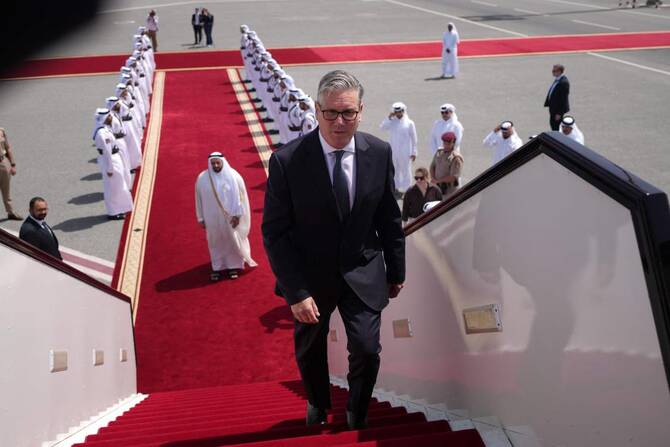
“We’re not supporting the blockade,” British Prime Minister Keir Starmer told the BBC.
“My decision has been very clearly that whatever the pressure, and there’s been some considerable pressure, we’re not getting dragged into the war,” he said. NATO Secretary General Mark Rutte told European governments that Trump wants concrete commitments in the near future to help secure the Strait of Hormuz, diplomats told Reuters last week.
NATO could play a role in the strait if its 32 members could agree on the formation of a mission, Rutte said on April 9.
Several European countries have said they’re willing to help in the strait but only once there is a durable end to hostilities and an agreement with Iran that their ships will not be attacked.
France will organize a conference with Britain and other countries to create a multinational mission to restore navigation in the strait, French President Emmanuel Macron said on X on Monday.
“This strictly defensive mission, distinct from the belligerents, will be deployed as soon as the situation allows,” Macron said. The initiative aims to establish rules for safe passage and the coordination of military vessels to escort tankers, Starmer said in parliament on Monday.
“Let me be very clear, this is about safeguarding shipping and supporting freedom of navigation once the conflict ends. Our shared aim here is a coordinated, independent, multi-national plan,” he said.
A meeting to draw up plans for the mission involving about 30 countries, including Gulf countries, India, Greece, Spain, Italy, the Netherlands and Sweden, could happen as soon as Thursday in Paris or London, a French diplomatic source said.
The military ships would provide reassurance without being belligerent, the source said, adding that Iran and the US would be informed of the mission but play no direct part.
Another European diplomatic source questioned whether Trump would welcome a mission now that he had ordered the blockade.
“Since Trump is now using the strait as his own leverage, does he even want a mission there?” the source said. The Strait of Hormuz should be reopened by diplomacy, Turkish Foreign Minister Hakan Fidan said on Monday, adding that creating an international force to oversee it would be complicated. He called for NATO to reset its ties with Trump at a summit in Ankara in July.