
WNAM REPORT: The growing cooperation between the northern port city of Hai Phong and various Chinese localities, covering trade, infrastructure, culture, education, and people-to-people exchanges, is building a well-rounded partnership and strengthening the city’s position as a key gateway in Vietnam–China relations.
Recent outcomes underscore Hai Phong’s growing position as a key node in bilateral connectivity, opening up fresh development opportunities. In 2025, its imports from China exceeded 7.6 billion USD, dominated by electrical equipment and components, machinery, plastics, steel, and optical and medical instruments. Meanwhile, its exports to China reached over 1.7 billion USD, led by electronics, mechanical products, footwear, garments and toys. In the first quarter of 2026, two-way trade maintained strong momentum, with imports topping 2 billion USD, up 48.26% year-on-year, and exports surpassing 467 million USD, up nearly 57%.
In the period, foreign direct investment (FDI) inflows into the city reached 716 million USD, an increase of 38.7% year-on-year. Of the total, investment from China, including Taiwan, Hong Kong and the mainland, was 322.48 million USD.
A notable milestone was the mid-February 2025 launch of a new shipping service linking Beibu Gulf Port (Guangxi, China), Hai Phong Port and Kolkata Port (India). The route marks a strategic step in regional maritime connectivity, enhancing trade links among Vietnam, China and India.
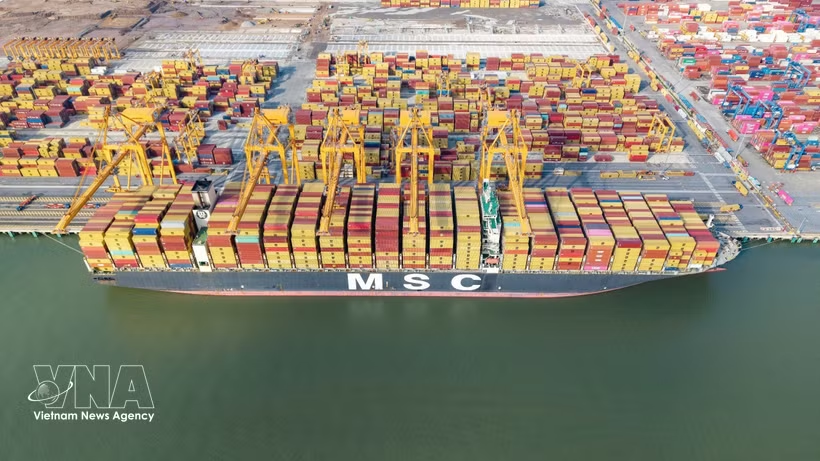
Bringing into full play its advantage as the only northern locality with all five modes of transport, along with a modern deep-sea port system and an international airport, Hai Phong is promoting both “hard connectivity” through transport and logistics infrastructure, and “soft connectivity” via smart customs and digital logistics to facilitate cross-border trade.
Beyond commerce, the city has intensified investment promotion and regularly participated in the China–ASEAN Expo in Guangxi, showcasing its signature products, investment policies and tourism assets, including Lan Ha Bay.
In February 2026, at the 17th Joint Working Committee Meeting between five Vietnamese localities – Quang Ninh, Lang Son, Cao Bang, Tuyen Quang and Hai Phong – and the Guangxi Zhuang Autonomous Region in Nanning, Hai Phong joined the mechanism as an official member, marking a turning point for deeper cooperation.
According to Director of the Hai Phong Department of Foreign Affairs Tran Thi Quynh Trang, the city has established partnerships with major Chinese localities such as Tianjin, Nanning, Ningbo, Shenzhen and Foshan. Cooperation has expanded across education, personnel training, transport, healthcare and notably artificial intelligence (AI).
Since 2025, the two sides have organised 21 exchange delegations, including high-level visits. Educational cooperation has been strengthened through student exchanges and scholarship programmes, while training initiatives in AI are equipping officials with skills aligned to digital transformation.
Cultural and tourism exchanges, including festivals and charter flights between Nanning and Hai Phong, have boosted connectivity. Vibrant people-to-people activities continue to deepen mutual understanding and ties.
With comprehensive cooperation across a variety of sectors, Hai Phong is emerging not only as an investment destination but also as a dynamic hub for multi-sector collaboration, contributing to the strengthening of Vietnam–China relations in a new phase.