
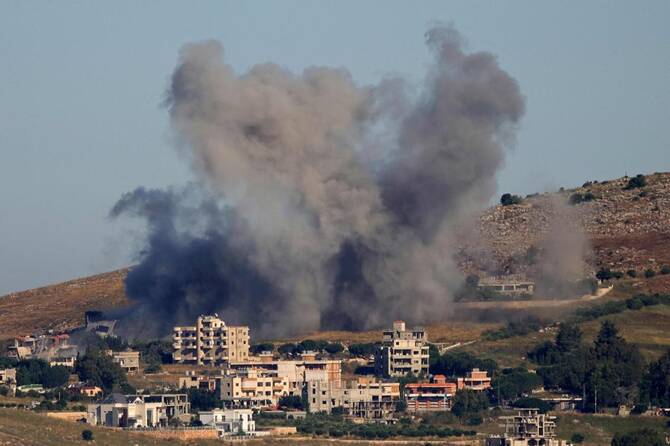
BEIRUT ( WNAM MONITORING): Israel and Lebanon agreed Wednesday to renew their fragile ceasefire and establish a number of pilot security zones in southern Lebanon from which Hezbollah militants would be excluded.
In a joint statement issued after a fourth round of US-mediated talks at the State Department, the two sides said the ceasefire would be contingent on a complete halt to Hezbollah attacks and the withdrawal of the group’s operatives from areas south of the Litani River.
“The two sides agreed, with the guidance of the United States, to swiftly advance the creation of pilot zones in which the Lebanese Armed Forces will take exclusive control of the territory to the exclusion of all non-state actors,” the statement said.
The agreement is intended to pave the way for a broader peace and security arrangement between the two countries.
“These steps will enable progress toward a comprehensive peace and security agreement,” the statement said. “All countries reaffirmed that the future of the relationship between Israel and Lebanon must be decided by the two sovereign governments. They rejected any attempt, by any state or non-state actor, to hold Lebanon’s future hostage.”
The reference appeared aimed at Iran, Hezbollah’s main backer. Tehran has insisted that any agreement to end its conflict with the United States and Israel must also include a halt to Israeli military operations in Lebanon. Hezbollah is not participating in the Israel-Lebanon talks.
Israel and Lebanon previously agreed to a cessation of hostilities in April, later extended in May, but fighting has continued despite the truce efforts.
A US-mediated arrangement announced Monday prompted Israel to suspend plans for strikes on Beirut’s Hezbollah-controlled southern suburbs, while Hezbollah halted cross-border attacks.
Nevertheless, violence persisted on Wednesday. Lebanese security officials said Israeli drone strikes killed at least six people in southern Lebanon and targeted a vehicle in Khaldeh, south of Beirut. Israel said it intercepted a hostile aircraft launched from Lebanon but did not immediately attribute it to Hezbollah.
The two sides also agreed to continue direct political and security negotiations. They are expected to reconvene during the week of June 22 in an effort to build confidence and resolve outstanding disputes.
Lebanon hopes the ceasefire can be expanded into a comprehensive nationwide agreement. Israel, meanwhile, is demanding Hezbollah’s disarmament before ending military operations in Lebanon and withdrawing troops from villages and towns it continues to occupy.
Israeli warning rattles Tyre
Israeli strikes continued across southern Lebanon, particularly around the heavily damaged cities of Tyre and Nabatiyeh.
Two overnight strikes near Tyre killed four Syrians and two Palestinians, according to local officials.
Israel also warned that Hezbollah members were operating within Christian neighborhoods of the coastal city. The warning alarmed residents and displaced families, many of whom had sought refuge there after fleeing bombardment in predominantly Shiite areas along the Mediterranean coast.
In response, the Lebanese army deployed forces to the Christian district of Tyre, seeking to demonstrate that Hezbollah had no armed presence there and to deter potential Israeli attacks.
The latest round of fighting began on March 2, when Hezbollah launched rockets toward northern Israel in support of Iran. Israel responded by invading southern Lebanon and has expanded its operations in recent weeks, while Hezbollah has continued to claim rocket and drone attacks against Israeli targets.
The conflict has killed 3,468 people in Lebanon and displaced an estimated 1.2 million others. According to Israeli Prime Minister Benjamin Netanyahu’s office, at least 27 Israeli soldiers and a defense contractor have been killed in or near southern Lebanon. Two civilians have also been killed in northern Israel.
Strike wipes out most of a family
Despite ongoing hostilities, many residents have returned to villages near the front lines after earlier evacuation orders.
Among them was the Al-Abdallah family, who returned to their home in Marwaniyeh believing the area had become safer after previous strikes.
A day later, two rockets hit the house, collapsing the three-story building and killing six family members, according to Eissa Al-Abdallah, whose brother Hassan was among the dead.
The family’s only survivor was 13-year-old Ahmed Al-Abdallah, who was thrown clear by the force of the blasts. He suffered two broken legs and multiple shrapnel wounds.
“What good is talking now? They are gone, and nothing will bring them back,” Eissa Al-Abdallah told The Associated Press by phone. “This land costs blood.”