
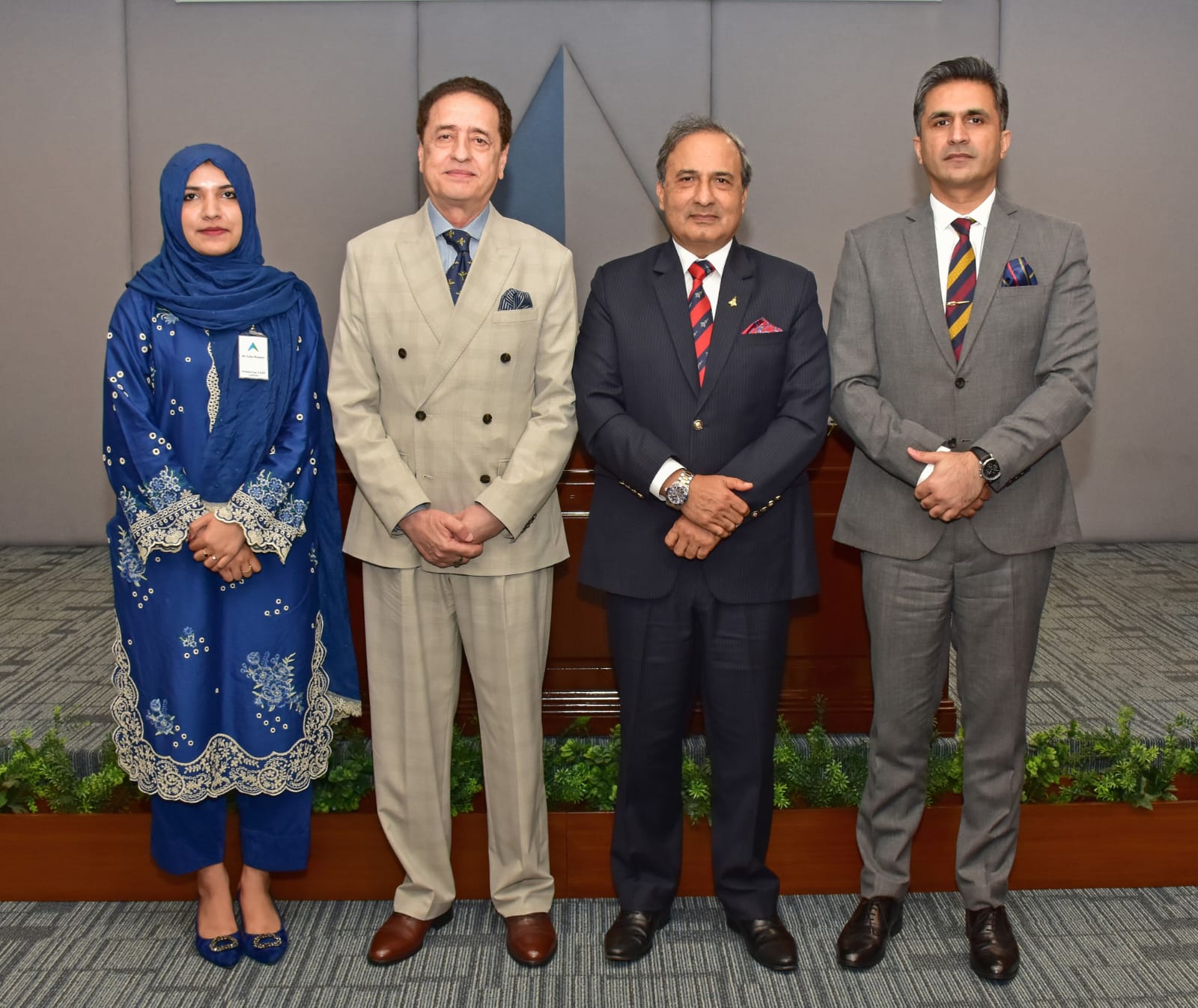
The Centre for Aerospace and Security Studies (CASS) Lahore organised an event titled “The PAF’s Legacy: From the Spirit of 1965 to Marka-e-Haq” on 07 September 2026 to commemorate PAF Day. As an independent think tank, CASS Lahore organises academic events for scholars and practitioners interested in national security in its wider context. The event was attended by PAF war veterans, serving and retired officials, academics, and intellectuals. Ms Ezba Walayat Khan, Research Assistant, CASS Lahore, delivered the opening address.
Air Cdre Khalid Farooq Chishti (Retd), a PAF Veteran, was the speaker. Tracing the evolution of the PAF, he highlighted the institution-building leadership of Air Marshal Asghar Khan and the front-line leadership of Air Marshal Nur Khan during the 1965 war. He also highlighted the pivotal role of Air Marshal Abdur Rahim Khan during the 1971 war. He subsequently linked these foundational developments to the technologically transformed PAF of today, under the leadership of Air Chief Marshal Zaheer Ahmed Baber Sidhu. Recalling key episodes from the 1965 and 1971 wars and the sacrifices of air warriors, he highlighted the PAF’s transformation from a defensive-offensive to a disruptive air force, driven by realistic training, modernisation, initiative and joint-service synergy. He noted that this evolution was further strengthened by tri-services synergy, most recently demonstrated during Marka-e-Haq through the coordination ensured by Army Chief Field Marshal Asim Munir. He further noted that the PAF’s operational effectiveness enables it to seize the initiative, maintain readiness and operate against a numerically superior adversary. He emphasised that PAF’s enduring legacy rests on courage, professionalism, discipline, sacrifice, comradeship and honour, carried forward by each generation.
In his concluding remarks, Air Marshal Asim Suleiman (Retd), President CASS Lahore, emphasised that PAF Day commemorates not only the victories of 1965 but also decades of “silent wars”, including indigenous development of the JF-17, protection of Pakistan’s nuclear programme, defence against Soviet incursions, support to allies and deterrence during successive crises. He paid tribute to the foundations laid by Air Marshal Asghar Khan, the leadership of Air Marshal Nur Khan in 1965, and the resilience of Air Marshal Abdur Rahim Khan in 1971, which shaped a tradition of professional excellence and courageous leadership. Under Air Chief Marshal Zaheer Ahmed Baber Sidhu, this evolution has culminated in a next-generation, multi-domain PAF integrating cyber, space, EW, and UAV capabilities, with practical demonstration during Marka-e-Haq in 2025, alongside the tri-services coordination facilitated by CDF Field Marshal Asim Munir. He reaffirmed the PAF’s readiness to respond to any Indian misadventure and paid tribute to its war heroes, martyrs, and combat, maintenance and support crews.
The event concluded with a lively interactive session. It highlighted air warfare dimensions, leadership decision-making and financial challenges. It also examined the contrasting professional cultures of the PAF and IAF, indigenous capability development and the selfless devotion of PAF personnel. The participants appreciated CASS Lahore’s initiative in hosting an engaging and thought-provoking discussion.
From 1965 to Marka-e-Haq: CASS Lahore Examines PAF’s Transformative Journey
3