
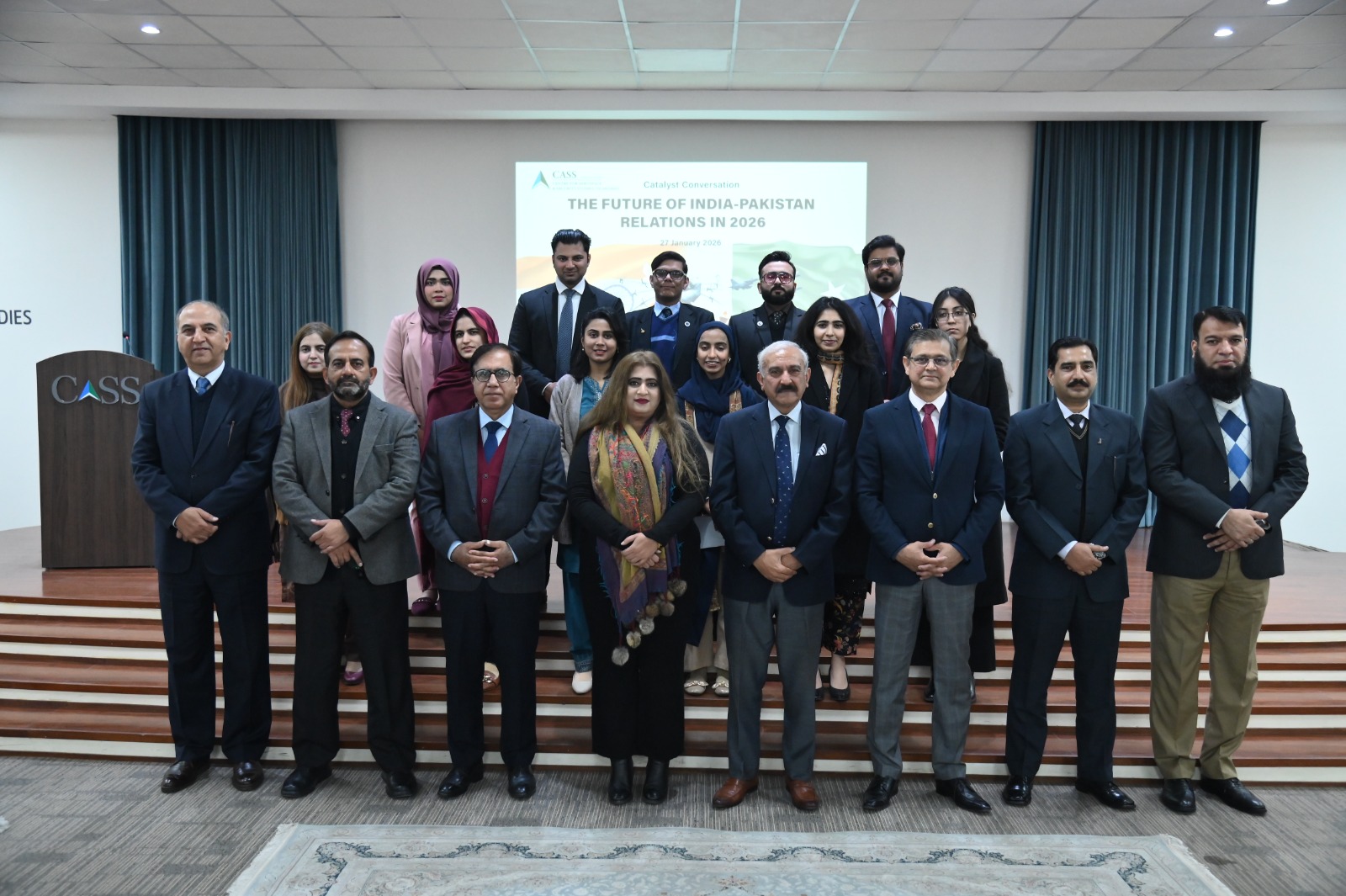
The Centre for Aerospace & Security Studies (CASS), Islamabad, organised a guest lecture titled ‘The Future of India-Pakistan Relations in 2026’ to examine evolving regional security dynamics, post-crisis strategic trends, and prospects for stability in South Asia.
The session was attended by academics and experts, who engaged in an in-depth discussion on the implications of the May 2025 war and its impact on bilateral relations between the two nuclear-armed neighbours.
In his remarks, the moderator, Air Marshal (Retd) Zahid Mehmood, stated that the 2025 war had significantly altered the strategic landscape of South Asia. He highlighted that future conflicts are likely to be shaped by multi-domain warfare, involving air, cyber, space, and maritime domains, making escalation control increasingly complex. He also noted that shifting geopolitical alignments and emerging regional flashpoints are likely to sustain instability, requiring more adaptive and forward-looking security policies.
In her address, Dr Maria Sultan, President, South Asian Strategic Stability Institute (SASSI), provided a comprehensive analysis of how the May 2025 war, particularly Operation Bunyan-um-Marsoos, marked a structural shift in the nature of India-Pakistan confrontation. She argued that future wars will no longer be primarily land-based but increasingly dominated by air power and high-tempo aerial operations, supported by cyber, space, maritime, and intelligence domains. Dr Sultan observed that while earlier strategic thinking assumed major fighting would unfold mainly in the southern theatre through conventional forces, the recent crisis demonstrated that the northern theatre is likely to become the main arena of high-intensity warfare, with supporting operations in the south.
Dr Sultan further highlighted that the framework of response and deterrence has evolved, as precision strikes are now extending deep into mainland territories rather than being limited to bordering areas. Despite the intensity of the four-day war, the absence of large-scale land mobilisation reflected a preference for limited, fast-paced, multi-domain operations over prolonged conventional campaigns. She cautioned that future crises will be increasingly shaped by the identification of economic and strategic infrastructure as legitimate targets, while attempts will continue to geographically contain escalation. She also pointed to emerging geopolitical variables, including developments in the eastern region, suggesting that previously marginal theatres may acquire strategic relevance in future conflict scenarios.
Looking ahead, Dr Sultan concluded that there are no credible signs of meaningful de-escalation, and that 2026 is likely to be characterised by managed hostility, recurring crises, and sustained mistrust. As a way forward, she emphasised the importance of crisis management and risk reduction, including strengthening military communication channels, reviving back-channel diplomacy, restoring water data-sharing mechanisms, and pursuing limited confidence-building measures through economic, diplomatic, and multilateral platforms such as the SCO and Track-II forums.
In his concluding remarks, Air Marshal (Retd) Javaid Ahmed, President CASS, observed that India faces significant challenges in effectively integrating advanced technologies into its military structure. He noted that modern weapons systems are making naval conflicts increasingly complex and highlighted that the downing of aircraft during the 2025 crisis resulted in a degree of strategic paralysis within the Indian Air Force. He further assessed that future conflicts are likely to involve greater reliance on air assets including, unmanned systems and missile engagements. He concluded that Pakistan currently retains a relative advantage in the air domain, which will continue to shape the regional balance of power.
‘Pakistan retains relative advantage in air domain, which will continue to shape regional balance of power’
CASS hosts lecture: The Future of India-Pakistan Relations in 2026
4