
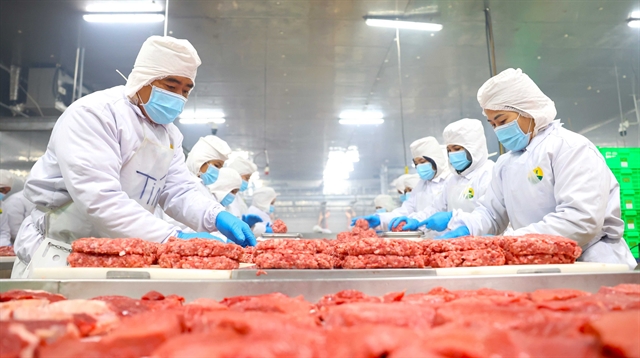
HÀ NỘI (WNAM MONITORING): The rising number of Vietnamese agricultural and food products obtaining Halal certification creates a great opportunity for domestic goods to penetrate rapidly global Muslim market.
As Việt Nam accelerates efforts to restructure its export markets, the Halal market is emerging as a promising avenue for deeper trade integration, aligned with the country’s long-term vision of sustainable growth.
The nation’s export market restructure includes to diversify markets and reduce reliance on traditional trading partners.
According to international organisations, the global Muslim population now exceeds two billion people, accounting for roughly 25 per cent of the world’s population.
The Halal economy is projected to reach approximately US$5 trillion by 2030, extending well beyond food and beverages into cosmetics, pharmaceuticals, logistics, tourism and Islamic finance.
Notably, the Halal market is no longer a niche market, but an increasingly comprehensive consumer market, where ethical standards, traceability, transparency and production integrity are prioritised.
Non-Muslim consumers are also gravitating towards Halal products, viewing certification as a guarantee of quality, safety and sustainability.
With its strengths in tropical agriculture, food processing and deep integration through next-generation free trade agreements (FTAs), Việt Nam is widely regarded as having significant potential to develop a structured Halal industry.
However, to turn that potential into a competitive advantage, Halal certification is not just a standard, also must be as an industry-wide development strategy.
Increasingly, firms are engaging with the Halal market in a proactive and strategic manner. HR Essence Co, Ltd has recently announced that several of its product have obtained Halal certification from the National Halal Certification Centre, including coffee, cereals and premium bird’s nest cereals.
The significance is not in the number of certified products but in the company’s approach. According to Hương Nguyễn, chairwoman of HR Essence, entering the Halal market requires a comprehensive restructuring of the value chain, from sourcing raw materials and production processes to quality management systems, branding and market access strategies.
In this sense, Halal is not merely a passport to export markets, but a filtering mechanism that compels businesses to raise governance standards, standardise procedures and invest seriously in intrinsic product value.
This marks a fundamental distinction between pursuing Halal certification as an export requirement and developing Halal products as a long-term industry strategy.