
WNAM REPORT: Indonesia will not charge tolls in the Strait of Malacca, its foreign minister said on Thursday, dispelling reports it could follow Iran’s example in the Strait of Hormuz.
Indonesia’s Foreign Minister Sugiono spoke to reporters in response to media reports over the possible blockage of the passage, which is a major shipping lane for global trade and energy. The speculation was fueled by the Indonesian finance minister’s comments about imposing a levy on vessels transiting the strait — a remark he almost immediately distanced himself from.
“Indonesia is not in a position to do that,” Sugiono said.
“We support the freedom of navigation as a trading nation. We also expect a free passage, and I believe there’s a commitment from many countries to create a free, neutral, and mutually supportive shipping lane.”
Similar clarifications were issued by Singapore and Malaysia, which also have jurisdiction over the strategic passage.
Singaporean Foreign Minister Vivian Balakrishnan said on Wednesday the city-state would not participate in “any attempts to close or interdict or to impose tolls” in its neighborhood.
“The right of transit passage is guaranteed for everyone,” he said during an interview with CNBC.
Malaysian Foreign Minister Mohamad Hasan told a forum on Wednesday that any decision about the Strait of Malacca “must involve the cooperation” of the littoral states and “cannot be done unilaterally.”
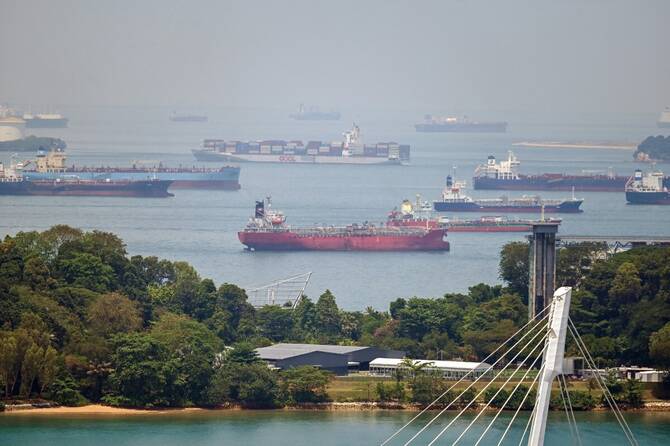
The Strait of Malacca is a narrow sea passage, stretching 900 km in length, between the Indonesian island of Sumatra to the west and Malaysia and Thailand to the east, with Singapore at the southern end of the strait, where ships exit toward the Pacific.
It provides the shortest sea route from the Middle East and Europe to East Asia where roughly 25 to 40 percent of global trade passes through annually. Countries like China, Japan and South Korea are dependent on the strait for their crude oil imports from the Middle East.
Malacca is the world’s largest “oil transit chokepoint,” where oil trade flows surpass that in the Strait of Hormuz, according to the US Energy Information Administration.
In the first half of 2025, some 23 million barrels of oil per day were transported through the Malacca Strait, making up around 29 percent of total maritime oil flows. Hormuz comes second, with about 20.9 million bpd passing through the strait during the same period.
Media speculation over the possibility of the passage being disrupted has been triggered by comparisons to the Strait of Hormuz — the main passage for Asia’s fuel supplies from the Middle East.
As the Strait of Hormuz has been effectively closed by Iranian forces since the start of US–Israeli military operations on Feb. 28, much of Asia has been pushed to the brink of an energy crisis.
China is the world’s largest importer of oil through the Strait of Hormuz and its supplies have been affected by its closure. According to data visualization platform Visual Capitalist, 37 percent of the oil passing through the strait goes to China.
While that oil would later go through the Strait of Malacca, it is not the only oil that passes the Southeast Asian waterway. The strait also controls access to most of China’s non-Gulf seaborne oil — from Russia and Brazil.