
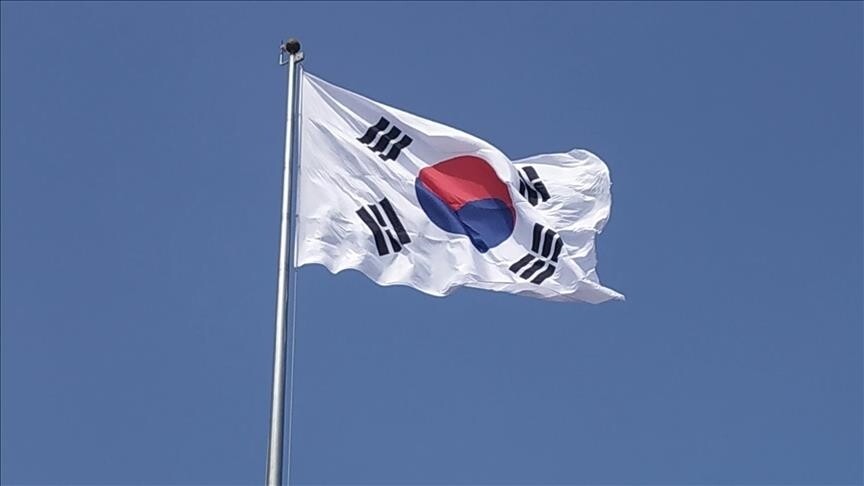
WNAM REPORT: South Korea’s presidential office on Tuesday discussed Seoul’s “response” to a fire that broke out following an explosion aboard a bulk carrier operated by a major South Korean shipping company in the Strait of Hormuz, as US President Donald Trump called on Seoul to join a US-led mission in the waterway.
A meeting held at the presidential office, attended by Presidential Chief of Staff Kang Hoon-sik and other senior officials, did not immediately disclose details of the discussion to the media.
Seoul said it is taking all necessary measures to determine the exact cause and circumstances of the explosion aboard the Korean-operated vessel in the Strait of Hormuz.
“We will be able to determine the exact cause of the incident when inspecting the damage once the ship is towed,” the Ministry of Foreign Affairs said, according to The Korea Times.
The incident occurred late Monday while the HMM Namu was anchored off the coast of the United Arab Emirates.
The blaze originated in the engine room, where crew members battled the fire for about four hours using the ship’s carbon dioxide systems.
All 24 crew members, comprising six South Koreans and 18 foreign nationals, were confirmed safe.
The cause of the explosion remains under investigation.
An official with South Korea’s HMM Co., which operates the carrier, said it remains unclear whether the incident was caused by an external attack or an internal malfunction.
Twenty-six South Korean-flagged ships remain stranded in the strait.
Following the incident, Trump urged South Korea to join the Hormuz mission, saying “perhaps it’s time for South Korea to come and join the mission.”
On Monday, Iranian state media reported that two missiles struck a US Navy vessel near Jask Island in the Gulf of Oman, but the United States firmly denied the claim.
Tensions have escalated as Iran’s Islamic Revolutionary Guard Corps earlier warned that any vessels violating transit protocols issued by Tehran in the Strait of Hormuz “will be forcefully stopped.”
The US and Israel launched strikes against Iran on Feb. 28, triggering retaliation from Tehran against Israel as well as US allies in the Gulf, along with the closure of the Strait of Hormuz.
Since April 13, the US has enforced a naval blockade targeting Iranian maritime traffic in the strategic waterway.
A two-week ceasefire took effect on April 8 through Pakistani mediation, followed by direct talks in Islamabad on April 11-12, but no agreement was reached on a lasting truce.
US President Donald Trump later extended the ceasefire without setting a new deadline, following a request from Pakistan.