
DUBAI/WASHINGTON ( WNAM MONITORING): Hostilities between Iran and the United States escalated sharply on Wednesday as Iran claimed responsibility for attacks on US military assets in the Gulf, including the headquarters of the US Fifth Fleet, while Washington reported intercepting missiles launched toward regional allies and carrying out retaliatory strikes.
Iran’s Revolutionary Guards Corps (IRGC) said it had launched missiles and drones against the US Fifth Fleet headquarters, an airbase and helicopters in a Gulf country in response to what it described as a US attack on a communications tower south of Qeshm Island.
Iranian media also reported that the IRGC Navy targeted a vessel identified as Panaya with missiles after accusing US forces of striking an Iranian tanker near the Strait of Hormuz, damaging its engine room.
“Disrupting the security of the Strait of Hormuz will carry a heavy price for the US military,” Iranian media quoted the IRGC as saying.
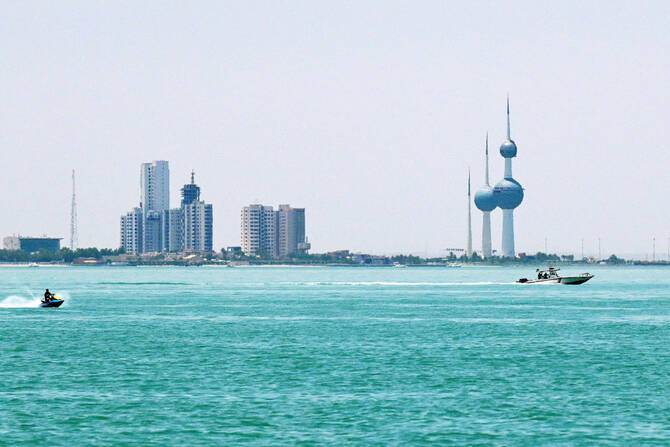
The latest claims came hours after Kuwait’s military said its air defenses intercepted hostile missile and drone attacks, while neighboring Bahrain activated warning sirens and urged residents to seek shelter.
The US military said two Iranian ballistic missiles fired toward Kuwait either fell short or broke apart before reaching their targets, while three missiles launched toward Bahrain were intercepted by US and Bahraini forces.
US Central Command (CENTCOM) said Iran had launched ballistic missiles toward regional neighbors but failed to hit any targets. It added that US forces conducted strikes on Iran’s Qeshm Island after defeating multiple Iranian missiles and drones.
Iranian media reported explosions near Qeshm Island, which lies close to the strategic Strait of Hormuz, while the United States separately said it had engaged a tanker heading toward Iran.
The renewed exchange underscored the fragility of a conflict now entering its fourth month after US and Israeli strikes on Iran in late February killed senior Iranian leaders and triggered a wider regional confrontation.
Although a shaky ceasefire remains in place, fighting continues sporadically and the Strait of Hormuz — one of the world’s most important energy chokepoints — remains largely closed to commercial shipping.
Last week, Washington and Tehran said they had reached a tentative framework aimed at ending the conflict, but neither side has formally endorsed a final agreement.
Iranian media reported that communications between Tehran and Washington had lapsed for several days. US President Donald Trump disputed those claims, insisting negotiations remained active.
“The conversations between us have been going on continuously, including four days ago, three days ago, two days ago, one day ago, and today,” Trump said in a social media post.
Nuclear talks remain deadlocked
Since mid-March, Trump has repeatedly said a negotiated settlement is within reach and that discussions could eventually address Iran’s nuclear program.
Washington maintains that preventing Iran from acquiring nuclear weapons remains its primary objective. Tehran insists its nuclear activities are entirely peaceful.
Iran is seeking access to billions of dollars in frozen oil revenues, relief from sanctions on crude exports, an end to restrictions affecting its ports, and continued leverage over the Strait of Hormuz.
US Secretary of State Marco Rubio told lawmakers on Tuesday that sanctions relief would only be considered if Iran agreed to abandon its nuclear activities.
“The war is over,” Rubio said during a contentious Senate exchange, although fresh military exchanges across the Gulf highlighted the continuing volatility of the conflict.
Regional impact widens
The war, which began on Feb. 28, has killed thousands of people, primarily in Iran and Lebanon, and disrupted global energy markets by sharply reducing traffic through the Strait of Hormuz, which previously carried roughly one-fifth of global oil and liquefied natural gas supplies.
The conflict has also intensified fighting between Israel and Lebanon’s Hezbollah movement.
Israeli forces continued strikes across southern Lebanon on Tuesday despite a US-mediated partial ceasefire announced a day earlier, according to Lebanese security sources.
The renewed violence has done little to reassure civilians. More than 1.2 million people have been displaced in Lebanon since the conflict escalated.
“Every time we return to our homes, there is a warning for us to be displaced again,” said Faten Al Chehime, who recently fled Beirut’s southern suburbs for a displacement camp.
The conflict’s impact has also spread to maritime trade.
Shipping giant MSC said one of its vessels was struck by two projectiles while docked at Iraq’s Umm Qasr port on Monday.
The IRGC said the attack was retaliation for a US strike on an Iranian vessel in the Gulf of Oman.
The growing disruption to global trade and logistics is hampering humanitarian operations worldwide, the United Nations children’s agency UNICEF said, warning that rising transport costs and supply-chain disruptions are affecting aid deliveries to Gaza, Lebanon, the Democratic Republic of Congo, Mali, Somalia, South Sudan, Nigeria and other crisis-hit regions.