ISLAMABAD ( WNAM MONITORING): Global technology giants and major corporate brands are allegedly hosting, amplifying, and monetizing a violent wave of anti-minority hate music in India, according to an investigative report released by a Washington-based think tank.
The study alleges that mainstream digital platforms have effectively become primary vehicles for spreading highly provocative, dehumanizing content targeting religious minorities, specifically Muslims and Christians.
The findings were detailed in a comprehensive report published by the Center for the Study of Organized Hate (CSOH)—a nonpartisan think tank dedicated to researching extremism, radicalization, and online harms.
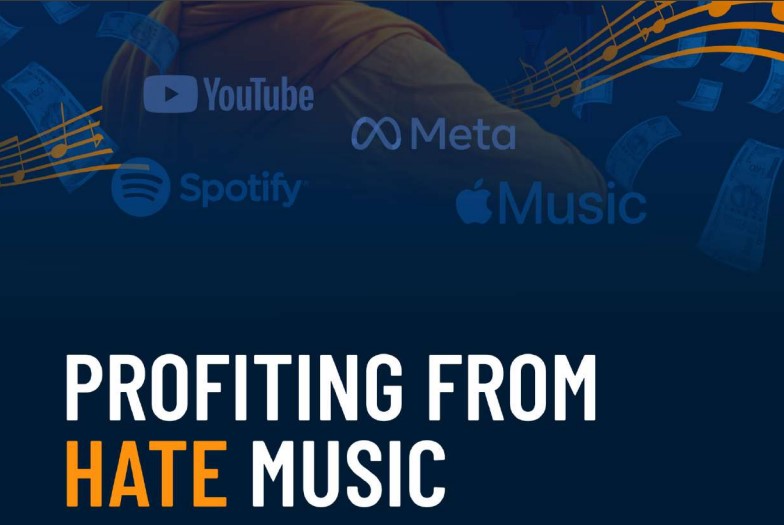
Titled “Profiting from Hate Music: The Role of YouTube, Meta, Spotify, and Apple Music in Hosting and Monetizing India’s Hate Music Industry,” the study maps the rapid ascent of “Hindutva Pop” or “H-Pop,” a highly lucrative genre of music that is allegedly weaponized by Hindu nationalist groups to vilify religious minorities, promote a majoritarian ideology, and cultivate fear, anger, and hostility.
Drawing on a database compiled between January 2025 and January 2026, CSOH identified 523 distinct Hindutva pop hate songs actively hosted across YouTube, Spotify, Apple Music, and Meta’s Music Library that reportedly violate the platforms’ own content policies.
According to the report, “210 songs were identified on YouTube, 109 on Spotify by 53 artists, 103 on Meta’s Music
Library, and 101 on Apple Music by 59 artists. YouTube songs alone have been viewed over 198 million times; Meta’s Music Library songs were used in more than 5.9 million Instagram Reels.”
According to the report, roughly half of all identified tracks (263 of the 523 songs) contain explicit calls for violence, urging listeners to eliminate, attack, or expel Muslims and Christians to establish an exclusively Hindu nation.
On YouTube alone, 104 of these songs allegedly contain direct incitement or threats of violence and have received at least 97 million views.
The remaining songs, while not explicitly calling for violence, are claimed to promote hatred through dehumanizing language, derogatory slurs, and conspiracy theories designed to foster conditions that contribute to real-world harm.
Unlike global hate groups that operate in the shadows, India’s H-Pop industry thrives in the mainstream, enjoying the active patronage and impunity granted by the ruling Bharatiya Janata Party (BJP) and its ideological parent, the Rashtriya Swayamsevak Sangh (RSS).
This political backing and entrenched popularity have allowed the genre to become a core tool for political and social polarization.
The report connects this digital wave to a dramatic increase in offline violence. These highly provocative songs are routinely played during religious processions and rallies outside mosques, which the study claims has already been linked to deadly communal violence.
“Hate music is one of the oldest and most dangerous instruments of mass violence, and we have seen where it leads, from Rwanda to Myanmar,” says Raqib Naik, Executive Director of CSOH.
“What makes India’s Hindutva pop so alarming is its reach. These companies and platforms, most of them based in the United States, have handed these artists a global stage, an audience of hundreds of millions, and the tools and revenue streams to keep producing more”.
“Through this report, we have been able to demonstrate what was long suspected: while American social media platforms have been censoring content even remotely critical of the ruling Modi government, they have simultaneously amplified, patronized, and funded content that calls for violence against Muslims and Christians,” says Kunal Purohit, independent journalist and co-author of the report.
The investigation alleges severe double standards and systemic moderation failures by Western tech platforms.
To test how these platforms enforce their rules, researchers reported a sample of 225 highly violative songs using the companies’ own moderation systems. Only 18 were removed, meaning more than 90 percent of the reported hate songs remained online.
Furthermore, the report unmasked the financial engines allegedly funding this machinery. In-stream advertisements for 103 major brands—including OpenAI’s ChatGPT, Google’s NotebookLM, Amazon Prime, Adobe, Dell, and Levi’s—were documented running directly alongside H-Pop tracks, appearing on 83 percent of the videos that explicitly call for violence.