
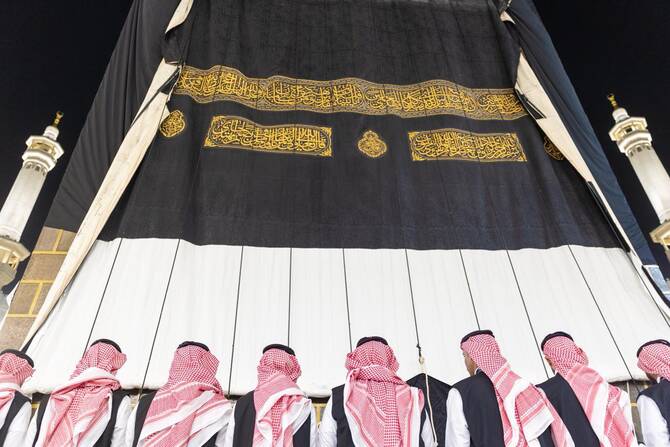
JEDDAH ( WNAM MONITORING): At the beginning of the new Hijri year, the Holy Kaaba was covered with its new kiswa, reflecting Saudi Arabia’s care for the holiest site in Islam and its expertise in producing Islamic craftsmanship.
The replacement of the kiswa is one of the key rituals at the Grand Mosque and marks the completion of months of work at the King Abdulaziz Complex for the Holy Kaaba Kiswa in Makkah, the Saudi Press Agency reported on Tuesday.
The process involved about 150 Saudi craftsmen working for 11 months to produce 47 pieces of luxurious black silk embroidered with 30 Qur’anic verses in silver thread plated with 24-karat gold. The cover weighs 1,410 kg.
They installed the embroidered curtain with gold-plated threads, the hizam (belt), the samadiah (decorative elements), lantern-shaped pieces and decorations around the mizab (rainwater spout), corners and other parts of the Kaaba, creating a scene marked by reverence and devotion.
The kiswa appears as a single seamless garment but is in fact made through a detailed production process using several types of fabric, each serving a specific purpose in its structure, appearance and durability.
Its main fabric is black silk, which forms the outer covering and gives the kiswa its distinctive appearance. It also includes embossed black silk used for inscriptions and decorative motifs, adding to its design.
Inside, off-white cotton is used as a lining to provide strength and durability, while white cotton supports additional sections to enhance structural stability.
Red silk is used in some decorative elements, and green silk is used behind the curtain of the Kaaba’s door. Embossed green silk is used for the inner covering.
Together, these materials are combined through a precise production process that reflects the craftsmanship behind the kiswa.