
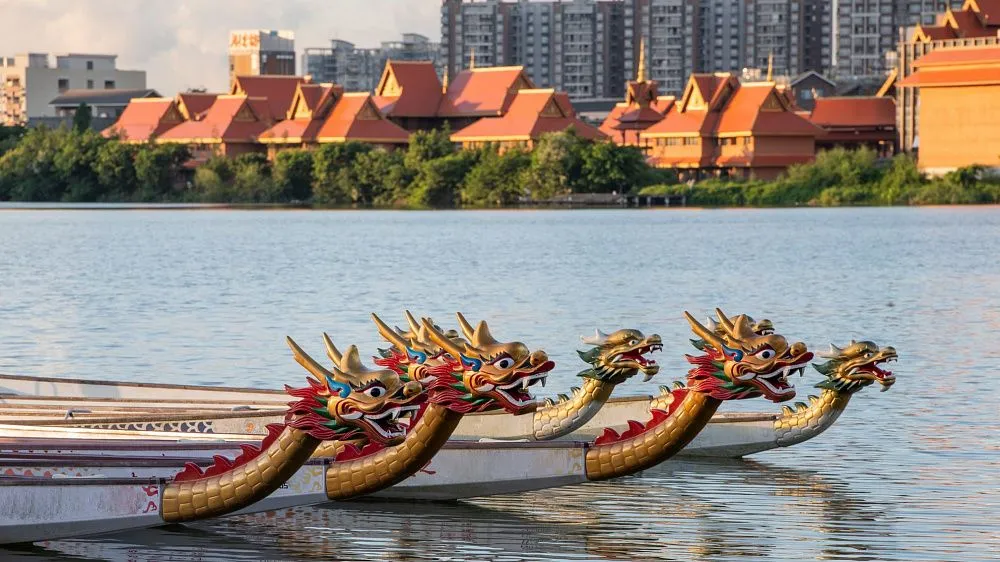
BEIJING ( WNAM MONITORING): From early Friday morning, waterways crisscrossing Chinese cities, towns and villages have been reverberating with the rhythmic splash of paddles and the beat of drums as people celebrate the Dragon Boat Festival.
The festive spectacle offers city residents the perfect outing as they begin their three-day break on Friday, while also drawing villagers from nearby areas to cheer for their hometown teams and join the celebrations.
As traditional culture enjoys a resurgence in China, Dragon Boat Festival celebrations are more lively than ever, sparking increased demand for tourism and cultural products. Their economic and social ripple effects extend well beyond the three-day holiday, giving a sustained boost to local tourism and related industries.
Since May, the Jinjiang River winding through Tongren City in southwest China’s Guizhou Province has turned into a training ground for dragon boat racers.
While this centuries-old sport traditionally honors Qu Yuan, a legendary poet and minister in the State of Chu during the Warring States Period (475-221 BC), who drowned himself in the Miluo River after being slandered and then exiled, its modern-day form continues to bring people together and, in particular, strengthens community bonds.
In Tongren, a city steeped in dragon boat racing tradition, even migrant workers return from distant cities to compete for the honor of their villages and neighborhoods. This deep-rooted devotion has turned the races into a major tourist attraction.
Last year, Tongren’s annual event generated 384 million yuan (about 56.4 million U.S. dollars) in tourism revenue, with some 300,000 spectators packing the banks of the Jinjiang River.
Notably, the influx of visitors is no longer confined to the city center. Increasingly, tourists are extending their trips into the countryside, spending their day along the Jinjiang River watching dragon boat races before retreating to mountainous homestays in the evening.
Notably, the influx of visitors is no longer confined to the city center. Increasingly, tourists are extending their trips into the countryside, spending their day along the Jinjiang River watching dragon boat races before retreating to mountainous homestays in the evening.
In the nearby Banliyuan Village, bookings at local lodgings are already surging ahead of this year’s event. Tang Chengyong, general manager of a homestay complex, said his property, which offers 25 rooms and 47 beds, was fully booked during last year’s Dragon Boat Festival holiday. As of June 16, reservations for this year’s holiday had already reached 80 percent capacity, with about 90 percent of guests from outside the province.
The festival’s growing appeal is drawing visitors to lesser-known counties and rural communities as well. Travelers who venture off the beaten path are often rewarded with a more authentic and lively experience, immersed in celebrations deeply rooted in local traditions.