
Despite subdued economic conditions in Europe and the wider world, Switzerland’s macroeconomy remains globally robust. This resilience rests on several key factors: a strong currency, low inflation, and a highly specialized export sector that has successfully mitigated the spillover socioeconomic effects of global geopolitical conflicts, trade disputes, and tariff wars. Switzerland’s economic strength vividly reflects its adaptability, export diversity, and the integration of smart technologies that are reshaping its economy, communities, and enterprises.
Dr Mehmood Ul Hassan Khan
It is a positive sign that Switzerland continues to maintain a highly stable, competitive, and knowledge-driven economy. This relies heavily on a skilled workforce, quality manufacturing particularly in pharmaceuticals and precision instruments a strong base of small and medium-sized enterprises (SMEs), and a dominant financial services sector. Swiss cities consistently rank among the world’s highest for innovation and quality of life, and the country remains an influential global diplomatic and economic hub, frequently serving as a mediator and host for international negotiations.
From this position of macroeconomic strength characterized by steady growth, low inflation, and limited near-term spillovers from geopolitical shocks Switzerland held a referendum on 14 June. The initiative in question proposed capping the Swiss population at 10 million by 2050. Concerns were raised that its approval would introduce uncertainty around long-term growth by challenging labour market openness and relations with the European Union. Ultimately, Swiss voters wisely rejected the “Sustainability Initiative,” with 54.79% voting against and a double majority of 12 rejecting cantons to 8 agreeing cantons; voter turnout stood at 58.86%. So, it was the first step in right direction for the opening-up, modernization, digitalization and AI orientation of the Swiss government and its private companies.
Concurrently, Pakistan-Swiss bilateral relations reached a historic diplomatic high in June 2026, pivoting from traditional trade toward deeper cooperation in regional mediation, cybersecurity, information technology, and pharmaceuticals. This shift has further strengthened the scope, utility, and importance of their bilateral economic ties across diverse sectors.
Analytically, Switzerland and Pakistan enjoy good, long-standing relations. The two countries have signed a range of economic agreements that have helped develop bilateral trade, covering areas such as investment protection, debt consolidation, aviation, double taxation, and the exchange of information on financial accounts. Switzerland also maintains a regular political dialogue with Pakistan.
Trade and economic relations between the two nations are strong. Switzerland has consistently ranked among the top seven foreign direct investors in Pakistan. Major Swiss companies have a significant presence there, employing more than 15,000 people. Comparative studies reveal that Swiss firms contribute to Pakistan’s economic development through long-term investment, innovation, and professional expertise. Their sustained presence reflects robust business ties and confidence in the country’s future. It is encouraging that the Swiss Business Council and Swiss companies are actively working to further strengthen bilateral relations through their commitment to high professional standards, innovation, and the development of local talent.
Pakistan and Switzerland have been discussing the expansion of bilateral investment ties and exploring new avenues for economic cooperation. Both sides have expressed keenness to deepen engagement in pharmaceuticals, tourism, information technology, cybersecurity, climate change, and disaster risk reduction.
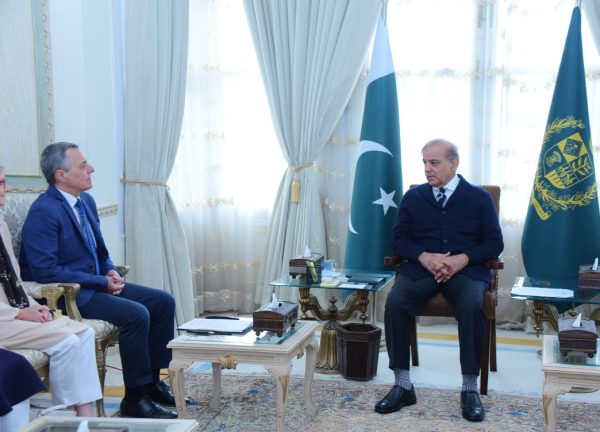
Most recently, Prime Minister Shehbaz Sharif and Swiss Vice President and Foreign Minister Ignazio Cassis met on the sidelines of ongoing technical-level talks between the United States and Iran in Bürgenstock, Switzerland.
Prime Minister Sharif appreciated sustained Swiss investment in Pakistan and expressed hope that Swiss companies would further scale up their footprint. He also offered to provide highly skilled IT and cybersecurity professionals from Pakistan to meet Switzerland’s growing demand in these sectors.
Foreign Minister Cassis lauded Pakistan’s mediation role in steering the negotiation process that led to the signing of the Islamabad Memorandum of Understanding between Iran and the United States and conveyed Switzerland’s willingness to assist the follow-up process. Prime Minister Sharif highlighted that successful implementation of the Islamabad MoU would pave the way for regional peace and global economic stability, and he extended an invitation to Foreign Minister Cassis to visit Pakistan.
In summary, Switzerland remains one of the top European investors in Pakistan, with major multinational companies such as Nestlé, Novartis, and Roche operating in the country. Both sides continue to cooperate closely to further strengthen bilateral relations in diverse areas, including the economy, investment, manufacturing, joint ventures, education, health, tourism, life-saving pharmaceuticals, disaster management, climate change, and green technologies.
The writer submits that both countries should extend their cooperation in pharmaceuticals, tourism, climate change, disaster risk reduction, community development, SMEs, classic watch manufacturing, education, hospitality management, and women’s empowerment. The writer suggests that Pakistan can support Switzerland with a skilled IT workforce, cybersecurity expertise, software engineers, and ICT capabilities through the development of practical pathways to increase exports, facilitate business-to-business engagement, and unlock the untapped potential of bilateral trade relations.
The writer proposes that Pakistan’s strengths in textiles and information technology should be further advanced through competitiveness, innovation, compliance readiness, and opportunities for partnerships with Swiss businesses in which joint ventures in fashion industry, seasonal garments and luxury items would create numerous befitting propositions for both sides in the days to come.
The writer upholds that to further Pakistan’s export diversity and support its companies, both sides should consolidate their economic relations and foster greater collaboration between businesses and institutions. In this context, they should jointly work to revive the “Science Diplomacy Initiative” and extend cooperation into agricultural technologies, smart SME models, and innovations for sustainable agriculture.
To conclude, the writer recommends that since Switzerland is a global powerhouse in the life sciences industry, famed for producing breakthrough life-saving medicines and vaccines, the two countries should extend their cooperation into medical R&D investments. Finally, initiating direct flights between Swiss and Pakistani airports would ease travel for business delegates and facilitate supply chain logistics, while leveraging Swiss expertise in hospitality and infrastructure development would further boost Pakistan’s international tourism sector.