
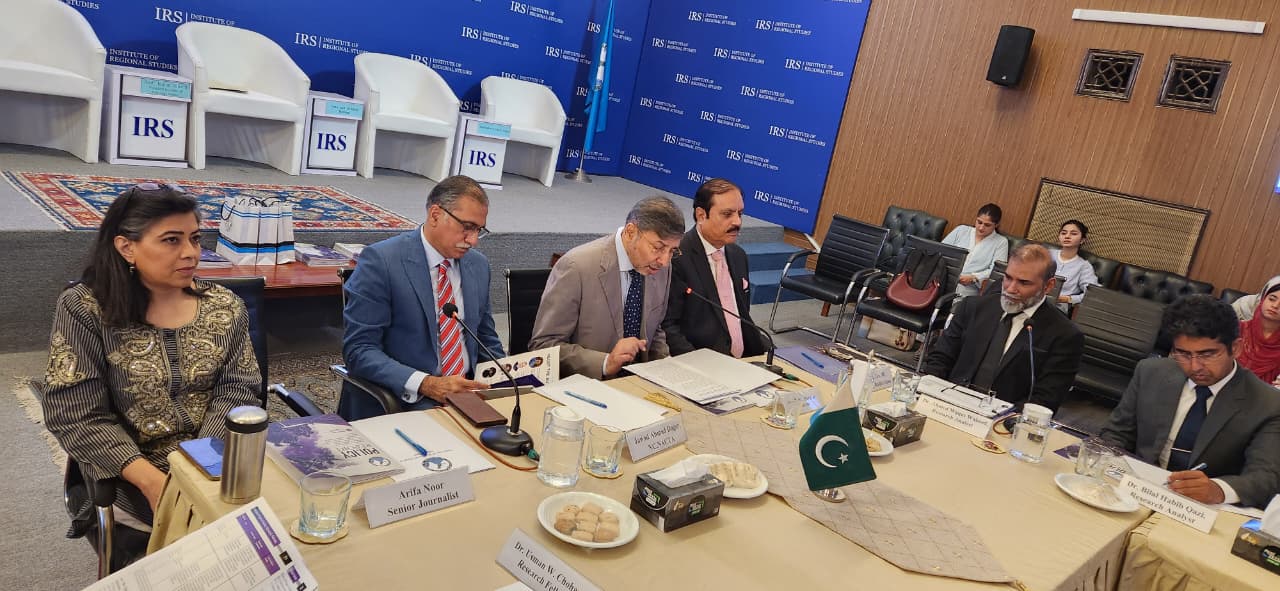
ISLAMABAD ( WNAM REPORT ): The Institute of Regional Studies (IRS), Islamabad, launched its report, Cognitive Warfare and Insurgent Legitimacy: TTP’s Strategic Communication Post-Taliban Takeover and Pakistan’s Counter-Narrative Imperative. The study is a joint effort of the Centre for Countering Terrorism and Violent Extremism Studies (CCTVES) and the Institute’s Strategic Discourse and Cyber Security Programmes.
The report comes at a critical time, with Pakistan ranking first in the Global Terrorism Index 2026 after recording 1,139 terrorism-related deaths across 1,045 incidents in 2025. It notes a 24 per cent increase in TTP attacks, making the group the world’s third deadliest terrorist organisation. With overall violence rising by approximately 258 per cent since the Taliban’s return to Kabul in August 2021, the report argues that Pakistan urgently requires a proactive, well-resourced, and evidence-based national counter-narrative to complement its counter-terrorism efforts.
In his opening remarks, Ambassador Jauhar Saleem, President of IRS, described the report as both timely and necessary after two decades of counter terrorism operations. While acknowledging Pakistan’s significant operational successes, he observed that the terrorist threat has evolved since 2021, with the TTP benefiting from renewed sanctuary in Afghanistan as well as India’s Offensive Defence Doctrine whereby New Delhi has incorporated terrorism into its foreign policy toolkit. He emphasised the need for a proactive, institutionally coordinated counter-narrative rooted in the lived realities of local communities, stressing that the war of ideas must be accorded the same priority as the fight on the ground.
Jawad Ahmad Dogar, National Coordinator of the National Counter Terrorism Authority (NACTA), emphasised that an effective counter-narrative policy must be grounded in evidence. He noted that sustainable progress requires addressing the root causes of terrorism and strengthening governance and state institutions. He further underscored the need to bridge the gap between the state and society, arguing that only then can a credible national narrative take root and effectively counter violent extremism. Appreciating the report for providing timely policy direction, he encouraged closer collaboration between researchers, academics, and policymakers to translate research into effective implementation.
Senior Journalist and well-known media anchor Arifa Noor contrasted TTP’s simple, relatable messaging with the state’s often technical, bureaucratic language. She argued that an effective national narrative must enjoy public legitimacy and emerge through a genuine partnership between the state and society. Addressing local grievances, she observed, remains indispensable, as kinetic measures alone cannot provide a lasting solution.
Major General (R) Tariq Rashid Khan, H.I. (M) described the study as timely, insightful, and highly relevant. He observed that military power alone has never been sufficient to defeat an ideology. In conflicts where legitimacy is contested, and behaviour is the principal target, narratives become the centre of gravity. He noted that while kinetic operations had previously achieved considerable success through capability and resolve, the post-2021 environment requires a broader strategy in which the state simultaneously denies militants operational space, reduces the socio-economic drivers of violence, strengthens public confidence, and ensures close coordination among all stakeholders.
The session was moderated by Dr. Waqas Ahmad Waheed and concluded with an interactive question-and-answer session attended by diplomats, senior government officials, law-enforcement officers, academics, researchers, members of the media, and students.
IRS Launches Landmark Report on TTP’s Cognitive Warfare
36