
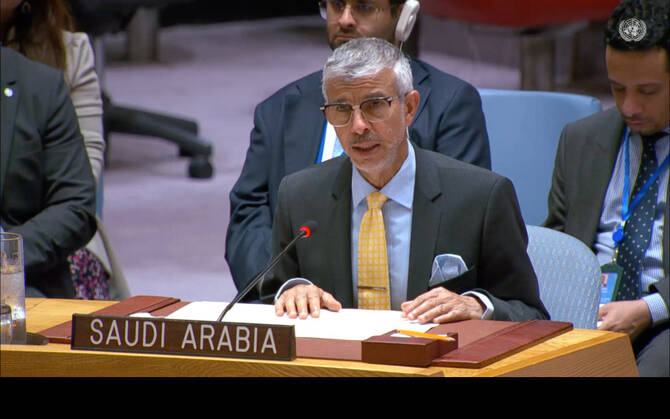
NEW YORK ( WNAM MONITORING): Saudi Arabia’s Permanent Representative to the United Nations, Abdulaziz Alwasil, told the Security Council on Wednesday that sexual violence continues to be used in armed conflicts as a weapon of oppression, intimidation, and forced displacement, targeting civilians, particularly women and children.
Addressing a high-level Council meeting on conflict-related sexual violence and the Women, Peace and Security agenda, Alwasil said such acts constitute serious violations of international humanitarian and human rights law.
He noted that the Council, through Resolution 1820, which was adopted in 2008, and subsequent related resolutions, had reaffirmed that conflict-related sexual violence poses a serious threat to international peace and security, which is why perpetrators of these acts must be held accountable.
“Addressing this crime is a shared responsibility for the entire international community and all states concerned,” Alwasil said, calling for coordinated efforts to tackle its root causes and protect civilians and victims.
The Saudi envoy reaffirmed his country’s commitment to international humanitarian and human rights law, describing it as rooted in “legal, humanitarian, and moral responsibilities.” He said the Kingdom, guided by the values and principles of Islam, insisted on respect for the provisions of the Geneva Conventions and called for strengthening the means of implementing international humanitarian law.
Alwasil condemned all violations committed against civilians and stressed the importance of accountability, adding that ensuring the delivery of humanitarian assistance and protecting vulnerable groups was “not only a legal obligation imposed by international humanitarian law, but above all, a collective humanitarian and moral responsibility.”
He pointed to the King Salman Humanitarian Aid and Relief Center (KSrelief) as an example of the Kingdom’s international support programs, saying it continues to assist the most vulnerable, including survivors of sexual violence, in cooperation with international humanitarian organizations.
Turning to international humanitarian law more broadly, Alwasil said civilians under the authority of a party to a conflict must be treated humanely without discrimination, and protected from all forms of violence and degrading treatment, including torture and killing.
He said violations committed in the Palestinian territories, including acts of sexual violence, represent a flagrant violation of international humanitarian law and shared humanitarian values, and called for urgent international action to halt these violations, protect civilians, and hold those responsible accountable.
“Providing protection in the face of sexual violence in areas of armed conflict is a legal obligation from which there can be no derogation,” Alwasil said, closing his remarks with a call to strengthen international cooperation in combating the phenomenon “wherever it may be.”