
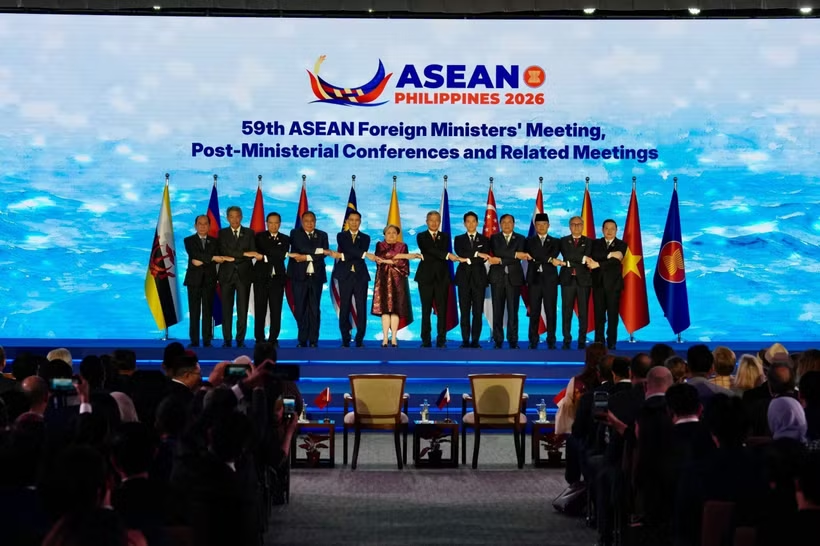
WNAM REPORT: Within the framework of the 59th ASEAN Foreign Ministers’ Meeting (AMM-59) and related meetings, Vietnamese Minister of Foreign Affairs Le Hoai Trung attended the ASEAN–China Foreign Ministers’ Meeting in Manila, the Philippines, on July 22.
In his remarks, Trung described ASEAN–China as one of ASEAN’s most dynamic and comprehensive partnerships, stressing the importance of effectively implementing the 2026–2030 Plan of Action to enhance the quality and strategic value of bilateral cooperation.
Regarding collaboration, he proposed three priorities: promoting high-quality economic integration and infrastructure connectivity; fostering innovation and artificial intelligence (AI) as new engines of growth; and strengthening strategic trust and cooperation in addressing non-traditional security challenges.
As for the East Sea, the Vietnamese minister underscored the importance of maintaining peace, stability, security, safety, and freedom of navigation and overflight. He welcomed progress in negotiations on the Code of Conduct in the East Sea (COC), and called for the early conclusion of a substantive COC in accordance with international law, particularly the 1982 United Nations Convention on the Law of the Sea (UNCLOS).
The participating ministers noted that the ASEAN–China Comprehensive Strategic Partnership has continued to grow robustly, delivering tangible benefits to people on both sides. They welcomed the initial progress in implementing the ASEAN–China Plan of Action (2026–2030) and agreed to organise a series of activities in 2026 to commemorate the 35th anniversary of ASEAN–China dialogue relations and the fifth anniversary of the Comprehensive Strategic Partnership.
Chinese Foreign Minister Wang Yi reaffirmed that ASEAN remains a priority in China’s neighbourhood diplomacy and reiterated its support for ASEAN centrality in the regional architecture.
He described ASEAN–China cooperation as an important driver of peace, stability and development in the region and beyond. China remains committed to supporting the implementation of the ASEAN Community Vision 2045 and enhancing coordination to advance regional integration, sustainable development and inclusive growth, he said.
According to Wang, future cooperation will focus on maintaining peace and stability, safeguarding economic and energy security, promoting technological innovation and artificial intelligence (AI), green growth, and people-centred development.
ASEAN member states welcomed China’s continued support for ASEAN centrality and its active participation in ASEAN-led mechanisms. Both sides agreed to step up cooperation in addressing non-traditional security challenges, including transnational crime, cybercrime, online fraud, terrorism and drug trafficking.
On the economic front, the ministers reaffirmed that the upgraded ASEAN–China Free Trade Area (ACFTA) 3.0 and the Regional Comprehensive Economic Partnership (RCEP) remain key frameworks for deepening regional economic integration. They encouraged member states to complete their respective domestic procedures for the early entry into force of the ACFTA 3.0 Upgrade Protocol and agreed to strengthen cooperation in digital transformation, green transition, AI, renewable energy and sustainable development.
The meeting also welcomed the adoption of the ASEAN–China Plan of Action on Building an Inclusive and Sustainable Digital Ecosystem (2026–2030), the establishment of the ASEAN–China AI Industry Innovation Centre, and ongoing efforts towards creating an ASEAN–China Digital Academy. It also took note of the proposal to designate 2027 as the “ASEAN–China Year of AI Cooperation.”
Both sides agreed to expand people-to-people exchanges, youth programmes, leadership scholarships, scientific research, innovation and startup cooperation, and strengthen collaboration in healthcare, education, environmental protection, rural development, poverty reduction and disaster management.