
WNAM REPORT: Achieving economic development and establishing oneself as a regional power centre is not simply a matter of being located in a favourable geopolitical position. There are countries around the world whose geographical advantages have done little to help them overcome economic turbulence or realise their full potential.
The South Caucasus, once portrayed primarily as a conflict-ridden region, has faced similar challenges and has not always been able to make the most of its strategic advantages. Azerbaijan’s broad-based and increasingly proactive policy towards regional relations, however, has opened a new chapter. Today, the voice of the Caucasus can be heard not only in the West, but increasingly across the East and into Central Asia.
There is, of course, no extraordinary or magical force behind this transformation. Rather, it is the result of a consistent, pragmatic and carefully pursued policy over many years. Against this backdrop, Azerbaijan’s close ties with European and Asian countries, as well as with the Turkic-speaking states of Central Asia, are far from coincidental. They reflect a broader strategy aimed at strengthening the country’s regional influence, expanding its economic partnerships and making full use of its position at the crossroads of Europe and Asia.
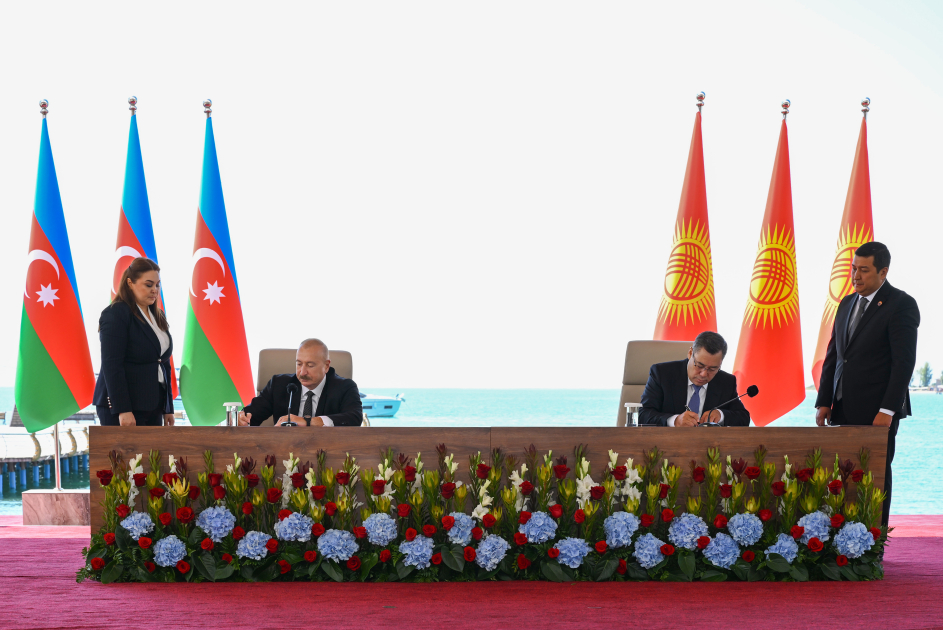
The Treaty on Allied Relations signed during Azerbaijani President Ilham Aliyev’s state visit to Kyrgyzstan represents more than a new stage in Azerbaijan–Kyrgyzstan relations. It is also an important element of a broader geopolitical order taking shape between Central Asia and the South Caucasus. The significance of the agreement lies in its potential to extend beyond bilateral relations, creating new opportunities for the future of the Organisation of Turkic States, the development of the Middle Corridor and the transformation of Eurasia’s transport map.
Relations between Azerbaijan and Kyrgyzstan have deepened rapidly in recent years. The treaty, in addition, on allied relations gives these ties a higher political dimension. An alliance implies closer coordination both on individual issues and in approaches to regional and international developments. President Ilham Aliyev’s statement that “allied relations entail great responsibility, and we are prepared to shoulder it” reflects the substance of this new stage.
The key issue is whether the alliance can translate into concrete economic and geopolitical projects rather than remain merely a diplomatic commitment. The decision to increase the capital of the Azerbaijan–Kyrgyzstan Investment Fund to $200 million is particularly significant in this regard. Expanding investment mechanisms can allow the political rapprochement between the two countries to be reinforced by tangible economic interests. The long-term sustainability of an alliance depends in part on the development of precisely these forms of mutual economic interdependence.
One of the alliance’s broader consequences could be the transformation of the Organisation of Turkic States. The OTS is no longer simply a platform based on cultural and historical ties. It is increasingly becoming a political and economic framework for cooperation in transport, trade, energy, investment and digital connectivity. Raising Azerbaijan–Kyrgyzstan relations to a new level could provide further momentum to this process.
Ultimately, the future strength of the OTS will depend on how closely its member states coordinate their political and economic policies. The alliance between Azerbaijan and Kyrgyzstan could serve as a model for other member states. If bilateral alliances develop into a broader regional network, the OTS could strengthen its institutional capacity and deepen coordination on common priorities.
The Middle Corridor will be one of the most important testing grounds for this process.
Growing demand for alternative and resilient transport routes between Europe and Asia is rapidly increasing the strategic importance of the Middle Corridor. But its future will not be determined solely by the existence of a China–Central Asia–Caspian Sea–Azerbaijan–Georgia–Europe route. The central challenge is to turn the corridor into a more efficient, faster and more integrated economic system.
Azerbaijan occupies a particularly important position in this emerging architecture. The Caspian Sea serves as a natural bridge between Central Asia and the South Caucasus, while Azerbaijan is the principal logistics hub on its western shore. The Port of Baku, the Alat Free Economic Zone, the Baku–Tbilisi–Kars railway and the country’s wider road and rail network are expanding Azerbaijan’s transit capabilities.
This infrastructure is elevating Azerbaijan’s role beyond that of a transit country. Baku increasingly seeks to become a regional logistics platform where cargo is not merely passing through, but is consolidated, processed, redirected and connected to new markets. This could give Azerbaijan a more durable strategic role in the Eurasian trade map.
Stronger Kyrgyz participation in the Middle Corridor could broaden this picture further. Central Asia’s role in the corridor is often assessed primarily through Kazakhstan and Uzbekistan, but deeper Kyrgyz integration could expand its regional reach. Azerbaijan–Kyrgyzstan cooperation could therefore strengthen economic links across the Caspian while contributing to a wider network connecting a larger part of Central Asia with European markets.
Yet the success of the Middle Corridor will depend on more than the construction of new roads and railways. Faster border crossings, digitalised customs procedures, unified documentation, optimised tariffs and improved information sharing among the various participants in the logistics chain are at least as important as physical infrastructure. The new level of Azerbaijan–Kyrgyzstan relations creates a political foundation for closer coordination in these areas.
A broader geopolitical shift should not be overlooked either. Central Asian states are seeking to diversify their external trade and transport links. Europe, meanwhile, is looking for a wider range of routes and partners for its connections with Asia. At the intersection of these two trends, Azerbaijan is positioning itself not simply as an energy exporter but as a strategic connectivity hub linking Europe with Central Asia.
This role also brings together the economic and geopolitical dimensions of Azerbaijan’s foreign policy. Energy, transport, trade and investment projects are increasingly becoming interconnected elements of a broader regional connectivity strategy. The alliance with Kyrgyzstan provides an opportunity to deepen that strategy in the Central Asian direction.
Ultimately, the Treaty on Allied Relations signed in July 2026 should not be viewed solely as a new framework for relations between Baku and Bishkek. Its more significant potential consequence could be the conversion of political trust between Azerbaijan and Central Asia into deeper economic and logistical connectivity.
If this potential is realised, the Azerbaijan–Kyrgyzstan alliance could become a model for closer integration within the OTS while also helping to consolidate the Middle Corridor not merely as an alternative route, but as one of the principal arteries of Eurasian trade.
The central opportunity for Azerbaijan, therefore, is not simply to become a point on the transit map, but to emerge as a pivotal link within a network connecting different regions. The new alliance with Kyrgyzstan can be viewed as one of the important pillars supporting this broader strategy in Central Asia.