
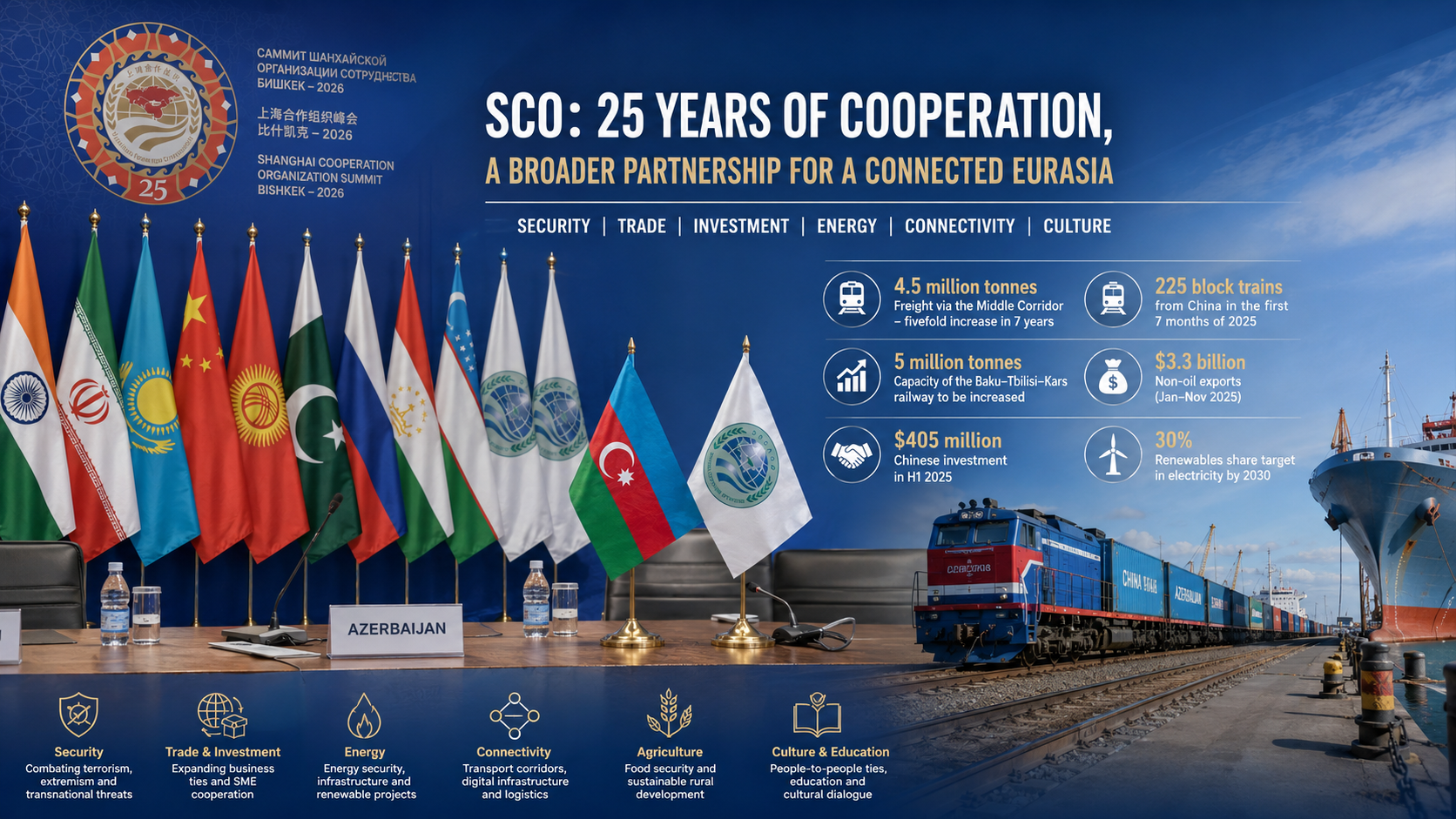
WNAM REPORT: Eurasia is becoming less about distance and more about connection, where trade routes are expanding, supply chains are being redirected, and countries that once dealt with each other mainly through diplomacy are increasingly connected by investment, transport, energy and technology.
The Shanghai Cooperation Organization (SCO), which marks its 25th anniversary this year, is one of the clearest examples of this shift.
The organization’s role for Azerbaijan as an SCO partner is increasingly practical rather than symbolic, as the relationship now covers security, trade, investment, energy, transport, telecommunications, agriculture, education and culture. These are the areas that increasingly overlap as Eurasian economies become more interconnected.
The scale of the organization alone explains why it matters. The SCO brings together 10 member states, including China, India, Russia, Iran, Pakistan and the Central Asian countries, representing roughly 40% of the world’s population and a substantial share of global economic activity. Therefore, for Baku, access to such a network creates opportunities well beyond traditional bilateral relations.
Moreover, Azerbaijan’s geographical position gives it particular relevance to the SCO’s growing economic network. As the country sits on the western shore of the Caspian Sea, linking Central Asia with Türkiye and European markets, its transport infrastructure is becoming increasingly important to this role.
It is significant to note that the Middle Corridor, connecting China and Central Asia with the Caucasus and Europe through the Caspian Sea, has seen rapid growth. Freight volumes along the route have increased roughly fivefold in seven years, reaching around 4.5 million tonnes. In the first seven months of 2025 alone, 225 block trains from China travelled through the corridor.
Infrastructure investment is following the demand. The capacity of the Baku–Tbilisi–Kars railway is being increased from about 1 million tonnes to 5 million tonnes a year, while Azerbaijan’s railway operator ADY has purchased 300 new wagons.
These numbers show more than transport statistics by portraying how Azerbaijan can turn geography into an economic asset. And the same logic applies to trade and investment.
Azerbaijan’s non-oil exports reached about $3.3 billion in January–November 2025, accounting for roughly 14% of total exports. At the same time, Chinese investment in Azerbaijan reached approximately $405 million in the first half of 2025.
The figures point in the same direction: the relationship with Asian economies is moving beyond the sale and transit of commodities towards investment, manufacturing, logistics and broader commercial ties.
Furthermore, transport corridors only become economically meaningful when companies use them. Therefore, cooperation in customs, telecommunications, agriculture and support for small and medium-sized enterprises can help turn infrastructure into actual trade.
Experts say a new railway can move goods faster. In the meantime, efficient customs can reduce costs, digital systems can make transactions easier, investment can create production capacity, and businesses can then use the same infrastructure to reach new markets.
Azerbaijan’s economic strategy is already moving in this direction. For example, industrial parks, the Alat Free Economic Zone and expanding logistics infrastructure are designed to attract investment and increase production rather than simply move goods through the country.
The Alat Free Economic Zone, for example, offers companies operating there exemption from customs duties for 15 years. Such incentives become more significant when combined with access to growing transport corridors connecting China, Central Asia, the Caucasus and Europe.
Energy remains another pillar
Energy is another area where Azerbaijan and SCO countries have obvious interests. Azerbaijan has spent decades building itself into an energy producer and transit country. The Southern Gas Corridor stretches roughly 3,500 kilometres, connecting the Caspian region with European consumers.
But the energy relationship is changing, and cooperation is no longer limited to oil and gas. Renewable energy, electricity transmission, technology and energy infrastructure are becoming increasingly important.
Azerbaijan has set a target of increasing the share of renewables in installed electricity generation capacity to 30% by 2030. Solar and wind projects are already expanding, creating another potential area for cooperation with Asian investors and technology companies.
Perhaps the strongest link between Azerbaijan and the SCO runs through Central Asia.
Baku’s relations with Uzbekistan, Kazakhstan, Kyrgyzstan and other Central Asian states have expanded rapidly in recent years. The Caspian Sea provides the physical connection, while the Middle Corridor provides the economic logic. Besides, the SCO adds another layer to this relationship by bringing these countries into the same multilateral framework. President Ilham Aliyev’s participation in SCO summits and his attendance at this year’s SCO+ meeting in Bishkek reflect the growing political importance of this engagement. But the more important question is what follows the meetings.
The real measure of a partnership is not the number of declarations signed, but the volume of trade, investment, cargo, energy and business activity generated afterwards.
There is also a cultural side to Azerbaijan’s engagement. The bust of Azerbaijani poet and thinker Nizami Ganjavi at the SCO headquarters in Beijing, installed in 2021 on the initiative of the Heydar Aliyev Foundation, is a small but visible example of how the relationship extends beyond economics and security.
Azerbaijan does not need the SCO to become its single most important economic platform. Its value lies elsewhere: it gives Baku access to a network covering some of the world’s most important markets, producers, consumers and transport corridors.