
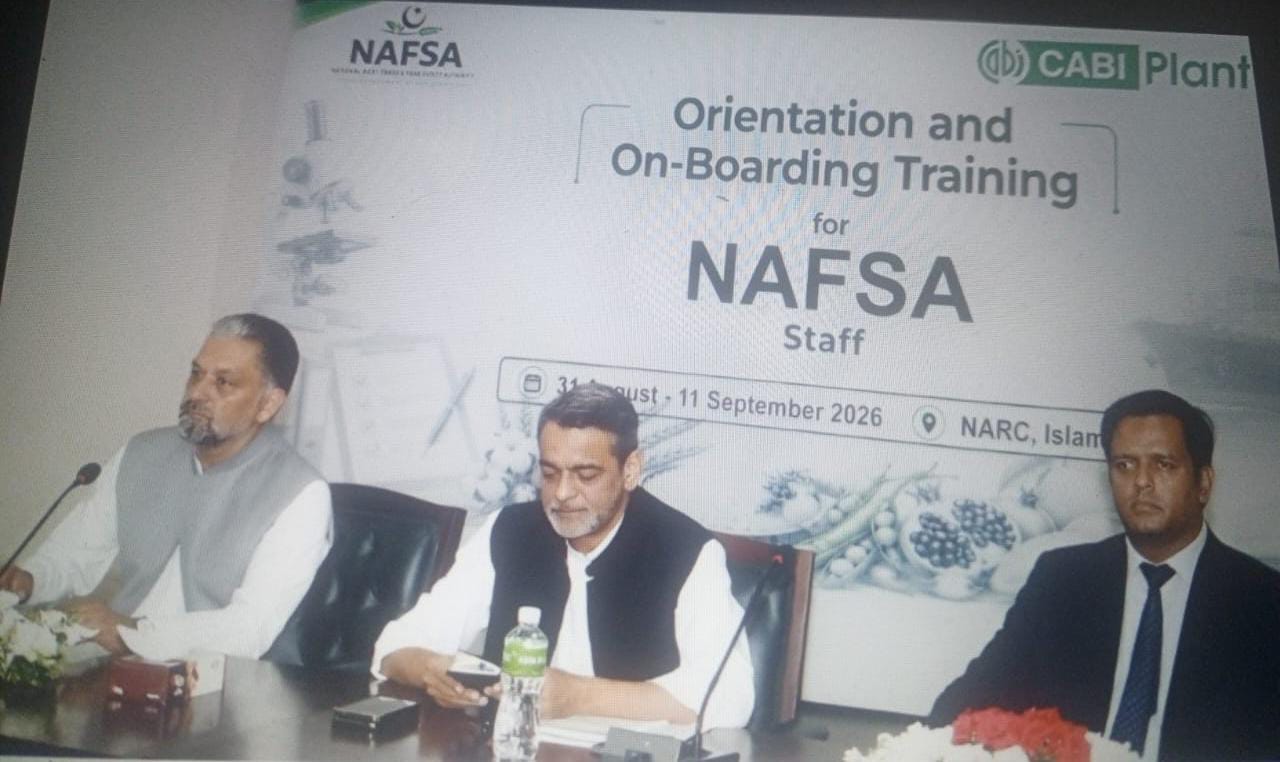
WNAM REPORT: The National Agri-Trade and Food Safety Authority (NAFSA), with technical support from CABI and contributions from relevant national institutions, is delivering a two-week Orientation and On-Boarding Training Programme for newly recruited Authorized Officers and Inspectors. The programme is designed to strengthen the practical and technical capacity required to carry out Pakistan’s plant-health, food-safety and agri-trade regulatory responsibilities effectively.
Running from 31 August to 11 September in Islamabad and Karachi, the programme covers 18 modules spanning plant-health regulation, sanitary and phytosanitary (SPS) compliance, Pest Risk Analysis (PRA), inspection and quarantine, food safety, pesticide regulation, laboratory systems, surveillance, crisis management and export certification. NAFSA is leading the programme as part of the induction of its new inspection workforce, while CABI and other technical partners are contributing expertise and practical support in their respective areas.
Addressing participants at the opening, Mr Ahmed Umair, Prime Minister’s Coordinator on Agriculture & Food Security and Chairman, Board of Governors, NAFSA, highlighted that the new workforce had been selected through a documented, committee-led recruitment process and would work within clearly defined operational and support structures. He stressed that performance, integrity, accurate documentation and technology-enabled operations would be central to the Authority’s work, with integrated systems supporting monitoring, accountability and consistent service delivery. Mr Umair also connected NAFSA’s role with Pakistan’s wider agricultural trade strategy, emphasizing the importance of harmonized standards, efficient certification and effective facilitation for farmers, exporters and international trading partners. He underscored the value of continued collaboration with government and international partners, including access to technical expertise, regional linkages and practical tools to support NAFSA during and beyond the onboarding programme.
Within this NAFSA-led programme, CABI is contributing specialist expertise, technical resource persons and learning materials in areas including the International Plant Protection Convention (IPPC), National Plant Protection Organization (NPPO) responsibilities, relevant International Standards for Phytosanitary Measures (ISPMs), import and export requirements, phytosanitary certification and risk-based regulatory decision-making.
Mr. Muhammad Imran Khan Mohmand, Director General, NAFSA: “Building the technical and practical capacity of our newly recruited officers from the outset is essential for effective regulation. This programme, supported by CABI and other technical partners, is helping our inspectors develop the knowledge and skills needed to protect plant health and food safety while facilitating compliant agricultural trade.”
Dr. Sabyan Faris Honey, Regional Director, CABI: “CABI is pleased to contribute technical expertise to this NAFSA-led initiative. Strong science-based inspection, pest-risk analysis and SPS compliance can help Pakistan protect crops and consumers while strengthening the foundations for safe and competitive agricultural trade.”
Inspectors are also receiving practical training in PRA, surveillance, Pest Risk Registers, pest reporting and emergency response. Hands-on sessions introduce CABI’s Horizon Scanning and PRA tools, which can support early identification of emerging pest threats and help officers use evidence to assess risks associated with commodities and pathways. Stronger capacity in these areas can contribute to protecting crops and agricultural production while supporting more science-based inspection and quarantine decisions.
The programme also links regulatory capacity with Pakistan’s agricultural trade ambitions. Better understanding of importing-country requirements, SPS measures, commodity-based PRA, risk-mitigation options and phytosanitary certification can help reduce the risk of non-compliant consignments and market rejections, while strengthening confidence in Pakistan’s regulatory and certification systems.
Food safety and pesticide regulation form another important part of the curriculum. Training covers pesticide residues, Maximum Residue Limits (MRLs), laboratory testing, registration, labelling, safety requirements and risk-based review of pesticides. Stronger regulatory oversight in these areas can contribute to safer food, more responsible pesticide use and better control of sub-standard or unregistered products, while supporting an enabling environment for safer and lower-risk crop-protection approaches, including biological alternatives.
The programme combines classroom learning with practical exercises, document reviews, case studies, digital-tool demonstrations, simulations, assessments and exposure to operational inspection procedures. This practical approach is intended to help newly recruited inspectors translate regulations and international standards into consistent decisions in inspection, certification and border-control settings.
The joint initiative brings together NAFSA’s regulatory leadership, CABI’s technical contribution and expertise from relevant national institutions. By strengthening the skills, accountability and operational readiness of the new inspection workforce, the programme can contribute to stronger plant-health protection, safer food systems, improved SPS compliance and more efficient agricultural trade for Pakistan.