
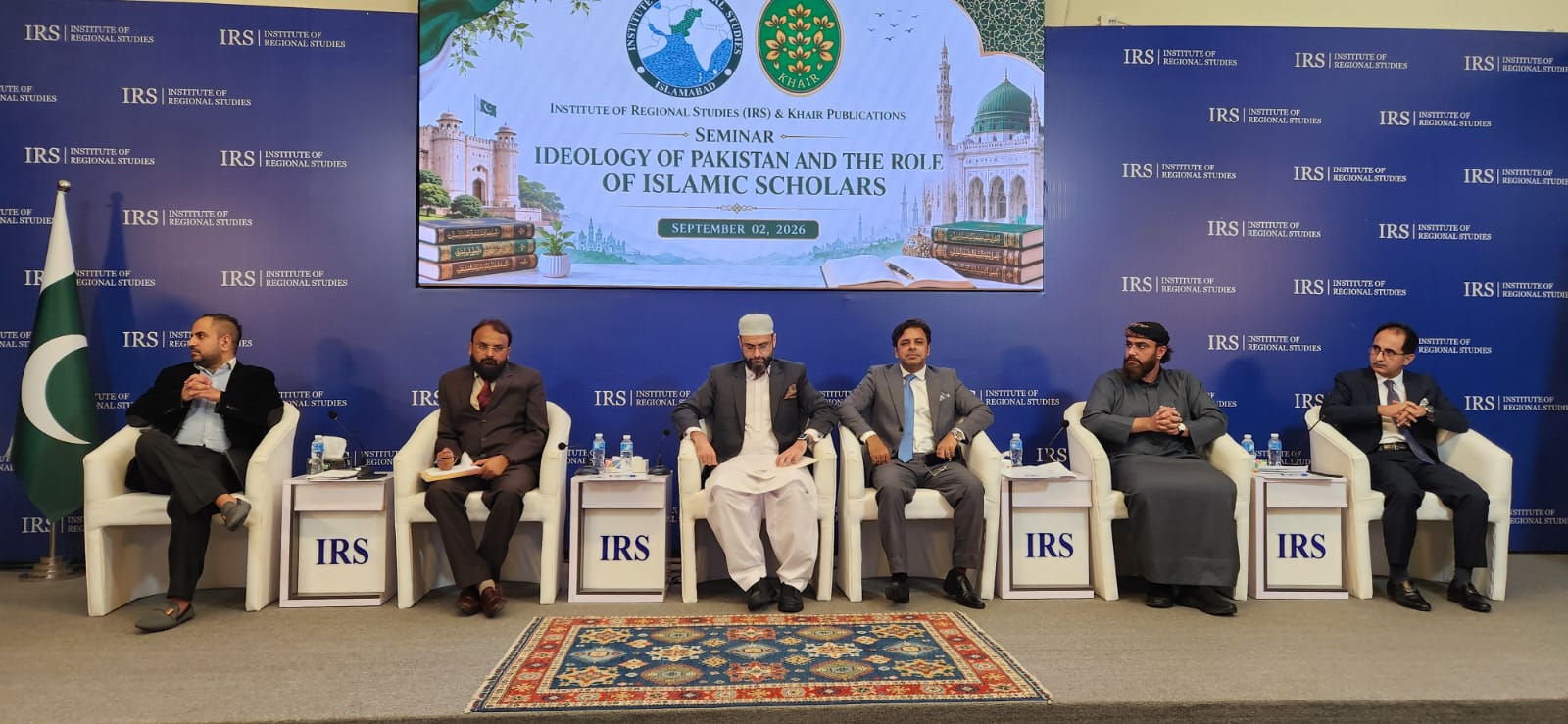
Islamabad ( WNAM REPORT ): The Institute of Regional Studies (IRS), Islamabad, in collaboration with Khair Publications, held a seminar titled “Ideology of Pakistan and the Role of Islamic Scholars” at IRS. The seminar examined the contributions of the Ulema and Sufis of the subcontinent, and their continuing relevance to Pakistan’s founding ideology and efforts to counter religious extremism.
In his welcome remarks, Dr. Rizwan Naseer, Senior Research Fellow and Director of Centre for Countering Terrorism and Violent Extremism Studies (CCTVES) at the IRS, highlighted the role of Islamic scholars in developing a shared Muslim identity through education, sermons, and writings. He described the Lahore Resolution of March 23, 1940, as the founding charter of the Pakistan Movement and noted the contribution of religious scholars and grassroots organizations alongside the Muslim League’s political leadership. He traced this legacy through the Objectives Resolution of 1949, its incorporation into the Constitution through Article 2A in 1985, and the 1973 Constitution’s declaration of Islam as the state religion. He highlighted Paigham-e-Pakistan, endorsed by more than 1,800 scholars in 2018, and the National Action Plan as efforts to counter extremist misuse of religious discourse.
Sahibzada Muhammad Saeed, International Relations Analyst, argued that Pakistan’s ideology cannot be fully understood without examining the historical contributions of the Ulema and Sufis. He presented the Two-Nation Theory, in part, as an extension of the intellectual legacy of Mujaddid Alf-i-Sani, which Allama Iqbal also recognized. He stressed that regional identities are not weaknesses and called for a shared national purpose that strengthens rather than suppresses local identities.
Mr. Sultan Nasir, scholar, poet, author, and civil servant, discussed the Sufis’ contribution to the ideology of Pakistan and the Two-Nation Theory. He highlighted the relationship among Sufi traditions, pluralism, and adherence to Shariah, citing contributions to poetry, music, and calligraphy by figures such as Ameer Khusrau, while emphasizing the preservation of Islamic fundamentals.
Dr. Syed Muhammad Abdul Rehman Shah, Islamic scholar and Certified SECP Islamic Finance Sharia Advisor, referenced Allama Iqbal’s Allahabad Address and the importance of a clear conceptual and constitutional framework for state survival. He recalled the Sunni Conference in Banaras and urged younger generations to study the Maktubat of Mujaddid Alf-i-Sani. He discussed Sirhindi’s opposition to Akbar’s Din-i-Ilahi, religious syncretism under Akbar and Jahangir, and the transformation from Wahdat-ul-Wujud to Wahdat-ush-Shuhud, calling for a stronger connection between this legacy and contemporary Pakistan.
Dr. Usman W. Chohan, Research Fellow at IRS, presented the concluding remarks, emphasizing the importance of critically engaging with Pakistan’s intellectual and ideological heritage. He underscored the need to connect historical scholarship with contemporary national challenges and reaffirmed the importance of dialogue among scholars, researchers, and policymakers in strengthening Pakistan’s intellectual discourse.
Sahibzada Pir M. Masoom Bhorvi delivered the vote of thanks, calling for renewed recognition of the role of Islamic scholars in Pakistan’s ideological development.
IRS, Khair Publications Seminar ‘Ideology of Pakistan and Role of Islamic Scholars’
11