
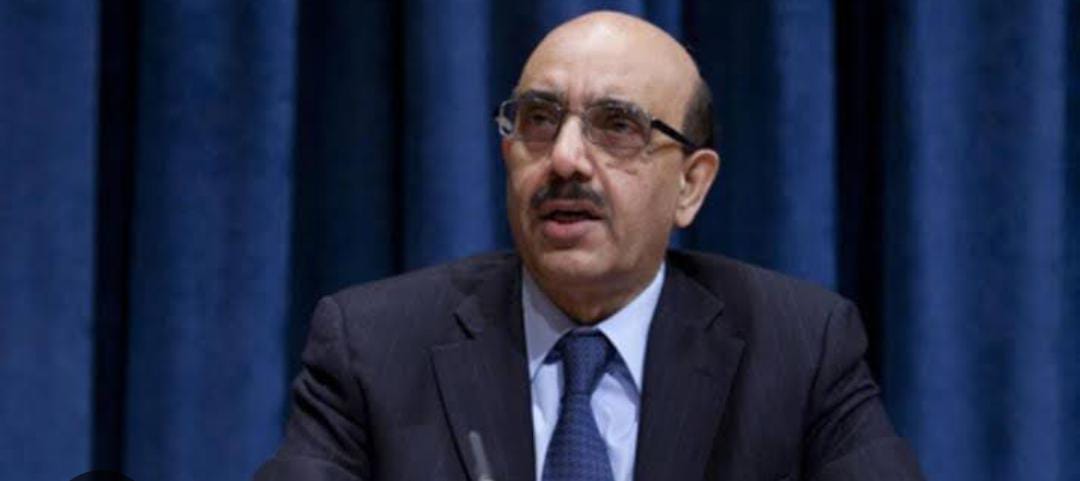
WNAM REPORT: Twenty-five years after the 9/11 terrorist attacks, the world must draw lessons from the devastating consequences of prolonged wars, military interventions and the stereotyping of Muslims, said Sardar Masood Khan, Former Ambassador of Pakistan to the United States, China and the United Nations, and former President of Azad Jammu and Kashmir.
Expressing solidarity with the victims of the attacks on the World Trade Centre, the Pentagon and the passengers of the aircraft involved, Sardar Masood Khan recalled the horrific moment of September 11, 2001, when he was posted in Washington, D.C. He noted that nearly 3,000 people were killed, including citizens of around 90 nationalities, and said Pakistan also lost citizens in the tragedy.
He said the immediate aftermath of 9/11 witnessed unprecedented international solidarity with the United States, including NATO’s invocation of Article 5, under which an attack on one member is treated as an attack on all. However, he observed that the goodwill generated at that time gradually diminished as the “war on terror” expanded beyond Afghanistan to Iraq and other theatres.
Sardar Masood Khan said incidents such as Abu Ghraib and Guantanamo Bay, followed by US military operations in Syria and Libya, contributed to the erosion of America’s international standing. He noted that, according to a Brown University study, the United States spent approximately $9 trillion on wars in Afghanistan, Iraq and elsewhere, while remaining embroiled in prolonged conflicts.
He contrasted this with China’s trajectory during the same period, saying that while the United States remained occupied with “forever wars,” China focused on economic development and emerged as the world’s second-largest economy.
Turning to Pakistan, Sardar Masood Khan said the country had paid an “astronomical” price for the war on terror, including severe reputational damage, economic losses and the loss of around 80,000 lives. He said official estimates put Pakistan’s economic losses at approximately $150 billion, while the actual cost was likely much higher. Despite the withdrawal of US and NATO forces, he noted, Pakistan continues to grapple with terrorism.
He described nation-building in Afghanistan as a failed experiment, stressing that societies must develop and build themselves rather than have external models imposed upon them. While Al-Qaeda was dismantled, he said, the prolonged intervention eroded American prestige, weakened its power and compromised its strategic priorities.
Sardar Masood Khan also highlighted the rise of Islamophobia after 9/11, saying Muslims increasingly came to be viewed through the prism of terrorism. He described such stereotyping as reductive and harmful to Western societies as well as the Muslim world.
He further pointed to the expansion of a culture of surveillance in Western societies, noting that US intelligence agencies had been monitoring Al-Qaeda and tracking Osama bin Laden even before 9/11, yet the attacks still exposed a massive intelligence failure.
“The enduring lesson of 9/11 is that terrorism must be confronted, but prolonged wars, military intervention, stereotyping and failed nation-building cannot provide a sustainable path to peace and security,” Sardar Masood Khan emphasized.