
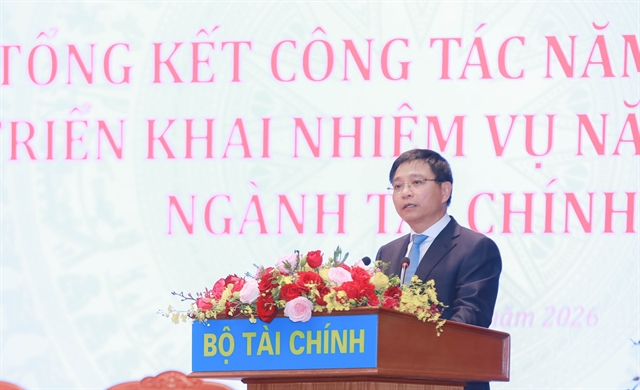
HÀ NỘI ( WNAM MONITORING): Buoyed by strong manufacturing output and record public investment, Việt Nam’s economy is estimated to have expanded by 8.02 per cent in 2025, placing the country among the world’s fastest-growing economies, while nominal GDP reached US$514 billion, ranking 32nd globally.
The figures were presented by Minister of Finance Nguyễn Văn Thắng at Thursday’s Government conference reviewing economic performance in 2025 and setting out priorities for 2026.
Thắng said Việt Nam’s average annual growth during the 2021-25 period stood at around 6.3 per cent, outpacing the previous five-year cycle.
Economic momentum was driven primarily by the processing and manufacturing sector, which grew by 9.97 per cent, its strongest showing since 2019 and the main engine of overall expansion.
GDP per capita rose to an estimated $5,026, about 1.4 times higher than in 2020, lifting Việt Nam into the upper-middle-income category ahead of official targets.
Growth was broadly shared across the country. Twenty of the 34 provinces and centrally governed cities recorded gross regional domestic product growth of 8 per cent or more, with six localities, including Quảng Ninh, Hải Phòng and Bắc Ninh, achieving double-digit rates.
Public finances remained within statutory thresholds. The budget deficit is estimated at 3.6 per cent of GDP, below the planned 3.8 per cent, while public debt is projected at about 36 per cent of GDP, well under the legislated ceiling of 60 per cent.
Public investment reached a record high in 2025, with around VNĐ1.08 quadrillion ($41 billion) allocated to development spending, bolstering infrastructure expansion and long-term growth capacity.
By the end of the year, Việt Nam had completed 3,335km of expressways, exceeding the original target by more than 800km. More than 1,700km of coastal roads have also been completed, meeting government benchmarks.
Looking ahead, the finance ministry said policy priorities would centre on sustaining growth momentum while safeguarding fiscal and financial stability.
Planned measures include further legal and institutional reforms in public finance and investment, targeted use of expansionary fiscal policy and continued digitalisation of tax and budget administration.
The ministry also aims to expand fully online public services and bring additional sector-specific databases into operation, in line with the country’s digital transformation agenda.
Thắng added that Việt Nam would continue developing its stock market and government bond market as key channels for medium- and long-term capital mobilisation, while strengthening coordination between fiscal and monetary policy to support growth and macro-economic stability.