
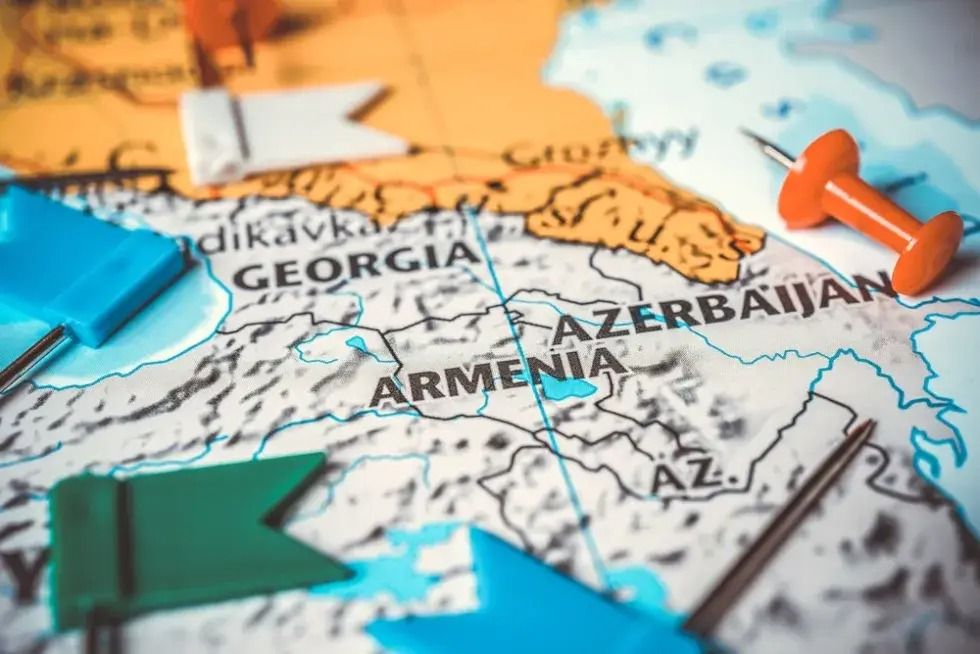
WNAM REPORT: The war between Iran, Israel, and the United States extends beyond these three nations, posing wider implications for both the Middle East and the South Caucasus. These regions account for a critical share of global oil transportation in terms of both production and export. Amid growing instability in the Middle East, particularly the disruption of shipping through the Strait of Hormuz, global energy markets are increasingly looking for alternative sources and supply routes. As a result, attention has shifted toward the South Caucasus and Central Asia. This raises an important question whether these regions are affected by the ongoing conflict.
Analysts suggest that while short-term gains are possible, long-term benefits are unlikely. A report on the South Caucasus by the Dutch financial institution ING Group indicates that rising oil and gold prices, driven by escalating tensions in the Middle East, could provide temporary support to the external balances of Azerbaijan, Kazakhstan, and Uzbekistan, while placing additional pressure on energy-dependent Armenia. Thus, while Azerbaijan and several Central Asian states may benefit from favorable commodity prices in the short term, Armenia faces increased economic risks.
According to the bank’s analysts, every sustained $10 increase in oil prices per barrel adds approximately $6 billion to Kazakhstan’s annual export volume and around $3 billion to Azerbaijan’s exports, equivalent to 1.8% and 4% of GDP respectively. From a fiscal perspective, the same increase in oil prices provides both countries with about $1.5 billion in additional fuel revenues, amounting to roughly 0.5% of Kazakhstan’s GDP and 2% of Azerbaijan’s GDP.
Recent market data illustrate this trend. The price of Azeri Light crude delivered on a CIF basis at Augusta Port rose by $5.61, or 6.82%, reaching $87.90 per barrel compared with the previous trading session. Meanwhile, Azeri Light exported via Ceyhan Port on an FOB basis increased by $5.34, or 6.82%, to $83.69 per barrel.
Other global benchmarks recorded similar gains. Urals crude rose by $5.04, or 10.75%, reaching $51.94 per barrel, while Brent crude produced in the North Sea climbed by $6.55, or 8.07%, to $87.71 per barrel. Notably, Azerbaijan’s 2026 state budget was calculated based on an average oil price of $65 per barrel, meaning current market prices significantly exceed the government’s baseline forecast.
Meanwhile, rising commodity prices are not limited to oil. Central Asian economies may also benefit from higher gold prices. For example, analysts note that a $1,000 increase in the price of gold per ounce could bring Uzbekistan approximately $4 billion in additional export revenue, equivalent to about 2.7% of the country’s GDP.
However, despite these potential gains, experts caution that the long-term outlook for the South Caucasus and Central Asia remains uncertain. Prolonged instability in the Middle East could disrupt global trade routes, financial flows, and supply chains. Although higher oil prices may temporarily boost export revenues for energy producers such as Azerbaijan and Kazakhstan, sustained geopolitical tensions may undermine broader economic stability.
One of the main concerns is the continued uncertainty surrounding maritime transportation through the Strait of Hormuz, one of the world’s most critical energy transit routes. Any prolonged disruption could trigger volatility in global markets, affect shipping costs, and weaken global economic growth.
Qatar’s Energy Minister Saad al-Kaabi warned that escalating tensions in the Middle East could “bring down the economies of the world,” adding that oil prices could rise to as much as $150 per barrel within two to three weeks if tankers and commercial vessels remain unable to pass through the Strait of Hormuz.
In addition, the region’s economies remain closely integrated into global supply chains. According to ING, countries of the former CIS have limited direct trade with the main parties to the conflict. However, their reliance on imports from the European Union and their economic links with partners such as Turkiye, Iran, and Gulf states represent potential vulnerabilities.
Another important factor is investor confidence. Persistent geopolitical instability in nearby regions may discourage long-term foreign investment in infrastructure, energy, and transport projects across the South Caucasus and Central Asia. Many of these initiatives rely on stable geopolitical conditions and predictable trade routes.
Therefore, while the current crisis may provide short-term economic advantages for certain commodity-exporting countries, analysts stress that a prolonged conflict would ultimately create greater economic risks than benefits for both the South Caucasus and Central Asia. Stable regional security and predictable global markets remain far more important for the sustainable development of these economies than temporary gains driven by geopolitical tensions.