
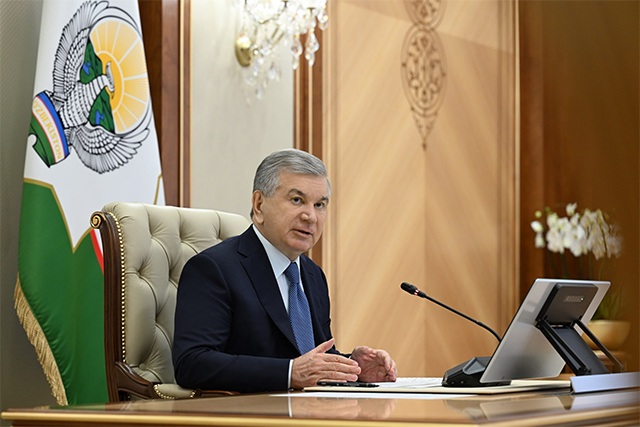
Tashkent( WNAM MONITORING): President Shavkat Mirziyoyev reviewed a package of proposals aimed at improving the efficiency of land use and further advancing the country’s land policy.
During the presentation, it was noted that over the past five years Uzbekistan has carried out a large-scale reform of land relations. The authority of local governors to allocate land has been abolished, and land distribution has been transferred to an auction-based mechanism. Over this period, 616,300 hectares of land have been allocated through auctions, generating 1.4 trillion soums in budget revenues. According to the data presented, the emergence of more efficient land users has tripled the доходность per hectare, reaching 50–60 million soums. Total production generated on these lands is estimated at 539 trillion soums, with exports amounting to US$2.1 billion.
Despite these results, unresolved issues remain. It was noted that the independence of land tenants is still limited, while more than 117,600 hectares remain unused. In response, plans include introducing a new agricultural land lease system and placing an additional 100,000 hectares up for auction this year under revised conditions aimed at improving resource efficiency.
Successful practices allowing tenants to independently select crops were highlighted in several regions, including the Fergana Valley, Jizzakh and Tashkent regions, and Karakalpakstan. In 2025, high-yield and export-oriented crops were cultivated on parts of these lands, generating export potential of US$150 million. Authorities stressed the need to expand this model and strengthen the economic independence of land users.
Proposals also include developing industrial plantation and livestock projects with land plots ranging from 50 to 500 hectares. Each region is expected to launch at least five major projects supported by state measures, including infrastructure financing, concessional loans for up to seven years with a three-year grace period, interest rate subsidies, and partial compensation for packaging costs.
Special attention was given to attracting advanced foreign agricultural technologies while safeguarding national interests. Proposals were considered to revise the framework for granting land to foreign investors, including mechanisms for subleasing through regional directorates for projects exceeding US$10 million. These measures would involve degraded and unused lands.
Another proposal involves restricting participation in agricultural land auctions to domestic farmers and entrepreneurs, as well as establishing a unified lease term of up to 49 years for industrial and construction projects. Plans also include simplifying lease extension procedures through digital services and integrating cadastral and tax systems, allowing agricultural leases to be extended up to 30 years in the absence of violations.
Existing paper-based procedures for changing land categories and calculating compensation were criticized for causing delays and reducing investment attractiveness. In response, authorities have tasked agencies with fully digitalizing these processes and introducing a system for evaluating land-use efficiency based on comprehensive criteria.
The meeting also addressed expanding the use of land lease rights as a financial instrument, including their application as collateral in lending, leasing and other financial operations. Additional proposals focused on simplifying re-leasing procedures and clarifying legal norms governing land relations.
In conclusion, the need to strengthen accountability for illegal land transactions and enhance oversight measures was emphasized, along with optimizing procedures for land acquisition for public needs. The President issued instructions to accelerate digitalization, improve transparency and continue advancing land reform.