RIYADH ( WNAM MONITORING): As Hajj season brings millions of people into the holy sites, its environmental impact is most visible in the volume of waste generated over a short period.
According to official data from the National Center for Waste Management (MWAN), during last year’s Hajj season household waste totaled 93,566.4 tonnes, while commercial waste reached 6,526.6 tonnes.
Construction and demolition waste accounted for a further 189,729.1 tonnes. Overall, the total waste recorded over the season was 348,382.1 tonnes, underscoring the need for Saudi Arabia to intensify efforts to make Hajj more environmentally friendly through waste-reduction and recycling initiatives.
The scale of those totals has sharpened attention on what can realistically be reduced, reused, or diverted during peak pilgrimage days, particularly for waste streams that surge inside the camps and service areas.
With renewables not currently planned as part of Hajj sustainability efforts this year, MWAN’s focus has centered on waste-diversion initiatives and on-the-ground programs that can be implemented at scale during the season.
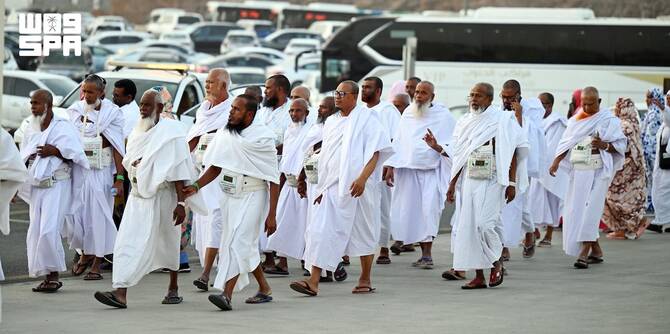
A representative of the center told Arab News that waste totals over the past five years show the scale of the challenge, with discarded ihram garments rising from 14 tonnes in 2022 to 62 tonnes in 2025, while textile waste increased from 10 tonnes to 13 tonnes.
There are no plans to use renewable energy such as solar during Hajj this year, but the representation clarified that “among the most prominent innovative practices and initiatives organized and developed by the MWAN during the (2026) Hajj season, in cooperation with the relevant entities, are initiatives to preserve blessings and make use of surplus food.”
Those initiatives are contributing to reducing waste and improving the efficiency of managing organic waste in line with environmental sustainability principles.
In pilgrim camps, where food distribution and consumption can generate significant surplus and organic waste, MWAN’s approach also relies on partners beyond the public sector.
According to an official statement, the center is also working to engage the non-profit sector as an effective partner in the transformation journey of the waste-management sector, strengthening its contribution to increasing the rates of diverting organic waste away from landfills.
“This is in addition to maximizing its awareness-raising role inside the camps of domestic and international pilgrims by spreading awareness of the importance of preserving food and reducing food waste,” the statement added.
MWAN’s initiative also includes empowering volunteer teams, organizing their roles in coordination with environmental supervisors, and providing them with the knowledge and skills needed to measure impact and achieve the initiative’s targets.
Alongside waste-management measures, the Kingdom is also investing in environmental improvements.
Under the Green Holy Sites initiative, Kidana Development Co., a subsidiary of the Royal Commission for Makkah City and Holy Sites, has tripled the amount of green space this year. More than 60,000 trees have been planted across the holy sites in Makkah as part of a greening drive aimed at enhancing sustainability while improving the pilgrimage experience.
With waste volumes remaining high, Saudi Arabia’s Hajj sustainability approach is increasingly defined by targeted interventions, such as diverting key waste streams through specialized initiatives, reducing organic waste through food-surplus programs, and expanding green spaces across the holy sites to support one of the world’s largest annual gatherings.