
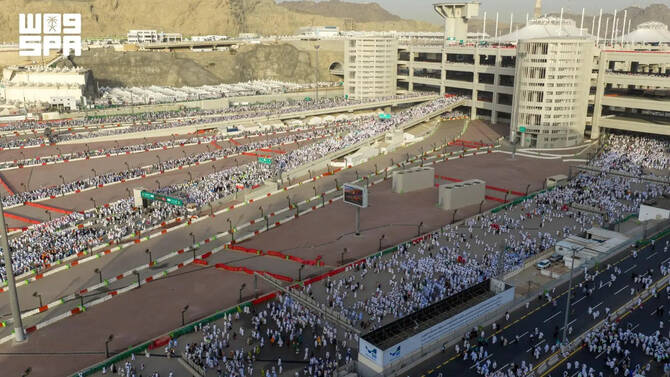
MINA ( WNAM MONIORING): The modern Jamarat facility stands as one of Saudi Arabia’s most significant development projects in the holy sites, representing a major leap in crowd management built to the highest international engineering and operational standards.
With a capacity exceeding 300,000 pilgrims per hour, the facility enables the safe and smooth movement of crowds during the stoning ritual at the peak of the Days of Tashreeq.
Each year, large groups of pilgrims converge on the Jamarat area in Mina to perform the ritual in a deeply spiritual scene reflecting obedience and adherence to the teachings of Prophet Muhammad.
The site has undergone a dramatic transformation over the years. Previously, the Jamarat consisted of small stone pillars surrounded by narrow spaces and limited pathways, leading to severe congestion as pilgrim numbers grew.
Today, it is a fully integrated engineering complex spanning five floors, 950 meters in length and 80 meters in width. The facility includes 386 escalators across 11 escalator buildings, multi-directional bridges, dedicated entry and exit routes, emergency exits, and advanced cooling and monitoring systems.
The complex operates through a sophisticated management system supported by specialized field teams working around the clock to ensure safety and provide medical and guidance services in coordination with security and service agencies. Multilingual guidance screens and modern surveillance cameras further improve crowd flow and pilgrim safety.
Kidana Development Company, the executive arm of the Royal Commission for Makkah City and Holy Sites, carried out extensive maintenance and preparatory work to enhance the facility’s infrastructure and operational readiness for Hajj.
The company operates an integrated technological system featuring 340 escalators and 682 digital surveillance cameras to monitor crowd density and ensure smooth movement. It has also deployed 228 golf carts to transport pilgrims and workers within the facility and surrounding areas.
Safety preparations included high-readiness firefighting systems comprising 295 fire boxes, 1,078 fire extinguishers and more than 3,350 automatic sprinkler units to strengthen rapid emergency response capabilities.
Technical upgrades also covered the operation and maintenance of 456 air-conditioning units to maintain suitable conditions for pilgrims, along with more than 74,000 lighting units across all floors, corridors and surrounding plazas.
Engineering maintenance extended to bridges, ramps, tunnels, basements and surrounding plazas, as well as escalator buildings, which were fully repainted to maintain operational and visual readiness.
The preparations also included maintenance of more than 1,216 informational and directional signs to improve pedestrian guidance, repairs to more than 520 canopies and metal structures, maintenance of four main tents on the fourth bridge, and cleaning of rainwater drainage channels and culverts in plazas and parking areas.
More than 28,000 plastic barriers were also installed to regulate crowd movement and direct pedestrian flow as part of efforts to provide pilgrims with a safe and seamless ritual experience.
The Jamarat facility continues to serve as one of the flagship development projects in the holy sites, reflecting Saudi Arabia’s commitment to advanced infrastructure, operational excellence and the safe management of millions of pilgrims during Hajj.