
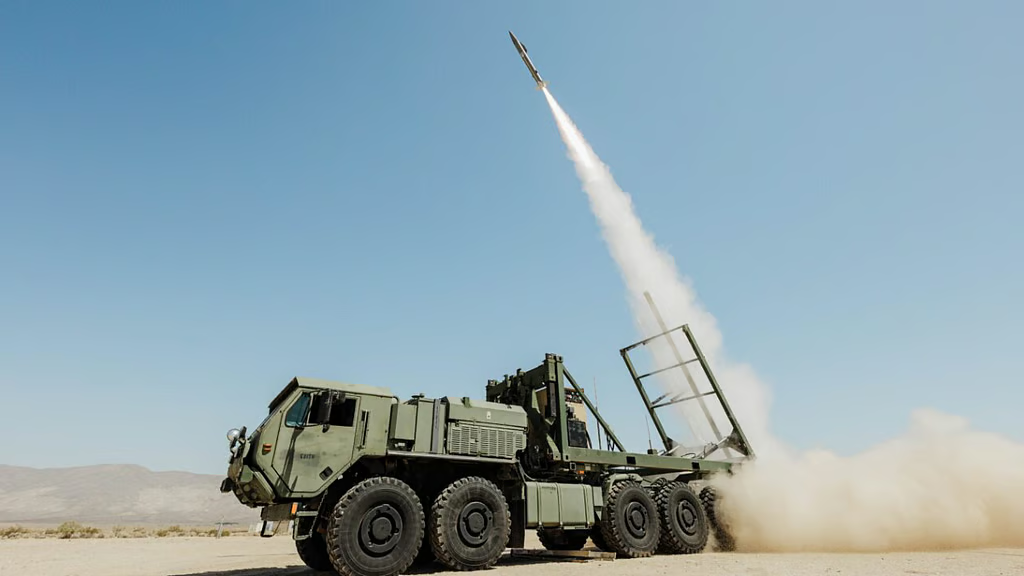
The race for hypersonics is sometimes called an arms race for speedier missiles. But in fact it is a battle for strategic position. But the importance of hypersonic is not so much about its speed as that it poses a threat to the precepts of deterrence, missile defence, and crisis stability. The U.S., China and Russia are spending billions of dollars on hypersonics, and these weapons are quickly becoming a twenty-first-century military staple.
The concept of travelling at hypersonic speeds isn’t new. The X-15 aircraft was an experimental aircraft that was flown during the Cold War to achieve speeds above Mach 6. But the goal was not to be fast. The development of ballistic missiles, capable of hypersonic velocity, had been going on for decades. What military planners wanted was a system that would be fast, accurate, flexible and be able to outflank the ever more sophisticated missile defense systems.
Two types of weapons have helped to accomplish this objective: The first one is referred to as the Hypersonic Glide Vehicle, a rocket launched vehicle that separates from the launching rocket and glides through the atmosphere, towards its target. Some of the more well-known examples are the Russian Avangard and Chinese DF-17. The second is the Hypersonic Cruise Missile which is powered by cutting edge scramjet engines which enable sustained hypersonic flight. The Zircon missile of Russia and America’s still-to-be seen Hypersonic Attack Cruise Missile exemplify this technology. These systems can change their flight path over the course of the flight making their path highly unpredictable unlike the conventional ballistic missile systems.
This is important to note. Normal ballistic missiles have a flight path that can be generally determined once it is detected. However, hypersonic weapons add an element of doubt to that. They fly through the air, navigate their way and move around on the air. This has placed a strain on the existing missile defence systems, for which this is not the typical scenario.
The issue of hypersonic weapons has turned from a technological issue to a geopolitical one. Russia sees Avangard and Kinzhal as instruments to maintain strategic parity with the allies of NATO and to overcome their missile defenses. China considers hypersonic weapons to be part of its overall A2/AD strategy, especially in the Western Pacific and around Taiwan. The U.S. is not willing to let a possible capability gap go unfilled, and has stepped up development efforts like Dark Eagle and Conventional Prompt Strike to ensure credibility of its deterrent.
These investments are being made for sound strategic reasons. Survivability is as important in modern conflicts as is destructive capability. A weapon that doesn’t reach its target will do little to deter. Hypersonic systems have the potential to breach more and more advanced defence networks, leaving missile shields, which have a key role in military planning for decades, deserving of skepticism. Their worth is thus not in their capacity to destroy but in their capacity to make an enemy believe that destruction is impossible.
However, as hypersonics has become a popular field, much hype has also emerged. These weapons are often referred to as “unstoppable” or “unbeatable. These sorts of descriptions are misleading. In the history of the military, there are few technologies that could not be defeated. All penetration leads to counterattack. Defensing hypersonic threats is not a novel challenge, as space based
tracking systems, glide phase interceptors, artificial intelligence based sensors and directed energy weapons are being developed. The ongoing race is more about hypersonic weapons itself than that. It’s a broader and more abstract contest between offensive and defensive technologies.
This is being underscored by recent wars. Russia’s use of Kinzhal missiles in Ukraine highlighted its impressive capabilities and also put its claims of invulnerability to the test. Even the most advanced missiles, which were supposed to have been picked up by the advanced air defence system, were reportedly hit by the missiles and damaged. The experiences serve to make an important point. Worryingly, hypersonic weapons are not changing the nature of warfare, since there is no way to defeat them. They are changing the nature of war as they make defence planning more complicated and speed up the decision making process.
One of their greatest worries is the effects they have on strategic stability. The stability of this period of nuclear arms depended on the predictability of behaviour, on clear signals, and on ample time for leaders to see what was happening. These are all assumptions that are not met by hypersonic weapons. Their speed reduces the decision making time. They are also very manoeuvrable, causing uncertainty about what they are going to hit. They can carry both conventional or nuclear payloads, adding to the uncertainty in times of crisis. All of these contribute to the risk of escalation for reasons of fear, confusion or misunderstanding, not intentional.
This is really more than a technological achievement, as it is the promise of hypersonic weapons. It also captures an evolving international security context in which geopolitical parties increasingly are focused on securing military gains through innovation in the application of military power, and not through sheer numbers. Hypersonic systems could be one of the most dominant weapons of power in the twenty first century just as nuclear weapons did in the twentieth century. The impact on deterrence or on global stability will depend not just on the advances in technology, but also upon the states’ desire to evolve new norms, confidence building measures, and arms control frameworks that can cope with this new reality. In the hypersonic race it’s not just about the speed. It’s a matter of power and perception, and the future balance of deterrence in a world that’s becoming much more competitive. (The Opinions expressed in this article are not necessarily the view point of WNAM)