
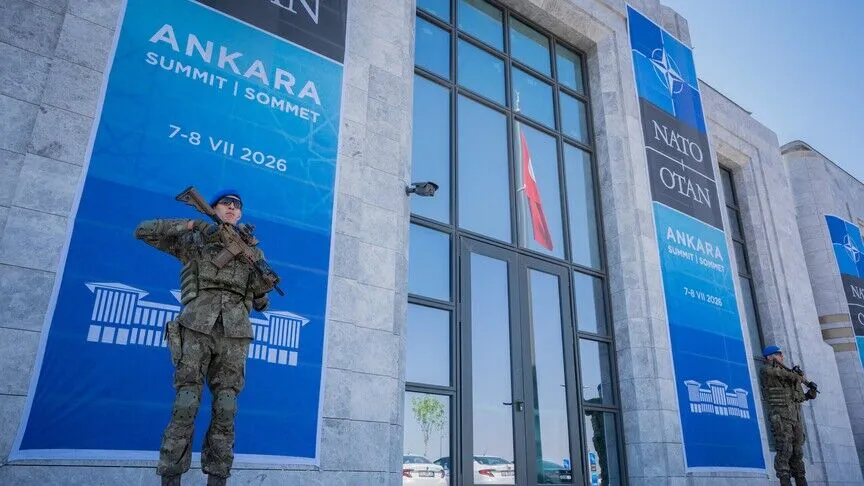
ANKARA ( WNAM MONITORING): Türkiye will host a NATO Summit for the first time in 22 years next week, bringing world leaders to Ankara at a time of deepening security challenges and shifting burden-sharing within the alliance.
Following the 2004 NATO Istanbul Summit, which became one of the key meetings in the alliance’s post-Cold War transformation, Türkiye will once again host NATO leaders in what officials describe as an “age of uncertainties.”
The 36th NATO Summit of Heads of State and Government, to be held in the capital Ankara, is seen as critical for the future of the alliance and the broader global security architecture.
The Ankara Summit is expected to make Türkiye’s diplomatic weight more visible, serving not only as a gathering of world leaders but also as a platform demonstrating Ankara’s growing influence within NATO.
The summit is expected to highlight Türkiye’s military contribution, defense industry, crisis-management capacity and leader-level diplomacy.
Burden-sharing will be one of the main items on the summit agenda.
Leaders from NATO’s 32 member countries, including US President Donald Trump, as well as foreign and defense ministers, are expected to gather in Ankara.
In addition to NATO members, the summit will also be attended by Indo-Pacific partners Australia, Japan, New Zealand and South Korea, bringing Euro-Atlantic and Indo-Pacific security agendas to the same table.
Defense industry forum
The NATO Summit Defense Industry Forum, held in recent years as a key side event, will take place in Ankara as part of the summit program.
A foreign minister-level engagement with Istanbul Cooperation Initiative partners will also be held. The initiative was launched at the NATO Istanbul Summit in 2004 and includes Bahrain, Kuwait, Qatar and the United Arab Emirates.
Türkiye will host leaders of NATO’s 32 member countries, along with invited leaders, nearly 100 ministers, senior diplomats, representatives of international organizations and thousands of foreign guests.
Nearly 3,000 journalists, television crews, photojournalists, digital media representatives and international broadcasters from around the world have applied for accreditation to cover the summit.
A total of 56,288 security personnel will be deployed, including 48,841 police officers and 7,447 gendarmerie personnel.
In addition, 639 personnel will conduct round-the-clock cyber patrols to combat cybercrime and security threats.
Participants will be served through Ankara Esenboga Airport, Murted Air Base and a recently redeveloped facility — the former Etimesgut Air Base, now designated simply as Ankara Airport.
Several side events will be held on the margins of the summit, including the NATO Parliamentary Summit at Dolmabahce Palace in Istanbul on June 28-29, an informal reception for allied permanent representatives and ambassadors resident in Ankara on July 6, the SAM-Chatham House Workshop on July 6, panels titled NATO Ankara Summit Dialogues on July 7, the SETA-MSC event Allies at Ankara on July 7-8 and the Transatlantic Policy Planners’ Roundtable on July 7-8.
2004 Istanbul Summit: turning point in NATO transformation
The Istanbul Summit, the 17th summit of heads of state and government in NATO’s 55-year history, is regarded as an important turning point in the alliance’s transformation process.
In addition to the 26 NATO members at the time, the summit was attended by heads of state and government, foreign and defense ministers, and civilian and military officials from 20 partner countries.
The meetings, at which 46 countries were represented, played an important role in shaping the international security agenda.
The Istanbul Summit drew attention for decisions to expand NATO’s role in Afghanistan, provide training support to Iraqi security forces, and welcome seven new members — Bulgaria, Estonia, Latvia, Lithuania, Romania, Slovakia and Slovenia — to their first NATO summit as full allies.
The seven countries officially became members on March 29, 2004 as part of NATO’s largest wave of enlargement after the Cold War.
The summit consisted of four main meetings: the North Atlantic Council (NAC), the NATO-Russia Council, the NATO-Ukraine Commission and the Euro-Atlantic Partnership Council (EAPC).
The summit brought together major world leaders in Istanbul, including then-US President George W. Bush, British Prime Minister Tony Blair, French President Jacques Chirac, German Chancellor Gerhard Schroder, US Secretary of Defense Donald Rumsfeld, Afghan President Hamid Karzai, Georgian President Mikheil Saakashvili, Iraqi Foreign Minister Hoshyar Zebari, Italian Foreign Minister Franco Frattini and senior representatives from many countries.
A NATO-Russia Council meeting was also held as part of the summit, but Russian President Vladimir Putin did not attend.
The meeting drew less attention than expected due to Putin’s absence and the lack of progress on issues concerning the withdrawal of Russian troops from Georgia and Moldova.
Then-Czech President Vaclav Klaus was also unable to attend because of a government crisis in his country, while Albania, Croatia and Macedonia, which were seeking NATO membership, were not given accession dates.
Decisions were taken to expand NATO’s presence in Afghanistan, end its operation in Bosnia and Herzegovina, provide training support to Iraqi security forces and strengthen the alliance’s operational capabilities. The launch of new partnership initiatives was also agreed.
Former US President Bush arrived in Ankara one day before the summit and held talks with Turkish officials. On the final day of the summit, in a speech at Galatasaray University, he said the US opposed Türkiye being separated from Europe by artificial boundaries.
Extraordinary security measures
Extraordinary security measures were also taken for the 2004 summit. Istanbul was protected by a security cordon during the event, which was attended by about 3,000 delegates and 3,500 members of the press.
Because of the NATO summit, the Grand Bazaar was closed to visitors for certain periods, while Turkish official post and telegraph organization, PTT prepared special-date stamped envelopes and postal materials in commemoration of the event.
During the summit, a major development affecting the international public came from Iraq.
The transfer of sovereignty in Iraq to the interim government earlier than planned was announced to the world while leaders were meeting in Istanbul.
Thus, while NATO leaders were discussing future security policies in Istanbul, one of the most important developments in world politics was taking place at the same time.
The 2004 Istanbul NATO Summit went down in history as one of the most important summits in NATO history in terms of decisions taken, international participation and its impact on security policies.