
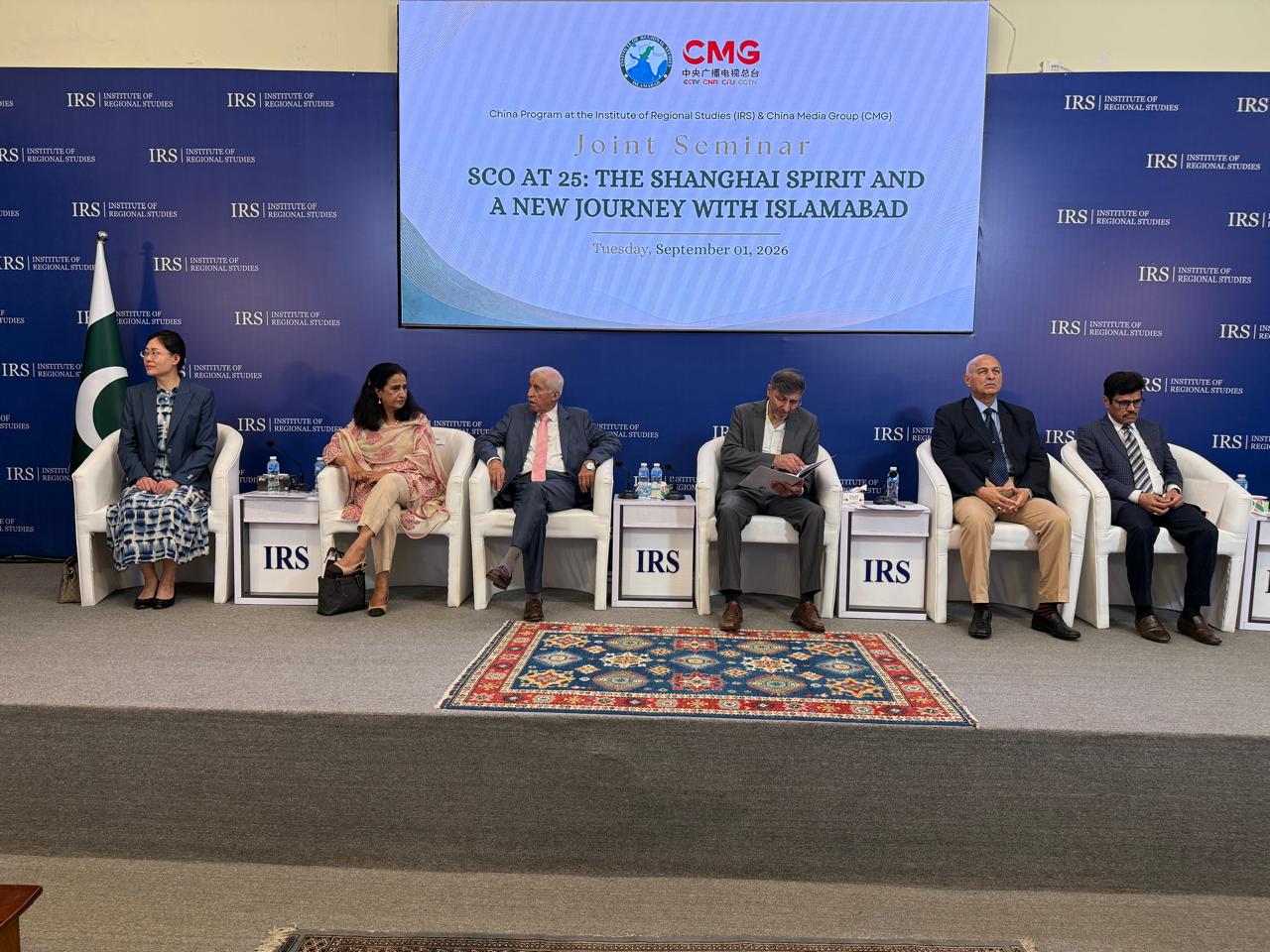
WNAM REPORT: A joint seminar, “SCO at 25: The Shanghai Spirit and a New Journey with Islamabad,” brought together federal ministers, senators, ambassadors, academics, think-tank representatives and media practitioners to reflect on the Shanghai Cooperation Organisation’s (SCO) 25-year evolution, the Shanghai Spirit, and Pakistan’s assumption of the SCO chairmanship. The seminar was organised by the China Program of the Institute of Regional Studies (IRS) in collaboration with China Media Group (CMG).
Mr. Qaiser Ahmed Sheikh, Federal Minister and Chairman, Board of Investment, was the Chief Guest. Senator Mushahid Hussain Sayed, Chairman, Pakistan-China Institute, delivered the keynote address, while Ms. Zhuang Xinyan, Counselor at the Embassy of the People’s Republic of China, delivered special remarks.
Ambassador Jauhar Saleem, President IRS, delivered the opening address. He described SCO’s 25 years as a worthwhile journey towards a more peaceful, secure and connected world. He noted that the SCO now spans 36 million square kilometres and represents 3.4 billion people, having reached this point “without a treaty of alliance, a standing army, or a single dominant vote.” Drawing upon his diplomatic experience, he said that most international formulations do not survive the test of time, but “the Shanghai spirit has not only survived, but also prospered.” He attributed the SCO’s resilience to the Shanghai Spirit, which does not require member states to fit any particular mould. Against the backdrop of the wars in Ukraine and West Asia and last year’s Pakistan-India conflict, he said the SCO could serve as “a factor of stability, a factor for peace and a factor of development.”
Federal Minister Qaiser Ahmed Sheikh said the SCO had evolved from a confidence-building mechanism into a platform encompassing security, business, economic cooperation and people-to-people contacts, representing around 25 per cent of the global economy. He attributed this evolution in part to China’s approach to consensus-building. With Afghanistan, India and Pakistan all members, he said, the SCO provided an important platform for the region to sit together and seek solutions to shared challenges.
Recalling his many visits to China since 1972, he highlighted the country’s emphasis on education and its achievement in lifting around 800 million people out of poverty. “How they did it, we have to study that,” he said. Noting that Pakistan spends more on defence than education, he called for greater emphasis on consensus-building in educational institutions and across society.
Senator Mushahid Hussain Sayed said the summit came at a time of “transformation, turbulence and transition,” marked by the unravelling of the Western-led order. Referring to Allama Iqbal’s vision of the rise of Asia, he described the SCO as providing the Global South with “a strategic option,” in contrast to alliance-based arrangements such as the Quad and AUKUS. He also highlighted the organisation’s potential to make landlocked Central Asian states “land-linked” through connectivity with Gwadar, describing the SCO as “the institutional voice of the Asian century.”
Ms. Zhuang Xinyan said China, as a founding member of the SCO, had helped “forge a new path of regional cooperation,” with seven cooperation platforms generating more than 160 projects. Describing Pakistan’s chairmanship as “a major event for the SCO family and a significant milestone in Pakistan’s diplomacy,” she called for upholding the Shanghai Spirit, strengthening security cooperation against the “three evil forces,” pursuing high-quality Belt and Road cooperation, and upholding true multilateralism. She reaffirmed that China, as Pakistan’s “iron brother,” stood ready to fully support Pakistan’s chairmanship.
Ambassador Naela Chohan described the Shanghai Spirit as “a beautiful spirit of friendship” and traced the SCO’s evolution from a border-security mechanism into a major Eurasian platform. Recalling Pakistan’s progression from observer status in 2005 to full membership in 2017, she said integrating CPEC with SCO transit routes could make “the new journey with Islamabad positive, fruitful and progressive.”
Dr. Muhammad Khan said the SCO had never sought to become a military organisation and was contributing to a vision of a multipolar world. He described Pakistan’s chairmanship as “a challenging task, a daunting task.”
Dr. Shafqat Munir Ahmad of SDPI called for the SCO to move from confidence-building and institution-building towards “delivery,” urging Pakistan to advance practical cooperation on counter-terrorism, water, climate, energy and food security.
In his concluding remarks, Dr. Usman Chohan of IRS said the world was increasingly confronted with competing conceptions of security and endorsed the Shanghai Spirit as “the human spirit.” Mr. Tasawar Zaman Babar of CGTN Urdu presented the vote of thanks.