
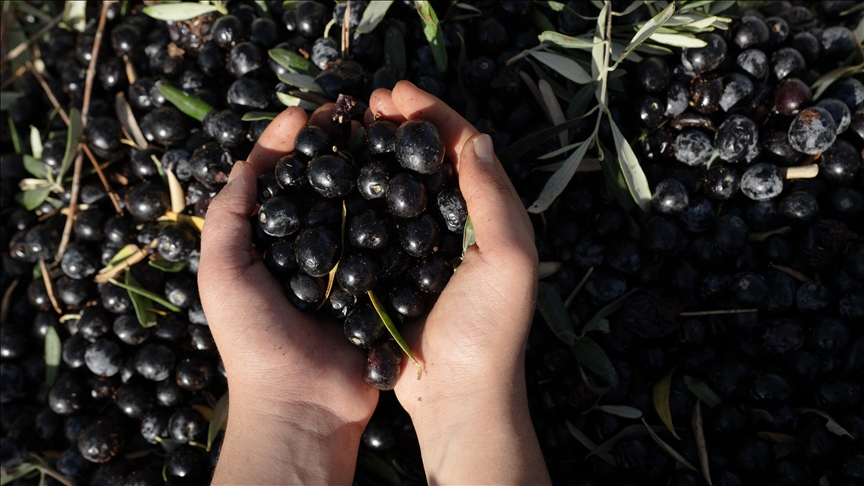
WNAM REPORT: Türkiye surpassed Italy in the production of olive and olive oil, becoming the second largest producer after Spain, according to the International Olive Council (IOC).
Jaime Lillo, executive director of the Madrid-based IOC, told Anadolu that Türkiye is now an indispensable country for the olive sector.
“Looking at the data from the last five seasons (2020–2025), Türkiye seems to have consolidated its position as the world’s second-largest producer of olive oil and table olives,” he said.
“Türkiye already makes a great contribution to the olive community,” he noted.
“As we said, it is a major olive oil and table oil producer, not only for its population but also for the growing international market,” he said. “Türkiye is already contributing to global health, as people consume olive oil and table olives worldwide, but also to the planet via the groves that have grown and continue to grow in Türkiye.”
Lillo stated that Türkiye has become the world’s largest producer of table olives, surpassing Egypt, with its “extraordinary season in 2024–25.”
He noted that global olive oil exports rose 25% in the 2024–25 season, with Türkiye contributing to the rise with a 132% increase.
Lillo noted that Türkiye has been represented by an executive director deputy within the IOC since 2023, and has been “very dynamic, very supportive, and involved in the main projects of the council.”
He stated that there is an internationally recognized collection of olive trees in the southwestern Turkish resort city of Izmir, and the IOC is seeking solutions for the challenges the sector is facing, like climate change, and the collection, as well as the olive gene bank in the city played key roles in the endeavor.
“Climate change is already a reality that we can see in the production statistics,” he said. “For example, in the fact that we have never seen two consecutive short seasons since we have had statistical data — we had seen an increase in variability between harvests, but never had we seen two short harvests below average, and that is what led to the extraordinary price increase we had two years ago, or a year and a half ago.”
Lillo stated that the IOC has been working with experts to prepare to adapt to climate change, emphasizing that climate change has undeniably affected the olive sector, the Mediterranean basin in particular, noting that olive trees could be used to act as a natural carbon sink in the fight against climate change.
He noted that the coronavirus pandemic was a turning point for the olive sector — when the world came to a standstill.
“At that moment when the world stopped, we stayed at home, and somehow, it showed what was most important, which was health, taking care of ourselves, taking care of our families, cooking at home … And at that moment, there was an unprecedented increase in olive oil consumption, not only in traditional markets, but also in new markets, such as the US, Canada, Brazil, China, and Japan,” he said.
He noted that there has been a change in the way olives are produced, as new olive trees and traditional ones are being cultivated at the same time.
“This is the best time ever to enjoy (olive) oils of excellent quality, the likes of which we have never seen before, of excellent quality in massive volumes,” he said. “And I think this is a great moment and great news for consumers, too, who have access to an extraordinary product that is taking on, with different varieties in different regions.”
Lillo stated that Syria is in talks with the IOC after leaving the council during the civil war, as the country is planning to rejoin, with the normalization process beginning. He mentioned that Syria is traditionally a major olive producer.
He added that the IOC is focused on delivering genetic material from the main oil varieties grown worldwide to the Svalbard Global Seed Vault, the world’s largest secure seed storage, for the first time at the end of February.
He mentioned that the IOC will also conduct a pilot project on more than 600 farms in 29 countries to provide the entire olive sector with tools to measure carbon balance, without the influence of the characteristics of olive groves.
IOC’s extended report
The IOC reported that the global average olive oil production in the 2000 – 2001 and 2004 – 2005 seasons reached 3.1 million tons, 320,000 tons of which were produced in Türkiye, making up 10% of the total.
Türkiye’s olive oil production fluctuated between seasons, peaking at 505,000 tons in the 2024 – 2025 season, 58% above the seasonal harvest average.
In 2025 – 2026, Türkiye is expected to produce 290,000 tons of olive oil, down 43% versus the 2024 – 2025 season.
Türkiye’s olive oil consumption is around 170,000 tons per season, or 5.5% of the global total. Türkiye consumed as much as 200,000 tons in 2024 – 2025.
The per capita olive oil consumption in Türkiye is estimated to be around 2 kilograms.
Türkiye exports around 96,000 tons of olive oil per season; exports rose by a margin in 2024 – 2025, reaching 160,000 tons, while only 100,000 tons of exports are expected in 2025 – 2026.
Meanwhile, the global olive oil import, considering some of the main markets like Australia, Brazil, Canada, China, Japan, non-EU European countries and the US, totaled 59,589 tons in the 2024 – 2025 season, down 45% versus the previous season.
In the 2024 – 2025 season, global olive oil exports rose 25%, with Türkiye, Tunisia, Spain and Italy contributing the most by 132%, 38%, 25% and 18%, respectively.
Table olive production reached 3.3 million tons in the 2024 – 2025 season, while consumption rose 5% worldwide. Türkiye, with a 13% surge, was the main driver of consumption in this period.
Global olive oil production is estimated to reach 3.44 million tons in the 2025 – 2026 season, while table olive production is expected to hit 2.9 million tons.
Table olive production is anticipated to increase in Portugal and Egypt, while falling in Spain, Türkiye, Jordan and Argentina in the 2025 – 2026 season.
Meanwhile, olive oil production is estimated to rise in Italy, Egypt, Morocco and Tunisia, and decline in Türkiye, Jordan, Argentina, and Spain in the same period.
According to the IOC, based on the reports by 1,000 researchers over the past two decades, olive oil reduces the risks of heart disease by 15%, death from cardiovascular disease by 23%, breast cancer in women by 62%, while also easing the risks of Alzheimer’s and diabetes.