
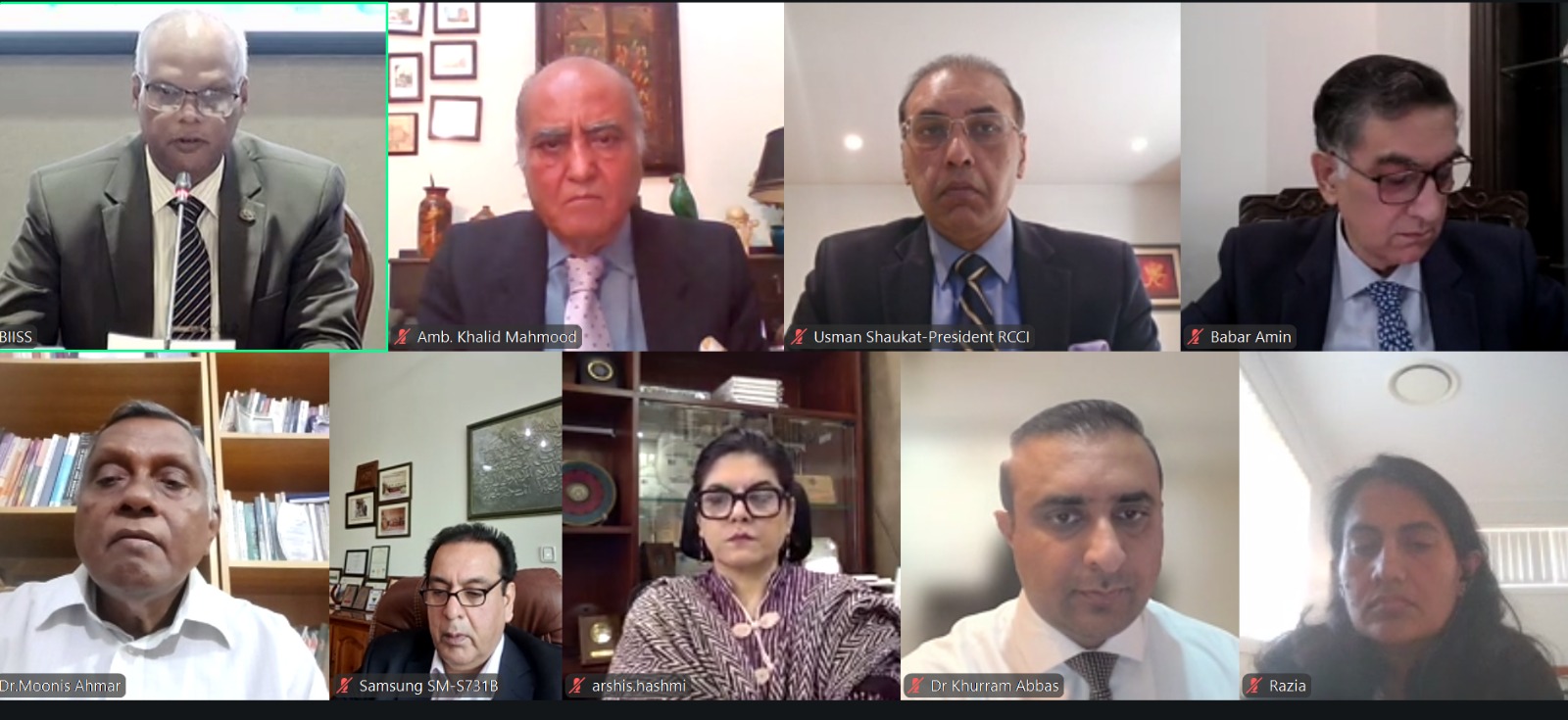
ISLAMABAD ( WNAM REPORT): The India Study Centre at the Institute of Strategic Studies, Islamabad, organized an International Webinar in collaboration with ISSI’s partner think tank, the Bangladesh International Institute of Strategic Studies (BIISS). The webinar, titled “Bangladesh-Pakistan Dialogue: Pathways for Constructive Engagement,” was aimed at discussing the current trajectory of bilateral ties between Pakistan and Bangladesh in the context of recent political transition in Dhaka, and ongoing geopolitical upheavals in the region. The webinar, jointly chaired by Ambassador Khalid Mahmood, Chairman BoG ISSI, and Major General A. S. M. Ridwanur Rahman, DG BIISS, was attended by policy experts, former diplomats, academics, business community representatives and research scholars. The speakers included: Ambassador Babar Amin, Pakistan’s former High Commissioner to Australia; Prof. Dr. Moonis Ahmar, Former Dean, Faculty of Social Sciences, University of Karachi; Prof. Dr. Arshi Saleem Hashmi, Dean Faculty of Contemporary Studies, NDU, Islamabad; Dr. Usman Shaukat, President, Rawalpindi Chamber of Commerce and Industry; Dr. Mahfuz Kabir, Research Director, BIISS; Dr. Khurram Abbas, Directory India Study Centre, ISSI; Dr. Sufia Khanom, Research Director (In-Charge), BIISS; Mr. Raja Amir Iqbal, Former President, Rawalpindi Chamber of Commerce and Industry; and Dr. Razia Sultana, Senior Research Fellow, BIISS.
Ambassador Khalid Mehmood in his welcome remarks underscored the growing momentum in Pakistan–Bangladesh relations, while recalling shared historical ties between the two countries based on mutual respect, bilateral cooperation, and a win-win approach for the entire region. Emphasizing the importance of economic collaboration, institutional linkages, and people-to-people contacts, he noted the significant potential for expanding bilateral ties across diverse sectors. He also stressed the shared commitment of both countries to addressing regional and global challenges such as climate change, food security, and sustainable development, while advocating for the revitalization of SAARC as a platform for regional integration. He described the evolving relationship as forward-looking and mutually beneficial, expressing confidence that continued dialogue and cooperation would contribute to regional peace, stability, and prosperity.
Major General (Retd) A. S. M. Ridwanur Rahman highlighted the importance of constructive engagement between Bangladesh and Pakistan in an increasingly interdependent world, noting that South Asia continues to face persistent political challenges such as conflicts and lack of cooperation, alongside non-political issues including climate change and food security. Emphasizing a forward-looking approach, he called for exploring pragmatic pathways for collaboration. He further underscored the need to bridge gaps in understanding each other’s priorities, offer actionable recommendations to policymakers, and address sensitive issues with due diligence. Concluding on a hopeful note, he pointed to the potential for strengthening bilateral ties by identifying challenges and opportunities for cooperation and advancing a mutually beneficial partnership.
Earlier in his welcome remarks, Dr. Khurram Abbas appreciated the leadership and organizing committees from both organizations for joining hands for a timely and meaningful engagement on the subject. He stressed that Pakistan–Bangladesh relations have witnessed a steady and encouraging upward trajectory over the past two years. This positive momentum provides a timely opening for both sides to move beyond symbolic engagement and explore substantive avenues of cooperation areas such as security, economy and people-to-people connectivity.
On bilateral trade and economic cooperation, Dr. Usman Shaukat, Dr. Mahfuz Kabir, and Raja Amir Iqbal highlighted the key challenges facing the two countries despite renewed optimism on both sides. They argued that while the leadership is committed to take the bilateral trade to USD 3 billion from the current one billion USD mark in the next three years, the potential remains untapped due to mobility constraints, strict trade regulatory mechanisms, and outdated payment channels. The absence of bilateral Free Trade Agreement (FTA) and Preferential Trade Agreement (PTA), and the underutilization of multilateral frameworks such as SAFTA and D-8 forum hamper the prospects for enhancing trade. The experts stressed more B2B ties, encouraging business groups to expand the trade scope beyond traditional commodities. They suggested pragmatic actions that may help reduce trade barriers. These include: easing visa restrictions, creation of Joint Special Economic Zones, digital trade facilitation, and Export Basket Diversification on both sides.
Ambassador Babar Amin and Dr. Razia Sultana discussed the regional geopolitical environment, with a special focus on the need for regional integration through revitalizing SAARC. They highlighted the quest among South Asian states, especially Pakistan and Bangladesh, to pursue an independent foreign and regional policy while resisting unilateral agenda of powerful neighbours. The experts stressed the need to capitalize on the shared commitment among political leadership in Pakistan and Bangladesh to revive SAARC.
Arshi Saleem Hashmi mapped the evolving security and strategic landscape of South Asia against the backdrop of intensifying external footprints and the region’s recalibrating policy orientations. She identified that over the past two years, Pakistan-Bangladesh relationship has gained renewed traction through high-level exchanges, revival of institutional dialogue mechanisms, enhanced trade engagement, and greater people-to-people contact. She highlighted potential of maritime cooperation between Pakistan and Bangladesh. While advocating for a structured tripartite framework involving Pakistan, Bangladesh, and China, Dr. Hashmi underscored that Beijing’s expanding engagement with South Asian states constitutes one of the most consequential developments in the regional order. In her assessment, China’s economic investments, connectivity initiatives, and strategic outreach are playing a stabilizing role by reinforcing a more balanced distribution of power in the region, thereby offering smaller states greater strategic space and diversified partnership options.
Dr. Moonis Ahmar presented solid recommendations to enhance people-to-people ties between Pakistan and Bangladesh. These include: academic, on arrival visa facilities, opening up of new consulates, arrangements for maritime transportation, and new direct air links.
Dr. Sufia Khanom presented an overview of the climate challenges facing the two countries, their present strategies in this regard, and how these strategies can be more effective through shared plans of action.