
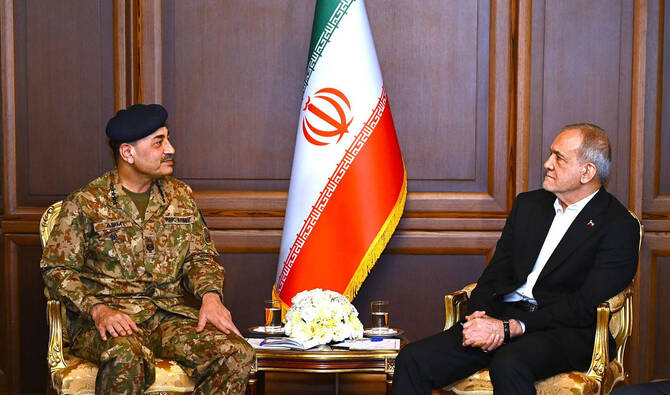
Islamabad ( WNAM REPORT ): Sardar Masood Khan, former Ambassador to the United States, China and the United Nations, and former President of Azad Jammu and Kashmir, has stated that Pakistan remains at the forefront of delicate diplomatic efforts to de-escalate tensions between the United States and Iran, even as the crisis enters a more volatile phase marked by coercive posturing and strategic uncertainty.
Commenting on recent developments, Ambassador Khan described Washington’s dual-track approach—combining optimism about negotiations with continued military pressure—as a calculated strategy of “coercive diplomacy.” He noted that President Donald Trump is attempting to balance domestic pressures, global market stability, and strategic objectives by projecting confidence publicly while maintaining leverage through military readiness and maritime restrictions.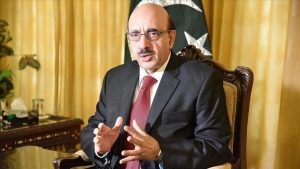
He observed that such signaling reflects internal pressures within the United States, where public opinion increasingly questions the utility and objectives of the ongoing conflict. At the same time, Iran has responded with equally firm rhetoric and countermeasures, reinforcing a tense “eyeball-to-eyeball” situation in the region.
Ambassador Khan warned that the situation around the Strait of Hormuz remains highly fragile. While there had been brief optimism following limited reopening for commercial shipping, renewed restrictions and heightened military alertness on both sides have reversed gains. “Both sides have their hands on the trigger,” he remarked, cautioning that any miscalculation could lead to a broader regional conflict with severe global economic repercussions.
Highlighting Pakistan’s role, he emphasized that Islamabad has invested significant political capital and diplomatic goodwill to bring both sides closer to a sustainable framework for dialogue. Pakistan, he noted, has successfully mobilized support from key regional actors, including Saudi Arabia, Turkey, and Egypt, forming a coordinated diplomatic grouping aimed at backing peace proposals and facilitating consensus.
Despite reports of delays in scheduling the next round of talks, Ambassador Khan stressed that diplomatic efforts remain active. Preparations in Islamabad are underway for a potential follow-up round, with Pakistan continuing to serve as a trusted conduit between Tehran and Washington. However, he acknowledged that progress depends on establishing a basic framework, including a durable ceasefire, clarity on the Strait of Hormuz, and stabilization of parallel conflict zones such as Lebanon.
He further pointed out that deep-rooted differences persist on critical issues, including nuclear commitments and regional security arrangements, with both sides maintaining sharply divergent positions. Bridging these gaps, he said, will require sustained engagement, careful calibration, and confidence-building measures.
Ambassador Khan expressed concern over the limited role of global institutions, particularly the United Nations, in managing the crisis, noting that regional actors like Pakistan have stepped in to fill the vacuum. He underscored that the stakes extend beyond the region, warning of potential economic turbulence and geopolitical instability if tensions escalate further.
Concluding his remarks, he reiterated cautious optimism, affirming that while the path to a breakthrough remains complex, Pakistan’s continued engagement and balanced diplomacy offer a viable pathway toward de-escalation and eventual resolution.