
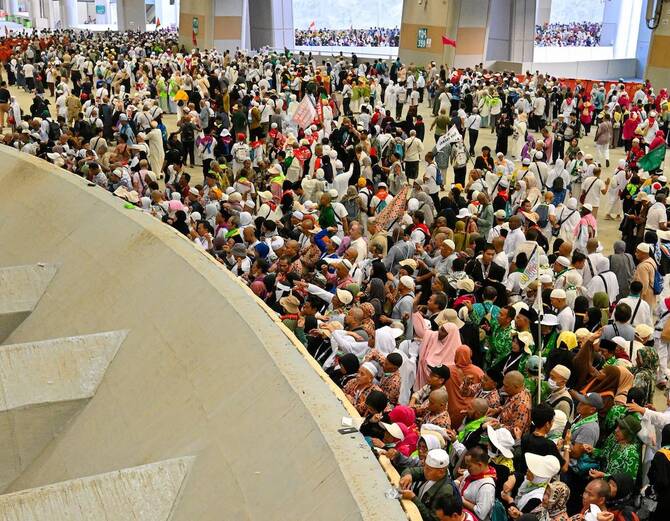
MINA ( WNAM MONITORING): Hajj pilgrims on Thursday began the ritual stoning of the devil, casting pebbles at the Jamarat — three stone pillars in Mina — marking the first day of Tashreeq.
The Days of Tashreeq are the three days following Eid Al-Adha, during which pilgrims complete key remaining rites of the Hajj pilgrimage.
These days mark the final stage of Hajj, as pilgrims prepare to conclude their journey and begin departing the holy sites. The period is also marked by intensified prayer and remembrance, with strict scheduling in place to ensure the safety and orderly movement of millions of pilgrims.
The symbolic stoning ritual begins at Al-Jamarah Al-Sughra, or the small pillar, followed by Al-Jamarah Al-Wusta, or the middle pillar, and concludes with Jamarat Al-Aqaba, the large pillar, in accordance with established prophetic practice.
Designated pathways across multiple levels of the Jamarat facility helped ensure the smooth flow of pilgrims and facilitate crowd management. The multi-tiered structure is designed to ensure efficient and safe movement.
Pilgrims carried out the ritual amid stable weather conditions, with wind speeds up to 30 kph and maximum temperatures forecast to rise to 42 degrees Celsius, according to the National Center for Meteorology. Minimum temperatures are expected to be around 30 early on Friday.
The Ministry of Interior reiterated its continued commitment to safeguard pilgrims across Mina and within their camps, noting that efforts include regulating pedestrian flow between tents, the Jamarat area, and routes leading to the Grand Mosque.
The ministry urged pilgrims to adhere strictly to official instructions during the days of Tashreeq, emphasizing safety guidance during key rituals, including circumambulating the Kaaba, the Sa’i between the hills of Al-Safa and Al-Marwa, and the stoning at the Jamarat in Mina.
Under the Presidency of State Security, the Security Aviation Command has intensified aerial operations over the holy sites to monitor pilgrim movement and ensure the smooth flow of buses transporting the guests of God across their designated routes.
These aerial patrols complement ground operations by providing real-time monitoring of crowd movement and supporting transportation management across Makkah and the holy sites, contributing to high levels of organization, efficiency, and pilgrim safety.
For its part, the Ministry of Hajj and Umrah called on pilgrims to adhere to official schedules and organizational guidelines to ensure the smooth performance of rituals and to help reduce the risk of heat exhaustion and sunstroke.
Speaking to Arab News, Fakhriyah Shaheen, an Iraqi pilgrim, said she values the Hajj arrangements and was keen to follow the organizing instructions.
Describing the stoning process, she said: “We did that with no difficulties and the system and tolerance among pilgrims were all good, and there were no incidents of crowding or stampede.”
She added: “We extend our gratitude to the security personnel who spare no effort in providing every service required by Iraqi pilgrims. May Allah preserve Saudi Arabia, its people, and its leadership. We are all brothers, with no distinction between us.”
Mohammed Islam, a Pakistani pilgrim, said that the stoning ritual proceeded smoothly, with security personnel, Hajj officials, and scouts readily available to provide assistance and answer any questions.
“May Allah reward you for your efforts. The services made Hajj easier, more comfortable, and very safe for us,” Islam said.