

Ruqia Zainab
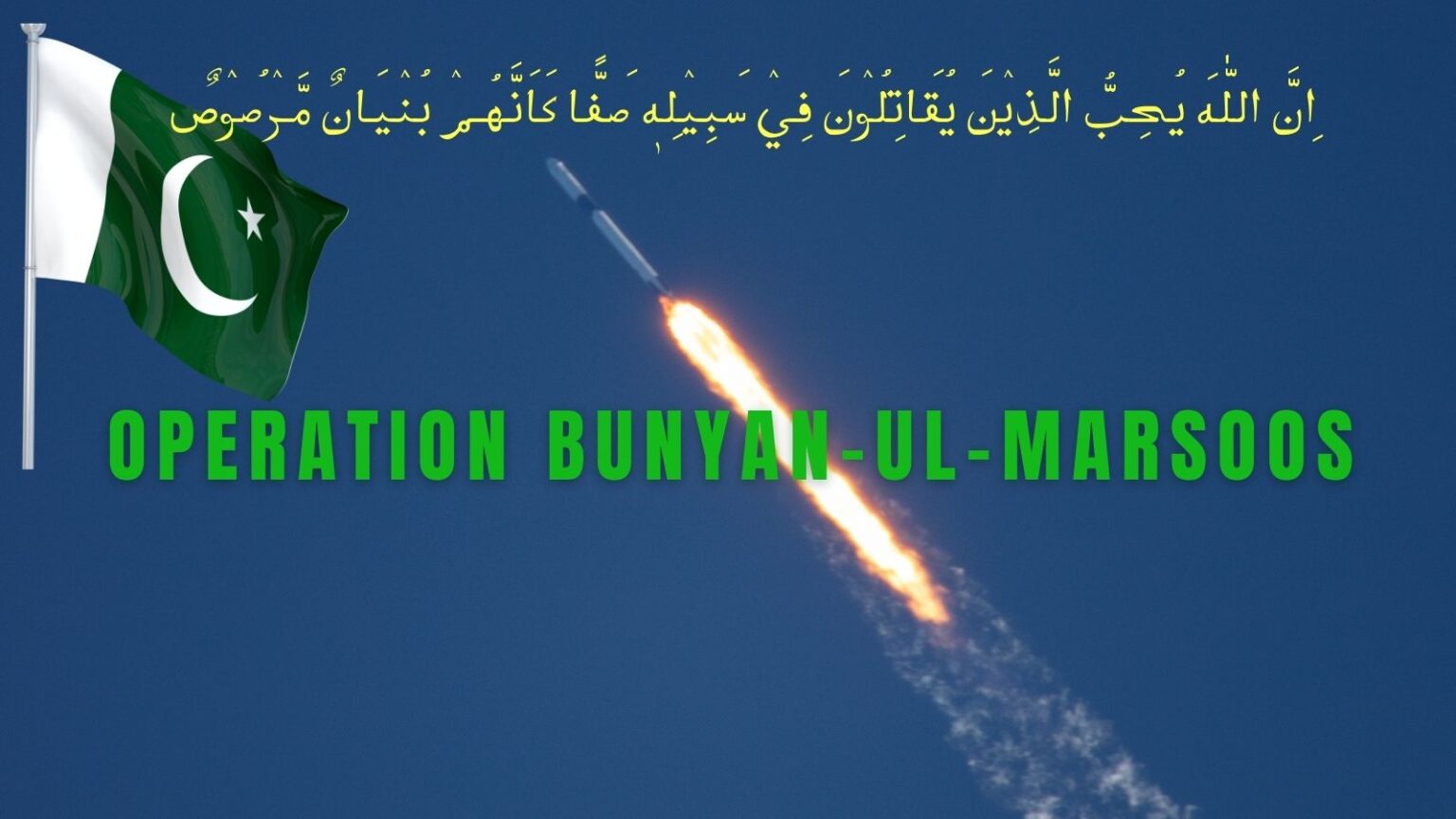
For decades South Asian power has been determined by military mass and economic scale but the crisis in recent times raises the possibility of this being determined by the precision, perception, and preparedness. A dominant narrative, that formed the strategic discourse in South Asia, for much of the last 20 years. The growing economy of India, increased military spending, procurement of high-end military platforms and growing international cooperation was seen as a sign of an inevitable conventional advantage. The assumption was a simple one – the more resources, the more effective the military. But the history of warfare has many examples of how the outcome of a war is not always decided by resources. But the reality in the time between Operation Swift Retort and Bunyan al-Marsoos is quite different, and besides sheer numbers. It’s more about the integration of technology, operational agility and the precision of the engagements. It was an historic event in Pakistan’s strategic trajectory when the Operation ‘Swift Retort’ was conducted. It was more than a military operation; it was a testament to the importance of making decisions in the face of crisis, being operationally ready, and controlling a military escalation. The operation underscored Pakistan’s capability in creating a coherent strategy for intelligence, planning, and execution in the face of a developing security landscape where technology is playing an increasingly dominant role in the region. Most importantly, it revealed a new fact: future wars fought between the two nations of South Asia would not be fought on the basis of force but on that of effectively using technology.
In the following years, the posture of Pakistan towards war changed drastically. In contrast, Pakistan has built up the ability, and not spent an exorbitant amount of money in a competition based on numbers. It was never about matching everything that a bigger neighbouring country had acquired, but it was about creating a ‘deterrence architecture’ that would guarantee strategic stability, precision, flexibility and preparedness.
This transformation was more and more apparent in the air domain. The Rafale and other advanced platforms have been touted for years as being a marksman and a technological edge in future air combat. It was assumed that fourth-and-a-half-generation systems, with better budgets and procurements would be the inevitable winners in the battlespace. However, modern warfare has demonstrated that the effectiveness of the military depends on more than one particular aircraft or weapon system. The key to success lies in the integration of platforms, sensors, communications, electronic warfare capabilities, intelligence networks and decision-making elements within an integrated operational framework. It was this understanding that Pakistan’s modernization efforts were based upon.
These investments would beef up the overall effectiveness of the force instead of just improving the individual platforms themselves, through investments in advanced radar, network-centric operations, electronic warfare and beyond-visual-range engagement systems. This upgrade of the JF-17 fleet was part of a larger modernization program designed to equip the force with advanced sensors, long-range engagement systems, and quality avionics that provide the pilots with more situational awareness and decision superiority to create an information-driven battlespace.
In 2026, the successful flight test of Taimoor Air launched Cruise Missile gave another instance of this evolution. The 600-kilometre range and its ability to attack both sea and land targets helped to increase Pakistan’s stand-off strike capability and gave it extra options in a crisis situation. It is not only important because it comes with a wide range, it is important because of its flexibility. Precision-guided systems can influence calculations by adversaries while providing more control in escalation processes.
The ongoing development of the Fatah missile family is another sign of a greater focus on precision-based deterrence. With a range of up to 400 kilometres, the Fatah-II is just the latest sign that modern military planning is focused on being responsive, accurate and flexible in its approach. These systems enable military planners to produce operational effects without significantly mobilising forces, increasing the deterrence potential and bringing down the risk of escalation.
Transformation has also taken place in the maritime area. When the first ‘Hangor’ class submarine was inducted in 2026, it was more than just the introduction of a new class of submarine. With Air Independent Propulsion, sophisticated sensors and extended under-water endurance, the sub is enhanced to bolster Pakistan’s sea denial capabilities in the Arabian Sea and played a role in making its deterrence more survivable. It’s more than just a platform, it is strategically important. The Hangor programme is indicative of an integrated maritime warfare architecture that integrates intelligence, and surveillance, reconnaissance, command-and-control and precision-strike elements into a networked structure. The integration improves situational awareness, aids in decision-making and boosts effectiveness of maritime operations.
For Pakistan, the essence of recent modernization is this idea of integration. These are not standalone solutions, but rather a progression of Taimoor, Fatah-II, Hangor, advanced surveillance, electronic warfare, capability in cyberspace and network-centric operations. These two combined create the basis of a precision warfare eco-system that can be used in multiple domains simultaneously.
The future battlefield is more and more networked and the success will rely on the ability to co-ordinate between the air, land, sea, cyber and information domains in real time. During recent crises, this reality has manifested itself more and more. Today, a conflict is not a military one any longer. It consists of the concurrent use of military, technological, information and cyber assets.
Today, precision strikes are not just about hitting the right target, but about attaining strategic effects from the coordinated use of multiple capabilities. This kind of situation makes it almost as critical as firepower to be able to incorporate information into a decision. This change has been made possible with the help of China-Pakistan cooperation.
As time went on, traditional defence procurement was expanded out to encompass aerospace development, naval modernization, technology transfer, defence manufacturing, and industrial capacity building. This strategic partnership is not just about acquiring skills; it’s about bolstering Pakistan’s technological capabilities. There is a growing focus on cultivating indigenous capabilities in Pakistan’s defence policy. The development of precision-guided systems, surveillance, anti-drone, electronic warfare, cyber security and local defence production are all testament to a new awareness that sustainable security must be technologically self-reliant. When a crisis occurs, states that are 100% reliant on external suppliers can be limited. A strategic and economic need is thus the need for indigenous innovation.
This path of Pakistan’s civilian and military leadership seems to be gaining momentum recently. They are clearly shifting their thinking to include technological innovation, development of indigenous capabilities and credible deterrence. No longer is numerical competition is the focus. Rather, it is now fixated more on readiness, flexibility and creating strategic impact with integrated capabilities.
Meanwhile, South Asia’s strategic landscape is continually changing. As part of the evaluation of military effectiveness, analysts are now looking at increasingly into the world of artificial intelligence, autonomous systems, cyber operations, electronic warfare and precision-guided technologies. The old indications of military power like numbers of troops and defence budgets are still valid, but are no longer sufficient. The most important thing that is required is the ability to convert information into awareness, awareness into decisions, and decisions into operational outcomes.
The ‘drift’ when it comes to societal change from Swift Retort to Bunyan al-Marsoos is, therefore, not just about the modernization of the armed forces. It is the tale of a certain path of adaptation. It highlights Pakistan’s efforts in the context of evolving security challenges to invest in precision strike technology, maritime deterrence, self-reliant defence manufacturing, technological innovation and integration on multi-domains. Of course, more important was challenging the notion that strategic advantages are always bestowed on the more powerful state.
The bottom line of this change is that fastest adaptation which turns the situation into a success. The future of conflict is in the hands of precision, connectivity and decision superiority. With the dawn of technological competition and multi-domain operations in South Asia, the power equation won’t be so much about numbers but how to invest in innovation and turn them into credible deterrence and strategic effects. The history of Pakistan from Swift Retort to Bunyan al-Marsoos not only reflects the military modernization process, but a new concept of power as well.
(The writer is: Strategic Studies student at National Defence University with research interests in emerging technologies, strategic affairs, and geopolitical developments. She has gained research and field exposure through internships and projects with the Institute of Regional Studies, Punjab Police, and Defence Export Promotion Organization. Her work focuses on the evolving dynamics of technology, security, and modern conflict in South Asia).