
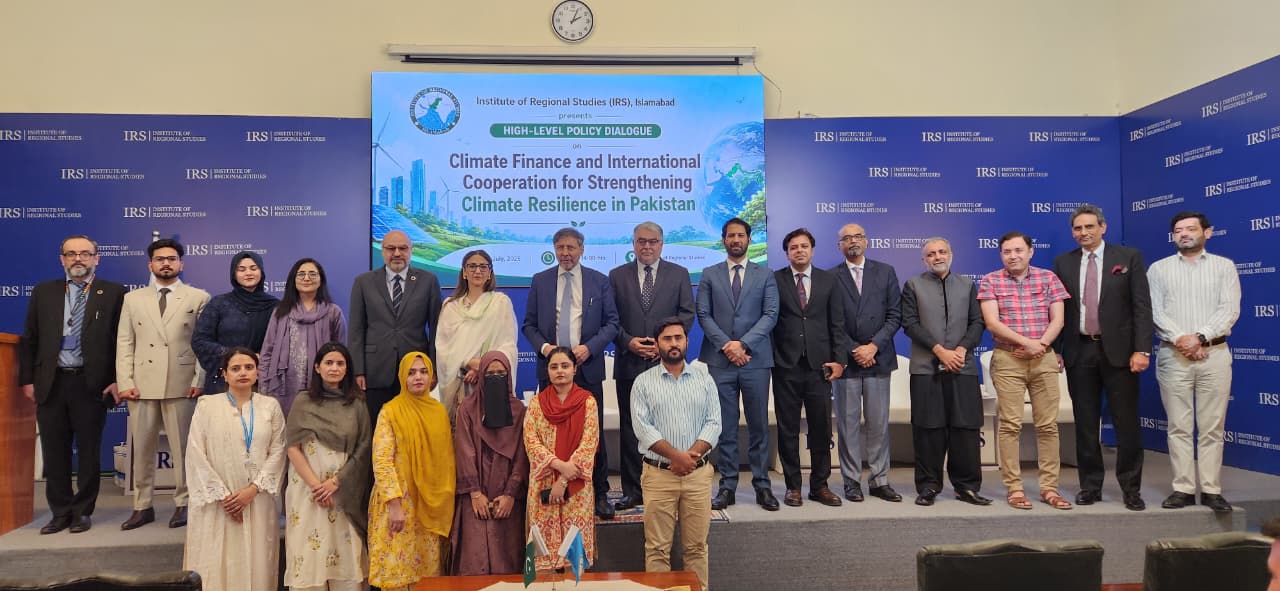
ISLAMABAD ( WNAM REPORT ): Climate change has become a defining threat to Pakistan’s economic stability, food and water security, public health, and long-term development, Minister of State for Climate Change and Environmental Coordination Dr. Shezra Mansab Ali Khan said, calling for enhanced climate finance, technology transfer, stronger institutions, and international partnerships to accelerate climate action. Delivering the keynote address at a High-Level Policy Dialogue titled “Climate Finance and International Cooperation for Strengthening Climate Resilience in Pakistan,” was organized by the Institute of Regional Studies (IRS) in Islamabad, she noted that despite contributing less than one percent of global greenhouse gas emissions, Pakistan remains among the countries most vulnerable to climate change, and stressed that international climate finance must be made more accessible, predictable, and responsive to support vulnerable countries.
In his opening remarks, Ambassador Jauhar Saleem, President of IRS, underscored the strategic importance of climate finance and international cooperation in strengthening Pakistan’s climate resilience. He said climate finance is not merely about mobilizing resources but about enabling resilient development, strengthening institutions, accelerating innovation, and expanding opportunities for sustainable economic growth. He expressed hope that the dialogue would generate practical recommendations and contribute to strengthening Pakistan’s engagement with the evolving global climate finance architecture.
Dr. Samuel Rizk, Resident Representative of UNDP Pakistan, said strengthening governance, institutional capacity, and policy coherence is fundamental to building climate resilience. He observed that effective climate finance is measured not only by the volume of resources mobilized but by its accessibility, quality, and ability to deliver tangible benefits to vulnerable communities, calling for stronger institutional coordination, greater investment in resilience-building, and integrated approaches to help Pakistan anticipate, withstand, and recover from climate impacts.
Climate change expert Ali Tauqeer Sheikh said Pakistan’s principal challenge is not the availability of climate finance but the absence of a coherent governance framework to coordinate and mobilize financial resources. He called for institutional reforms to establish a single coordinating authority for climate finance, greater transparency and accountability through ring-fencing and independent auditing of climate-related funds, and improved access to international climate finance. He also highlighted the importance of innovative financing instruments, including blended finance, risk-sharing mechanisms, and contingent financing, to leverage greater public and private investment in climate resilience.
Hamza Haroon, Regional Director for West and South Asia at the Climate Vulnerable Forum-V20 (CVF-V20), highlighted inequities in the global climate finance architecture and the challenges faced by climate-vulnerable countries in accessing affordable finance. He called for scaled-up concessional finance, greater mobilization of private investment, and stronger country-led climate financing mechanisms. Referring to Pakistan’s Climate Prosperity Plan, he said it holds potential to attract investment in climate-resilient development and stressed the importance of establishing a national country platform to improve coordination, project implementation, and access to international climate finance.
Amir Khan Goraya, Chief Executive Officer of the National Disaster Risk Management Fund (NDRMF), underscored the importance of shifting from disaster response to risk-informed investment. He said greater investment in resilient infrastructure, preparedness, and locally driven adaptation measures is essential to building long-term resilience to climate change, and called for integrating climate risk considerations into national development planning and investment decisions to safeguard development gains. He further stressed that strengthening institutional capacities and fostering collaboration among government, development partners, and local communities are critical to building a climate-resilient Pakistan.
The dialogue was attended by senior government officials, representatives of international organisations, development partners, climate experts, policymakers, academics, and members of the diplomatic community.
Predictability and Speed Key to Pakistan’s Climate Goals, Says State Minister
49