WNAM REPORT: Vietnam is set to fundamentally transform its approach to maritime development, shifting from a focus on the marine economy to the broader goal of becoming a strong maritime nation under a new Party resolution.
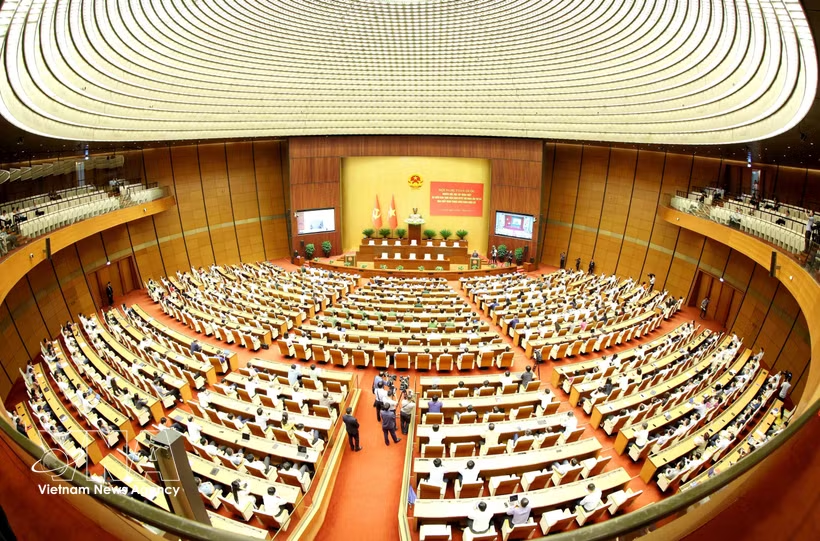
Presenting the key contents of the resolution on developing Vietnam into a strong sea-based nation at a national teleconference on July 29 to study, disseminate and implement the outcomes of the third plenum of the 14th Party Central Committee, Politburo member, Chairman of the committee’s Commission for Policies and Strategies Nguyen Thanh Nghi said the document responds to the urgent need to expand the development space, innovate maritime governance, and bring into full play the sea’s strategic role in economic growth, national defence and security, foreign affairs, and international integration.
The resolution introduces a new strategic vision and breakthrough thinking for maritime development. Rather than concentrating solely on exploiting resources, Vietnam will move toward effective governance and sustainable use of its maritime space, underpinned by science and technology, innovation, and digital transformation.
It sets the goal of building a nation with modern maritime governance, a competitive marine economy, advanced marine science and technology, strong capacity to safeguard national sovereignty over its seas and islands, and a higher international standing in maritime affairs, thereby turning the sea into one of the country’s key pillars for national development and protection.
The resolution identifies the sea as a strategic development space where new growth poles, emerging industries, and fresh drivers of economic expansion will take shape. It stresses the close integration of marine economic development with national defence and security, ensuring a peaceful and stable environment conducive to sustainable growth. A modern, unified and interconnected maritime governance model is also proposed, based on national marine spatial planning and integrated data systems.
To that end, the resolution outlines five guiding principles and development goals through 2030 with a vision to 2045, and nine major groups of tasks and solutions, Nghi said.
For guiding principles, it reaffirms the sea as Vietnam’s strategic development space and a fundamental source of national strength. Building a strong maritime nation is defined as a long-term strategy closely linked to the cause of national construction and defence.
The resolution also calls for a fundamental shift in governance thinking, moving from sector-based management to integrated governance of national maritime space, and from marine resource exploitation to modern maritime governance. It highlights institutional reform as a strategic breakthrough, along with unlocking the country’s maritime potential, mobilising all available resources, and developing coastal growth poles, economic centres and marine economic corridors that connect the mainland, islands and new development areas.
Science, technology, innovation, digital transformation and high-quality human resources are seen as the primary drivers, with priority given to marine surveys, scientific research, and mastery of marine and ocean technologies.
The resolution further emphasises the sustainable use of marine resources alongside environmental protection and marine ecosystem conservation, promoting green and smart development within ecological limits, and enhancing resilience to climate change, ocean changes, natural disasters and other emerging risks.
It also underscores that building a strong maritime nation is the shared responsibility of the entire Party, people, armed forces, political system, businesses and citizens.
The nine priority tasks include strengthening Party leadership and public awareness and improving the effectiveness of maritime governance; completing institutions and marine spatial planning; mobilising and effectively using resources and developing strong maritime enterprises; and promoting innovation and high-quality human resources.
Attention will also be paid to accelerating the growth of modern, green and smart marine industries; expanding marine infrastructure and economic centres; protecting marine ecosystems, and improving climate resilience in coastal and island areas; promoting maritime culture and the well-being of coastal communities; and enhancing national defence, security, international cooperation and Vietnam’s global maritime standing.