
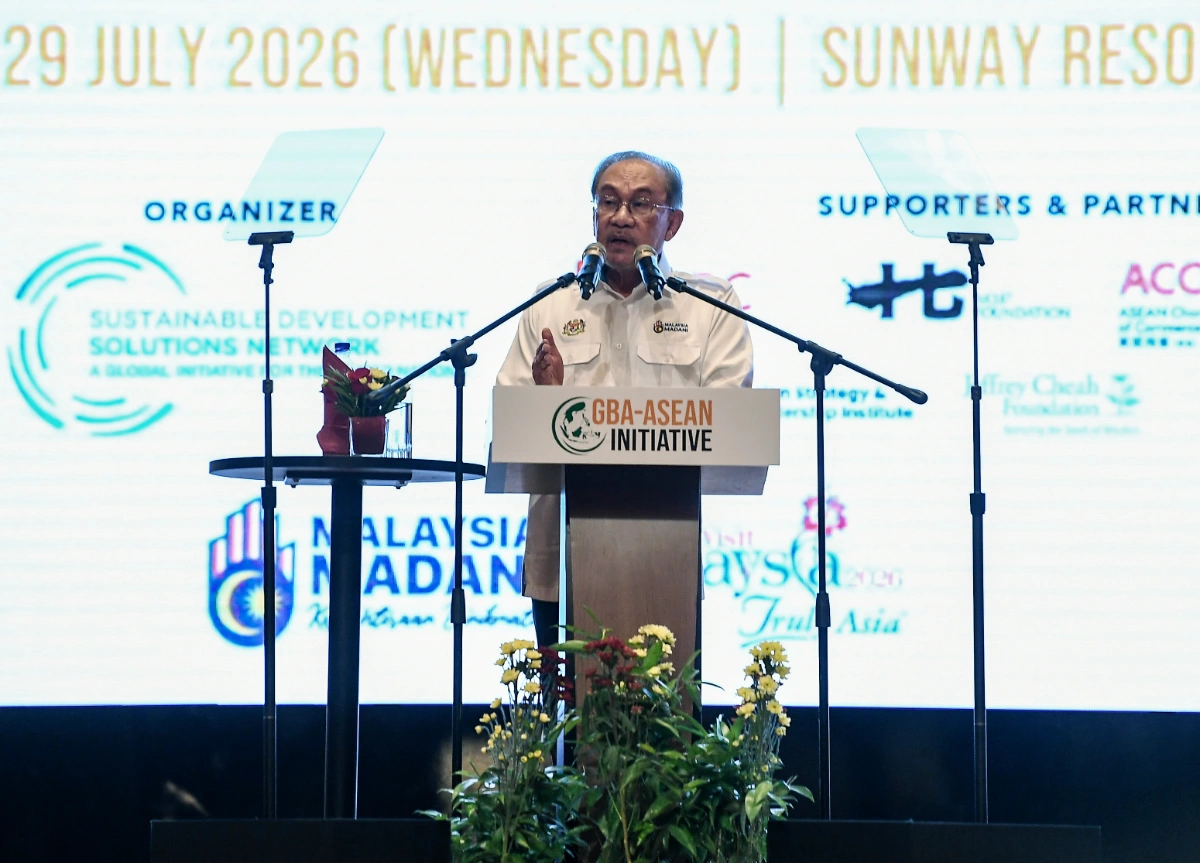
PETALING JAYA ( WNAM MONITORING): The transition to clean and renewable energy is no longer merely an environmental ambition but a national security imperative as countries grapple with geopolitical tensions, supply chain disruptions and energy uncertainty, Prime Minister Datuk Seri Anwar Ibrahim said.
Speaking at the 2026 GBA-ASEAN Conference on Energy Transition and Integration, Anwar said Malaysia and ASEAN must accelerate energy transition efforts to strengthen energy security and economic resilience amid global disruptions.
He said geopolitical conflicts and supply chain disruptions had exposed the risks of relying on finite fossil fuels, making the transition to clean energy a national security imperative.
However, he stressed that achieving this transformation would require significant investment and stronger collaboration between governments, the private sector, investors and project developers.
Anwar highlighted Malaysia’s pioneering role in green financing through the introduction of the Green Sukuk in 2017, which combined Islamic finance principles with sustainability objectives.
He said the initiative reflected Malaysia’s commitment to ethical investment, social justice and environmental stewardship while strengthening the country’s position as a regional hub for sustainable investment.
He added that cooperation with China and other international partners should continue through ASEAN-led mechanisms, including the ASEAN Power Grid, to enhance regional electricity connectivity.
For ASEAN, Anwar said deeper energy integration would enable the region to demonstrate how sustainability, peace and economic growth can advance together.
“This region, being one of the most peaceful and economically dynamic regions in the world, can showcase how peace and sustainability, with a focus on alternative energy and environmentally sustainable policies, can be achieved,” he said.
Anwar also highlighted Malaysia’s National Energy Transition Roadmap (NETR), which focuses on ensuring a stable, affordable and reliable energy supply, driving economic growth, reducing emissions and protecting natural ecosystems.
Under the roadmap, Malaysia aims to increase renewable energy capacity to 31% by 2025, 40% by 2035 and 70% by 2050.
He reiterated that Malaysia would not build new coal-fired power plants and would gradually retire existing coal capacity, while natural gas would continue to play a transitional role.
“We are committed to no new coal plants and to the gradual retirement of existing coal capacity,” he said.
However, Anwar stressed that the energy transition must remain people-centred and aligned with the principles of Malaysia Madani, which emphasise humanity, ethics and social justice.
“The Madani framework promotes growth, digital transformation and energy transition, but we have never lost sight of our culture, our humanity and our ethics,” he said.
He warned that a transition focused solely on technology without considering its social impact could deepen inequalities.
“A transition that is technologically brilliant but socially devastating is not a transition. It is an injustice,” he said.
Anwar said the benefits of the energy transition and digital transformation must reach ordinary Malaysians, particularly poorer and marginalised communities.
He said Malaysia and ASEAN stand at a critical crossroads amid multiple global crises, underscoring the need for collective action and stronger regional cooperation.
“For ASEAN, energy transition and integration require collective action and a convergence of resolve. Malaysia has taken an active role, and we will continue to do so,” he said.
Meanwhile, Anwar highlighted the Greater Bay Area (GBA) as an important partner, describing it as a global hub for finance, advanced technology and manufacturing.
He said the GBA’s innovation ecosystem could help Malaysia and ASEAN accelerate green development and strengthen regional energy cooperation.
“The decisions we make in these critical years will echo for decades. Let us be remembered as the architects of a green golden age, an era in which the economy thrived, the environment healed and our societies became more compassionate, just and united,” he said.