
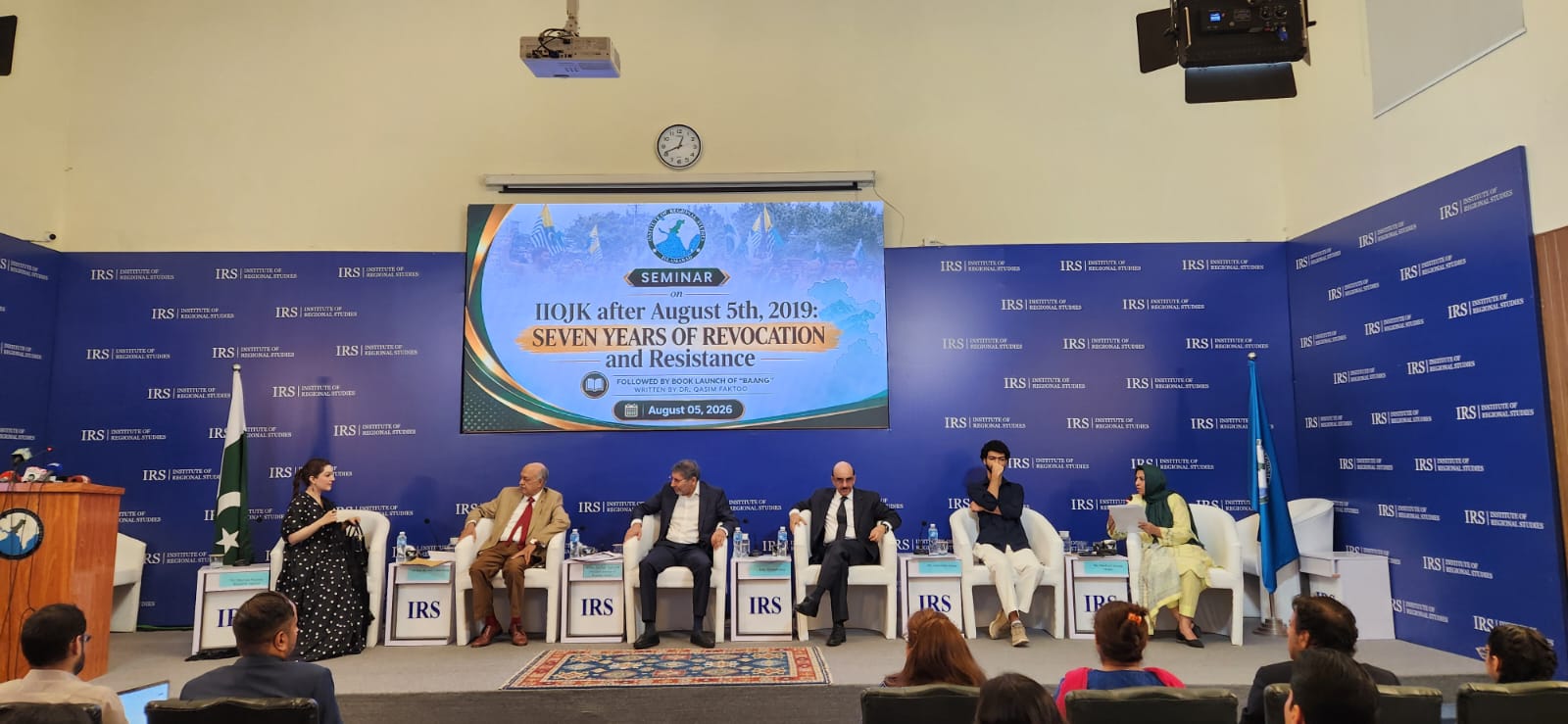
WNAM REPORT: During a seminar at the Institute of Regional Studies (IRS), Islamabad, titled, “IIOJK after 5th August, 2019: Seven Years of Revocation and Resistance”, experts, while recognizing the importance of engaging with literature on Kashmir, highlighted the absence of serious scholarship on Kashmir produced from Pakistan—an essential component for informed policy formulation.
The seminar focused on the evolving situation in Indian Illegally Occupied Jammu and Kashmir (IIOJK). It featured a discussion on BAANG, a book authored by Dr. Qasim Faktoo, a Kashmiri political leader who has remained incarcerated in Tihar Jail for nearly three decades. The book provides an account of India’s strategic maneuvers in the region. Panelists noted that the book foresaw the 2019 annexation and exposed plans aimed at altering the demography of IIOJK.
Speaking on the occasion, Ambassador Masood Khan, former President of Azad Jammu and Kashmir, stated that India’s actions of 5 August 2019 violated international law and undermined constitutional commitments made to the people of Jammu and Kashmir. He highlighted concerns over demographic changes, restrictions on political representation, surveillance, detentions, and alleged human rights violations in IIOJK. Stressing the need to strengthen Pakistan’s internal capacity, he remarked that Kashmiris cannot rely solely on international support and called for greater strategic and grassroots efforts. He also appreciated the republication of BAANG by IRS and recommended its translation into English and inclusion in academic curricula.
Ms. Mushaal Hussain Mullick, Chairperson of the Peace and Culture Organization, reaffirmed that the sacrifices and resilience of the Kashmiri people continue despite years of repression. She urged the youth, media, and academia to play a proactive role in countering misinformation and strengthening the global narrative on Kashmir.
Lieutenant General (R) Asif Yasin Malik underscored the strategic significance of the Kashmir dispute, emphasizing the need for sustained national resolve and credible scholarship to effectively present Pakistan’s position.
Senator Dr. Zarqa Suharwardi Taimur highlighted the humanitarian dimensions of the Kashmir issue and called for stronger diplomatic and parliamentary efforts to keep it on the international agenda.
Dr. Mujahid Gillani emphasized the importance of research and documentation in preserving the historical record and advancing an evidence-based understanding of the Kashmir issue.
Mr. Ahmed Bin Qasim, son of Dr. Qasim Faktoo, reflected on the experiences of families affected by prolonged imprisonment, emphasizing that books and ideas sustained political prisoners under severe restrictions. He said Kashmir should be viewed not only through the lens of suffering but also as a source of intellectual resilience, calling for serious scholarship and greater academic engagement on Kashmir. He regretted the decline in quality research on Kashmir produced in Pakistan in recent years.
Concluding the discussion, Ambassador Jauhar Saleem, President of IRS, cited Nelson Mandela’s triumph over apartheid as a reminder that prolonged struggles can ultimately succeed through perseverance, unity, and hope. He emphasized that history is replete with examples of seemingly impossible causes prevailing, expressing confidence that the aspirations of the Kashmiri people would also endure.
Serious Scholarship Key to Building an Effective Narrative on Kashmir: Experts at IRS Seminar
21