
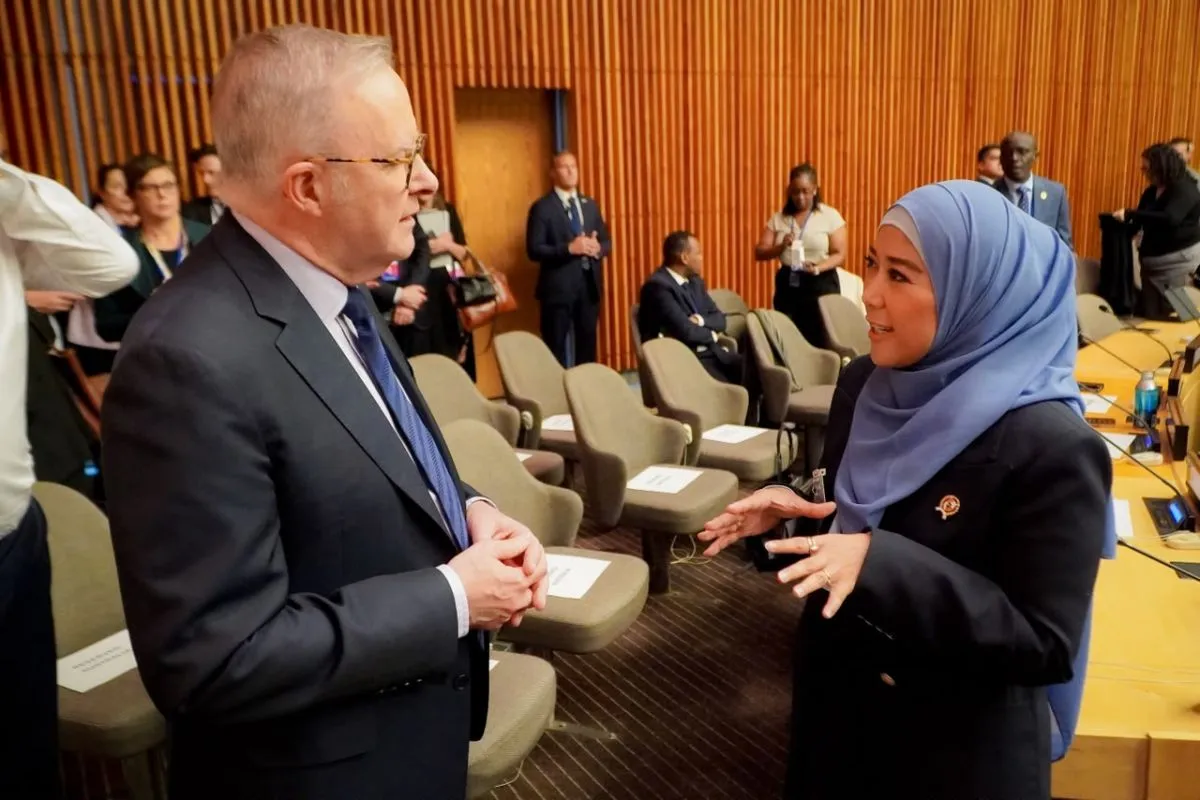
Jakarta ( WNAM MONITORING) : Indonesian Communication and Digital Affairs Minister Meutya Hafid has called for urgent global safeguards to protect children from artificial intelligence risks at a high-level summit held on the sidelines of the 81st United Nations General Assembly in New York.
Addressing world leaders on Tuesday (September 22), Meutya noted that around 70 million Indonesian children are growing up in an ecosystem increasingly shaped by AI technologies.
She urged international policymakers and technology companies to embed child safety into AI infrastructure rather than respond only after harm occurs.
“Our children will live in increasingly close proximity to AI. Consequently, we must ensure children’s safety and rights from the very beginning, rather than waiting until risks have already materialized,” Meutya said in a statement.
The high-level session, titled “Protecting Children’s Rights Facing Artificial Intelligence: The Coalition for Children’s Rights and Protection in the Age of AI as an Operational Tool,” was co-chaired by French President Emmanuel Macron, Spanish Prime Minister Pedro Sánchez, Kenyan President William Ruto, and Australian Prime Minister Anthony Albanese.
The gathering brought together heads of state, UN leaders, technology executives, civil society advocates, and academic experts to develop concrete measures to address emerging digital harms.
Indonesia participated in the event as part of the Global Coalition for Children’s Rights and Protection in the Age of AI.
During the meeting, the coalition officially launched its 2026–2027 roadmap, outlining key global priorities.
The roadmap focuses on embedding safety and privacy by design, establishing clear accountability, setting strict safety-testing standards, promoting AI literacy, and combating the misuse of AI to generate deepfakes and child sexual abuse material.
While acknowledging AI’s significant potential for education and creativity, Meutya emphasized that automated safeguards cannot replace institutional oversight.
“We cannot leave children’s safety to algorithms. Governments, technology platforms, the industry, parents, schools, and the international community must each assume their respective responsibilities,” she said.
Because AI operates across borders, Meutya stressed that global regulatory frameworks must take young people’s perspectives into account, along with the specific vulnerabilities of developing nations.
“The world is currently defining the rules for AI. Indonesia wants to ensure that children’s voices are taken into account during that process,” the minister emphasized.