
Introduction
The Saudi-led military intervention in Yemen, known as Operation Decisive Storm, initially reported as a joint Gulf response to the occupation of Sana’a by the Houthi and the so-called expansion of Iranian influence over the Arabian Peninsula, was launched in March 2015. The two principal intervention leaders, Saudi Arabia and the United Arab Emirates (UAE), framed their operation as a collective effort to safeguard the Gulf security interests, ensure regional stability and rebuild the internationally recognised government in Yemen (Juneau, 2016). Yet as the war dragged on, the coalition slowly evolved into seemingly integrated alliance to disintegrating coalition that was marked by warring proxy networks, strategic divergences and increasing political distrust.
This article argues that Saudi Arabia and the United Arab Emirates were now on fundamentally incompatible political and security objectives, and the war in Yemen is a greater transition from coalition warfare towards intra-alliance warfare. Saudi-UAE divergence changed the trajectory of the war enormously and aided in the territorial disintegration of Yemen, the undermining of centralised authority, and the further proliferation of violence, instead of just being a tactical dispute (Day, 2020). A turning point at the end of the year in 2025 when Saudi-led airstrikes on supposedly UAE-linked shipments at Mukalla and the announcement by the UAE to withdraw remaining forces marks the turning point at which the partnership between Saudi Arabia and the United Arab Emirates took a different form with the Saudi Arabia being more of a partner than a competitor (Reuters, 2025).
Historical Background of the Saudi–UAE Coalition in Yemen
The Saudi-UAE coalition was formed in March 2015 in response to the Houthi occupying Sana’a and advancing into southern Yemen with the intention of restoring the internationally recognised government of Yemen. Saudi Arabia mainly perceived the conflict in terms of security in order to restrict the power of Iran and prevent the formation of a hostile actor in its southern borders (International Crisis Group, 2021). Although at first it was consistent with Riyadh, the UAE soon pursued its own strategic agenda, including maritime and power control over southern ports, and counterterrorism, as well as became involved with the local parties, including the Southern Transitional Council (STC) promoting the idea of autonomy or secession of southern Yemen (Encyclopaedia Britannica, 2025).
Owing to humanitarian consequences, the initial military operation by the coalition was immensely condemned worldwide. The blockade and air campaign resulted in the destruction of the infrastructure and food insecurity among the majority of the population, and due to this, the United Nations identified Yemen as one of the most severe humanitarian crises of the twenty-first century (United Nations, 2022). Saudi Arabia remained the primary patron of the internationally recognised government, but towards the end of the 2010s, the UAE had reduced its direct military role in favour of local proxies and security alliances.
In 2019, the divergence between the United Arab Emirates and Saudi Arabia increased. The most striking example of the common conflicts between the UAE-supported forces and the soldiers allied to the Saudi-supported Hadi government was the STC seizure of Aden in 2019 which was the manifestation of the coalition cohesiveness breakdown (Day, 2020). Rather than eliminating these competing objectives, Saudi-led mediation by the Riyadh Agreement institutionalised the fragmented political space in Yemen. The partial military withdrawal of 2019 by the UAE showed further asymmetries in the coalition. The move was seen as a retreat that put Riyadh in a disproportionate burden on the war, a move that intensified distrust between the two allies despite Abu Dhabi concentrating on it as a strategic rebranding.
Divergent Strategic Objectives
Saudi Arabia
Preventing instability along its borders and combating hostile non-state actors have always been the top priorities of Saudi Arabia’s Yemen policy. Riyadh’s security-driven strategy was strengthened by the Houthi movement’s control over northern Yemen and its drone and missile attacks on Saudi territory (ICG, 2021). Long-term stability in Yemen requires the restoration of a central government and the preservation of Yemen’s territorial integrity, according to Saudi policymakers.
However, Saudi Arabia’s capacity to produce decisive results was limited by its reliance on airpower, the ineffectiveness of its local allies, and mounting international pressure. Due to strategic weariness and shifting regional calculations, Riyadh began to favour de-escalation and negotiated exits by 2019.
The UAE
The UAE, in its turn, had in place a focused and narrow strategy of concentrating on the Red Sea littoral and southern Yemen. To gain power without the liabilities of governing the country, Abu Dhabi created and equipped a system of militias, among which the most famous is the STC (Al-Muslimi, 2019). The broader maritime approach that the UAE pursues to ensure the control of Bab al-Mandeb and the safety of international trading routes was consistent with the control over such ports as Aden, Mukalla, and Mocha (Ulrichsen, 2020). It distinguished itself as compared to the state-centric structure of Saudi Arabia by laying stress on counterterrorism operations against Al-Qaeda in the Arabian Peninsula (AQAP).
2025: Shifting Battle Lines in Yemen
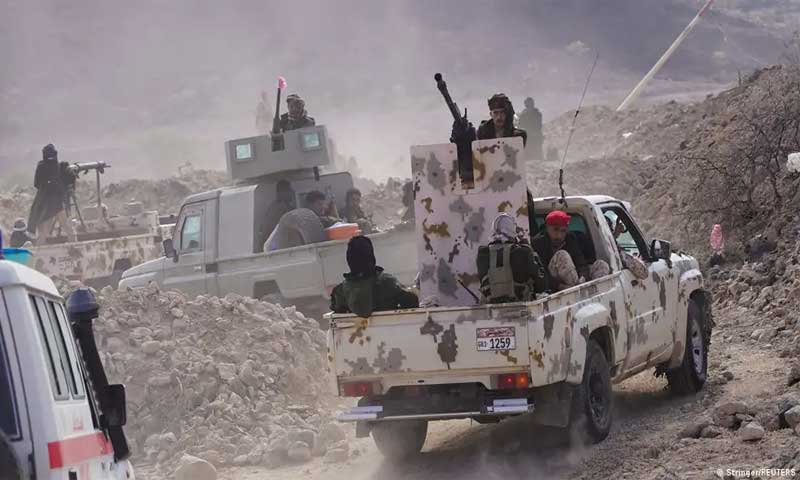
In December 2025, the STC launched a major offensive in southern Yemen and seized control of two areas, Hadhramaut and Al-Mahrah, which are both strategically important to Saudi Arabia (Reuters, 2025). These developments escalated the concerns of Saudi Arabia regarding border security and disintegration of Yemen. The situation deteriorated dramatically when on December 30, 2025, Saudi-led forces attacked the port of Mukalla in retaliation over alleged arms shipments in favor of STC forces in connection with the United Arab Emirates (Reuters, 2025; Hindustan Times, 2025).
To this, the Presidential Leadership Council of Yemen backed by Saudi Arabia demanded the withdrawal of all the UAE forces and stopped defence cooperation. The UAE declared that it withdrew the remaining counterterrorism forces, thus leaving its military presence in Yemen even though it refuted the claims and insisted that it was keen on ensuring stability in the region (Reuters, 2025). It marked a Saudi-UAE rapport rupture that had never been heard of before.
Analysis and Conclusion
The war in Yemen is an example of the disintegration of coalition warfare in case allies have a common threat but not a political goal. Although Saudi Arabia and the United Arab Emirates initially agreed that they will fight Houthi expansion, the structurally different nature of the two countries made cooperation become an intra-alliance competition. The UAE approach of decentralization and proxy form of strategy to maritime security and southern Yemen was a contrast to the state-centered approach of Saudi Arabia.
The internationally recognised government was undermined, fragmentation boosted, and Saudi aspirations of Yemeni unity were directly sabotaged by the UAE support of the STC. All the conflict-management methods led to failure since they addressed tactical differences as opposed to strategic inconsistencies. This prolonged misorientation reached the Mukalla incident of December 2025 and the withdrawal of the UAE.
On a larger scale, however, the case brings to light an important lesson that interventionist coalitions must learn, that without institutionalised coordination and shared vision of the political goal, coalitions become forums of competition, which introduces as much instability as they are supposed to represent. ( The author is student of M.Phil. at MY University)
Opinions expressed in this article are the authors’ own and do not necessarily reflect WNAM’s editorial policy
References
Al-Muslimi, F. (2019). The UAE’s security strategy in Yemen. Sana’a Center for Strategic Studies.
Day, S. W. (2020). Yemen divided: The story of a failed state in South Arabia. I.B. Tauris.
Encyclopaedia Britannica. (2025). Yemen conflict.
Hindustan Times. (2025, December 31). Saudi airstrike on Mukalla escalates tensions with UAE.
International Crisis Group. (2021). Rethinking peace in Yemen.
Juneau, T. (2016). Iran’s policy towards the Houthis in Yemen. International Affairs, 92(3), 647–663.
Reuters. (2025, December 30–31). Saudi–UAE tensions escalate over Yemen’s southern offensive.
Ulrichsen, K. C. (2020). The Gulf states and the Yemen war. Oxford University Press.
United Nations. (2022). Yemen humanitarian needs overview.