

Muhammad Abdullah
Islamabad’s physical footprint is expanding, and with it comes a natural buzz about where the city’s economic heart lies. As new developments emerge across its growing neighbourhoods, discussions about “downtowns” have gained momentum. Yet growth in geography does not necessarily equate to growth in commercial centrality. In urban practice, a downtown is not defined by where buildings appear, but by where commerce, capital, institutional presence, and everyday economic life consistently converge. This raises a strategic question for policymakers and investors alike: as Islamabad continues to make room for more people and more places, has its commercial core shifted, or does it remain anchored in a well-established location?
Market signals indicate that that core remains intact. Commercial land values in the Blue Area have increased significantly over the past decade, with overall value rising by about 277 percent, and by more than 100 percent in just the last two years. These increases have occurred in an already high-value, deeply traded zone, indicating the kind of sustained demand that attracts not only local but national and international capital. In real estate markets, such performance reflects structural centrality, a place where business activity, investment confidence, and tangible economic demand consistently intersect.
The composition of activity in Blue Area supports this interpretation. The corridor continues to host a dense concentration of federal institutions, corporate head offices, financial and telecom firms, major healthcare facilities, and professional services. Iconic structures such as Centaurus and Ufone Tower do more than punctuate the skyline; they anchor substantial day-to-day economic flows and employment at a scale that few other localities can rival. This clustering of high-order functions helps sustain commercial land value and positions the area as Islamabad’s principal downtown.
Planning authorities are reinforcing this downtown role through concrete regulatory and infrastructural actions. The Capital Development Authority has approved several initiatives aimed at strengthening Blue Area’s long-term function as the city’s commercial nucleus. Among these is the development of Islamabad’s first pedestrian-only street within Blue Area, intended to improve walkability, public realm quality, and commercial visibility. This initiative complements structured parking projects, utility upgrades, and planned improvements in public transport connectivity along key corridors. Collectively, these measures signal a forward-looking commitment to a compact, vertical downtown that can accommodate future growth without dispersing economic activity.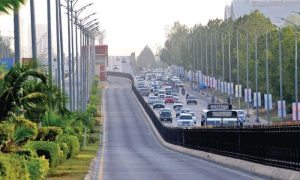
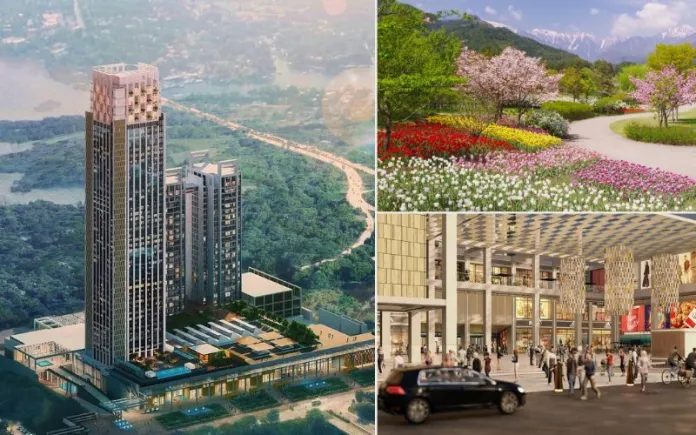
This future orientation is also evident in the built form now taking shape. New high-rise and mixed-use towers like corporate towers and condominium complexes are integrating modern business environments, energy-efficient systems, integrated parking, and residential spaces tailored for professionals seeking proximity to work. Such developments increase not only supply but functional depth, allowing the Islamabad downtown to absorb evolving business needs while remaining competitive and adaptable over time.
Peripheral growth continues to play an important role in meeting housing demand and enhancing lifestyle options for residents. Commercial activity in these areas tends to serve localized catchments, supporting neighbourhood retail and services rather than anchoring citywide economic activity. Their emergence contributes to Islamabad’s broader urban ecosystem but does not redefine the spatial logic of its downtown.
In cities that are both expanding and densifying, downtowns evolve while remaining identifiable because of where economic functions concentrate and endure. Islamabad appears to be following a similar trajectory. While the city’s map may stretch outward, planning direction, market behaviour, and investment opportunities continue to converge on the Blue Area corridor. For investors, planners, and business leaders navigating Islamabad’s future, this distinction is not merely academic. It shapes where capital is likely to flow, where long-term commitments align with policy direction, and where the city’s downtown will continue to anchor its commercial life.
The author is: Communications and Advocacy Coordinator who can be reached at [email protected]